
'%3e%3cpath%20d='M25.8906%2030.68L16.0006%2025L6.14062%2030.68V4.55C6.14063%203.75435%206.4567%202.99129%207.0193%202.42868C7.58191%201.86607%208.34498%201.55%209.14063%201.55H22.8906C23.6863%201.55%2024.4493%201.86607%2025.0119%202.42868C25.5746%202.99129%2025.8906%203.75435%2025.8906%204.55V30.68ZM9.14063%203.55C8.87541%203.55%208.62105%203.65536%208.43352%203.84289C8.24598%204.03043%208.14063%204.28478%208.14063%204.55V27.23L16.0006%2022.72L23.8806%2027.23V4.55C23.8806%204.28478%2023.7753%204.03043%2023.5877%203.84289C23.4002%203.65536%2023.1458%203.55%2022.8806%203.55H9.14063Z'%20fill='white'/%3e%3cpath%20d='M9.14063%202.55H22.8906C23.4211%202.55%2023.9298%202.76071%2024.3048%203.13579C24.6799%203.51086%2024.8906%204.01957%2024.8906%204.55V8.62H7.14062V4.55C7.14063%204.01957%207.35134%203.51086%207.72641%203.13579C8.10148%202.76071%208.61019%202.55%209.14063%202.55Z'%20fill='%238A3301'/%3e%3cpath%20d='M25.8906%209.62H6.14062V4.55C6.14063%203.75435%206.4567%202.99129%207.0193%202.42868C7.58191%201.86607%208.34498%201.55%209.14063%201.55H22.8906C23.6863%201.55%2024.4493%201.86607%2025.0119%202.42868C25.5746%202.99129%2025.8906%203.75435%2025.8906%204.55V9.62ZM8.14063%207.62H23.8906V4.55C23.8906%204.28478%2023.7853%204.03043%2023.5977%203.84289C23.4102%203.65536%2023.1558%203.55%2022.8906%203.55H9.14063C8.87541%203.55%208.62105%203.65536%208.43352%203.84289C8.24598%204.03043%208.14063%204.28478%208.14063%204.55V7.62Z'%20fill='white'/%3e%3cpath%20d='M16%2020.25C15.7348%2020.25%2015.4804%2020.1446%2015.2929%2019.9571C15.1054%2019.7696%2015%2019.5152%2015%2019.25V14.07C15%2013.8048%2015.1054%2013.5504%2015.2929%2013.3629C15.4804%2013.1754%2015.7348%2013.07%2016%2013.07C16.2652%2013.07%2016.5196%2013.1754%2016.7071%2013.3629C16.8946%2013.5504%2017%2013.8048%2017%2014.07V19.25C17%2019.5152%2016.8946%2019.7696%2016.7071%2019.9571C16.5196%2020.1446%2016.2652%2020.25%2016%2020.25Z'%20fill='white'/%3e%3cpath%20d='M18.5999%2017.66H13.4199C13.1547%2017.66%2012.9004%2017.5546%2012.7128%2017.3671C12.5253%2017.1796%2012.4199%2016.9252%2012.4199%2016.66C12.4199%2016.3948%2012.5253%2016.1404%2012.7128%2015.9529C12.9004%2015.7654%2013.1547%2015.66%2013.4199%2015.66H18.5999C18.8651%2015.66%2019.1195%2015.7654%2019.307%2015.9529C19.4946%2016.1404%2019.5999%2016.3948%2019.5999%2016.66C19.5999%2016.9252%2019.4946%2017.1796%2019.307%2017.3671C19.1195%2017.5546%2018.8651%2017.66%2018.5999%2017.66Z'%20fill='white'/%3e%3c/g%3e%3cdefs%3e%3cclipPath%20id='clip0_29353_35'%3e%3crect%20width='32'%20height='32'%20fill='white'/%3e%3c/clipPath%3e%3c/defs%3e%3c/svg%3e) Wishlist
Wishlist
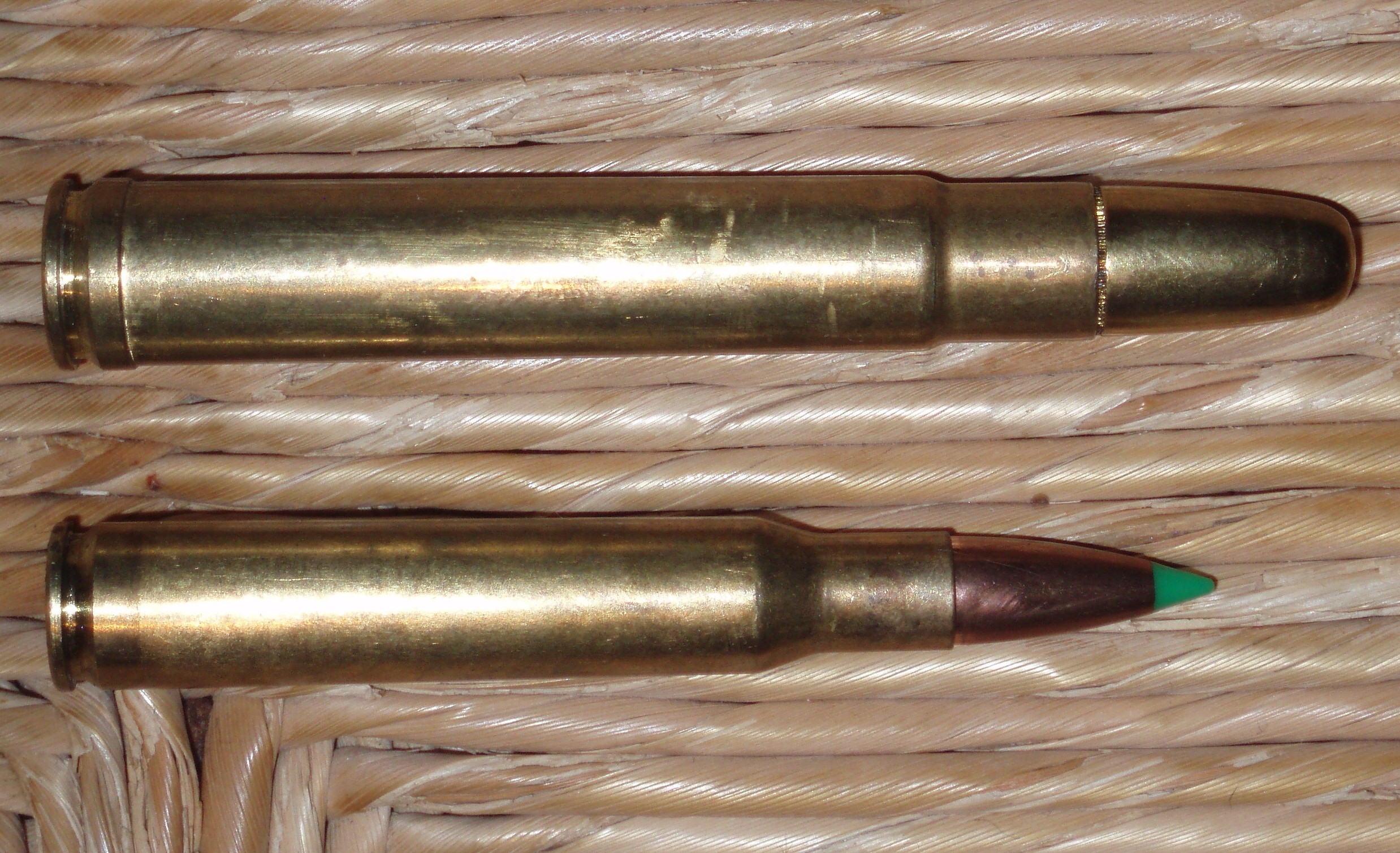
The .30-06 Springfield has been around since 1906, which means shooters have had more than a century to argue about what bullet weight belongs in it.
And somehow, we still haven't settled it.
Ask one hunter and 150 grain is all you need. Ask another and 165 grain is the perfect middle ground. Someone else will tell you the .30-06 doesn't really come into its own until you load a 180 grain bullet.
The interesting part is that none of them necessarily has to be wrong.
One of the reasons the .30-06 has survived for so long is that it isn't tied to one narrow type of ammunition. Factory loads span an unusually broad range of bullet weights and designs. You can find light, fast bullets at one end and heavy 200 or 220 grain projectiles at the other. Between those extremes sit the three weights that define modern .30-06 ammunition for a lot of shooters: 150, 165 and 180 grains.
Those three numbers may not look very far apart on a box, but changing bullet weight changes the personality of the cartridge. Velocity changes. Trajectory changes. Recoil can change. Downrange performance changes. And just as importantly, the bullets themselves are often designed for different purposes.
So rather than declaring one grain weight the winner, let's figure out what you're actually getting when you move from 150 to 165 to 180 grains.
Quick Answer: 150, 165 or 180 Grain?
If you want the simplest possible starting point, think of the three common .30-06 bullet weights this way.
150 grain emphasizes velocity. Common factory loads can approach 2,900 fps, and some higher velocity loads push beyond 3,000 fps. It is an attractive choice when you want a relatively flat trajectory from the .30-06 without moving to a lighter specialty bullet.
165 grain sits in the middle. It gives you more projectile mass than a 150 while retaining more velocity than a typical 180 grain load. That balance is why 165 grain ammunition has become such a popular general purpose option.
180 grain emphasizes bullet mass. Traditional factory loads commonly start around 2,700 fps. You give up some initial velocity compared with a 150, but you gain a heavier projectile and access to a huge selection of hunting bullet designs.
But there is a catch that matters throughout this entire article:
Grain weight doesn't tell you everything.
A 150 grain conventional soft point and a 150 grain modern monolithic hunting bullet can have very different ballistic characteristics. Two bullets weighing exactly the same can have different shapes, ballistic coefficients and construction. Even their muzzle velocities can differ substantially.
So bullet weight is a great place to start.
It just shouldn't be where the decision ends.
Why the .30-06 Works With So Many Bullet Weights
The .30-06 Springfield was adopted by the U.S. military in 1906, but its longevity goes far beyond military history. One reason it became such an enduring sporting cartridge is its flexibility.
The cartridge uses .308 inch diameter bullets, giving ammunition manufacturers access to an enormous variety of projectile designs. Factory ammunition has historically covered weights from roughly 110 grains at the light end through 220 grains at the heavy end. Current manufacturer catalogs continue to show that versatility, with loads clustered around 150, 165, 168, 175, 178 and 180 grains along with options outside that range.
That doesn't mean all those bullet weights are equally common or equally useful for every shooter.
For most people standing in front of a shelf of .30-06 ammo, 150, 165 and 180 grains are the numbers worth understanding first.
They're far enough apart to demonstrate what changing bullet weight does without getting lost in every specialized load ever made.
And 150 grain is where the speed side of that conversation really starts getting interesting.
150 Grain .30-06: Let the Cartridge Run
A 150 grain bullet is relatively light for the .30-06, and that gives ammunition manufacturers room to push velocity.
Federal's 150 grain Power Shok provides a good traditional reference point. Federal publishes the load at 2,910 fps at the muzzle with 2,820 foot pounds of energy. Its published velocity drops to 2,340 fps at 200 yards and 2,081 fps at 300 yards, where it still carries 1,442 foot pounds of energy.
Those numbers help explain the appeal.
The 150 grain load starts fast and produces a relatively flat trajectory, which makes it easy to understand why this bullet weight has been so closely associated with deer sized game and other applications where shooters value velocity and manageable trajectory.
But here's where simply saying "150 grain .30-06 goes 2,900 fps" gets us into trouble.
It doesn't always.
Hornady's 150 grain CX Superformance load demonstrates how much the specific ammunition can change the equation. Hornady's current catalog includes the 150 grain CX Superformance, and published ballistic data for that load puts it at roughly 3,080 fps, considerably faster than the traditional 2,910 fps baseline.
Same cartridge.
Same bullet weight.
Very different velocity.
That is an important lesson because it's easy to treat grain weight as if it determines the entire ballistic profile. It doesn't.
The 150 grain category gives manufacturers a relatively light projectile to work with, but bullet construction, propellant, ballistic coefficient and the specific factory loading still determine what happens after that.
Does 150 Grain Shoot Flatter?
Generally, when comparing conventional loads with similar bullet designs and zero distances, the faster 150 grain option can produce a flatter trajectory over ordinary hunting distances than a slower 180 grain load.
But there's another trap here.
Light doesn't automatically mean flatter forever.
A heavier bullet with a more aerodynamic shape and higher ballistic coefficient can retain velocity better than a lighter projectile with a poor ballistic coefficient. As range increases, bullet shape becomes increasingly important.
That's why I wouldn't choose ammunition by looking at bullet weight and muzzle velocity alone.
If you are comparing two actual boxes of ammunition, look at the manufacturer's trajectory data and ballistic coefficient for those exact loads.
For the shooter deciding broadly between conventional 150, 165 and 180 grain .30-06 ammunition, however, the familiar pattern remains useful:
150 grain usually represents the faster end of the three.
Then we get to what might be the most interesting bullet weight of all.
165 Grain .30-06: The Middle Child Has a Point
At first, 165 grain ammunition can seem unnecessary.
If 150 grain gives you speed and 180 grain gives you weight, why not simply choose whichever of those two characteristics matters more?
Because 165 grain gives you a little of both.
A conventional 165 grain .30-06 factory load commonly lands around 2,800 fps, putting it only about 100 fps behind the familiar 150 grain 2,910 fps benchmark while adding 15 grains of projectile weight. Federal factory data, for example, includes 165 grain loads around that 2,800 fps level.
That doesn't sound like a dramatic difference, and that's precisely the appeal.
You're not making a radical move toward a heavy projectile. You're nudging the cartridge toward more bullet mass without giving away a huge amount of initial velocity.
For someone who wants one .30-06 bullet weight to cover a broad range of ordinary shooting and hunting applications, 165 grain deserves a serious look.
But I still wouldn't call it the universally "best" .30-06 bullet weight.
Your rifle may shoot a particular 150 grain load exceptionally well. You might have an application where a carefully chosen 180 grain projectile makes more sense. Or you may care more about bullet construction than the 15 grain difference between two boxes.
The 165 isn't magic.
It's just a very useful compromise.
180 Grain .30-06: Slower Doesn't Mean Weaker
This is where looking only at muzzle velocity can fool you.
A traditional 180 grain .30-06 factory load commonly runs around 2,700 fps. Compare that with approximately 2,910 fps for a traditional 150 grain load and it looks like the heavier bullet has simply lost more than 200 fps.
It has.
But velocity isn't energy.
Federal's published Power Shok figures make the point nicely. Its 150 grain load produces 2,820 foot pounds of muzzle energy at 2,910 fps. The 180 grain version starts slower at 2,700 fps but produces 2,913 foot pounds of muzzle energy.
So the heavier bullet starts slower while actually carrying slightly more calculated muzzle energy in that particular comparison.
That's basic physics, but it's easy to overlook when velocity is the biggest number printed on the box.
Remington's traditional 180 grain Core Lokt gives us another useful reference point. Published ballistic data puts the load at roughly 2,700 fps, with velocity around 2,250 fps at 200 yards and about 2,040 fps at 300 yards. Comparable ballistic data places energy at roughly 2,913 foot pounds at the muzzle and around 1,666 foot pounds at 300 yards.
The important point isn't that 180 grain automatically beats 150 grain.
It doesn't.
The point is that slower and weaker are not synonyms.
A heavier bullet changes the balance rather than simply reducing performance.
150 vs 165 vs 180 Grain: What Actually Changes?
Put the three traditional factory baselines next to each other and the pattern becomes easy to see.
A typical 150 grain load might start around 2,910 fps.
A typical 165 grain load might start around 2,800 fps.
A typical 180 grain load might start around 2,700 fps.
As bullet weight goes up, typical muzzle velocity goes down.
But projectile mass goes up.
That tradeoff affects trajectory, recoil, retained velocity, energy and terminal performance. Then bullet construction and aerodynamic efficiency complicate the picture further.
This is why I don't think shooters should approach the question as:
"Which grain is best?"
A better question is:
"Which load gives me the combination I want?"
That's a subtle difference, but it completely changes how you shop for .30-06 ammunition.
Bullet Construction Can Matter More Than 15 Grains
Imagine two boxes sitting next to each other.
One contains a 150 grain traditional soft point.
The other contains a 165 grain modern controlled expansion bullet.
It would be a mistake to assume the second load is simply the first one with 15 extra grains.
Projectile construction affects expansion, penetration and weight retention. Shape affects ballistic coefficient and drag. Materials matter too, particularly when comparing traditional lead core bullets with monolithic copper designs.
Remington's Core Lokt is a good example of a conventional hunting design. Remington describes the bullet as using a tapered copper jacket locked to a lead core, with the design intended to promote expansion while maintaining penetration and weight retention.
Hornady's CX takes a completely different approach with a monolithic copper alloy projectile.
Both can be .30-06 ammunition.
Both can even weigh 150 grains.
But they aren't the same bullet.
So when you reach the point of actually buying ammunition, choose the bullet design for the job first and then evaluate whether the available grain weight makes sense.
That's much more useful than blindly buying 180 grain because someone told you heavier is always better.
What About 125 Grain .30-06?
The .30-06 doesn't suddenly stop working below 150 grains.
Federal historical ballistic data and current market listings demonstrate how fast lighter .30 caliber bullets can be pushed. A 125 grain .30-06 load can reach roughly 3,140 fps depending on the ammunition.
That is moving.
These lighter loads push the cartridge further toward velocity and can make sense for certain varmint, predator and recreational applications depending on the particular projectile.
But they aren't where I would start someone who simply wants to understand mainstream .30-06 ammunition.
Think of 125 grain as one end of the cartridge's enormous flexibility rather than the weight that defines it.
The other end gets even more interesting.
Yes, the .30-06 Can Shoot 200 and 220 Grain Bullets Too
Move beyond 180 grains and the .30-06 starts showing just how broad its operating range really is.
Heavy 200 and 220 grain loads have a long history in the cartridge. Federal ballistic data, for example, has listed a 220 grain .30-06 soft point at approximately 2,400 fps.
That's almost the opposite philosophy of the lightweight 125 grain load.
One is using a relatively light projectile at more than 3,100 fps.
The other is launching a bullet nearly twice as heavy at around 2,400 fps.
And they're both .30-06 Springfield.
That's remarkable versatility for a cartridge introduced more than a century ago.
It also explains why trying to describe "the ballistics of a .30-06" with one velocity or one energy figure doesn't make much sense.
Which .30-06?
The load matters enormously.
How Far Can a .30-06 Actually Shoot?
This question gets messy because people use range to mean several completely different things.
How far can the bullet physically travel?
How far can you hit a target?
How far does the bullet remain supersonic?
How far does it retain a certain amount of energy?
How far should you shoot at game?
Those aren't the same question.
A .30-06 projectile can physically travel far beyond normal hunting distances, but that tells us very little about an appropriate shot.
Effective range depends on the specific ammunition, bullet construction, target, conditions, rifle and shooter.
Even within the same bullet weight, a high ballistic coefficient projectile can retain velocity much better than a less aerodynamic bullet. Wind becomes increasingly important as distance grows. And for hunting, terminal performance imposes another limitation because an expanding bullet may require a certain impact velocity to perform as designed.
So I wouldn't give the .30-06 one universal effective range.
For ordinary hunting distances, the cartridge has considerably more ballistic capability than many shooters will ever need. Beyond that, the exact load and shooter become increasingly important.
If you want to know what your ammunition is doing at 300, 400 or 500 yards, use the ballistic data for the actual load in your rifle rather than a generic ".30-06 trajectory" chart.
Is 150 Grain Enough for Deer?
For appropriate deer hunting applications, 150 grain .30-06 ammunition has been popular for generations, and modern manufacturers continue to offer numerous 150 grain hunting loads.
But the important word there is hunting load.
A 150 grain bullet designed to expand appropriately on deer sized game is a completely different proposition from a 150 grain FMJ simply because the scale says they weigh the same.
This is where bullet construction matters more than obsessing over whether you should move from 150 to 165 grains.
If your rifle shoots a quality 150 grain hunting bullet accurately and the manufacturer designed that projectile for the game you're pursuing, there is no rule saying you need to move to a heavier bullet simply because one exists.
The same logic applies to 165 and 180 grain ammunition.
Choose the projectile for the job.
Then make sure your rifle likes it.
What About Elk and Larger Game?
As game size increases, shooters often begin looking toward heavier .30-06 bullets and tougher projectile construction.
That's where 180 grain ammunition becomes particularly interesting, along with some of the premium 165, 175, 178 and heavier bullet designs available today.
But again, weight alone doesn't make a bullet appropriate for larger game.
A strongly constructed 165 grain bullet may behave very differently from a lightly constructed 180 grain projectile. Penetration, expansion characteristics and impact velocity all matter.
This is why the modern ammunition market makes the old "150 for this, 180 for that" rules less absolute than they once seemed.
Bullet technology gives shooters far more choices within each weight category.
Which .30-06 Bullet Weight Has the Least Recoil?
All else being reasonably similar, lighter bullet loads generally offer the potential for less recoil than heavier loads, but there is an important caveat.
Recoil isn't determined by bullet weight alone.
Projectile weight, powder charge, velocity and rifle weight all contribute. A very fast 150 grain load can produce more recoil than someone expects, while a heavier rifle can make a stout 180 grain load feel more manageable.
That's another reason you shouldn't assume every 150 grain load will feel identical.
If recoil matters to you, compare actual ammunition specifications and test the load in your rifle rather than choosing solely by grain weight.
Which .30-06 Bullet Weight Shoots the Flattest?
Among conventional 150, 165 and 180 grain factory loads with broadly similar bullet designs, 150 grain usually gets the initial trajectory advantage because of its higher muzzle velocity.
But as distances grow, ballistic coefficient matters increasingly.
A streamlined heavier bullet can retain velocity better and resist wind more effectively than a lighter bullet with a less efficient shape. That's why serious long distance comparisons should be made between specific loads, not simply between grain weights.
For the shooter comparing ordinary hunting ammunition at normal distances, however, 150 grain remains an attractive choice when a relatively flat trajectory is high on the priority list.
So, What Is the Best .30-06 Bullet Weight?
After all of that, you might expect me to pick one.
I'm not going to, because doing so would make the article less useful.
150 grain is an excellent place to look when velocity and a relatively flat trajectory are priorities.
165 grain offers perhaps the most natural middle ground, retaining plenty of speed while adding projectile mass.
180 grain shifts the balance toward a heavier projectile and gives shooters an enormous selection of proven hunting bullet designs.
If you have absolutely no specialized requirement and simply want a starting point, 165 grain is a very sensible middle of the .30-06 spectrum.
But I would rather have a rifle that shoots a well designed 150 grain bullet exceptionally accurately than force it to use 165 grains because someone on the internet called that weight perfect.
And I would rather choose a properly constructed 165 grain bullet for a particular application than blindly buy a 180 grain load because heavier sounds more powerful.
Your rifle gets a vote.
That is something ballistic charts can't tell you.
Buy a few quality loads appropriate for what you're doing, shoot them from your actual rifle and see which one produces the accuracy and consistency you want.
The .30-06 Doesn't Really Have One Personality
Maybe that's the reason we're still talking about this cartridge more than a century after it appeared.
A 125 grain .30-06 moving at more than 3,100 fps feels like a completely different animal from a 220 grain load traveling around 2,400 fps. Yet both can come out of the same rifle.
The familiar 150, 165 and 180 grain loads occupy the incredibly useful space between those extremes.
If you want speed, start around 150.
If you want balance, look hard at 165.
If you want more bullet mass, 180 becomes extremely attractive.
Then stop looking only at the number printed next to GR on the box.
Look at the bullet.
Look at the velocity.
Look at the trajectory.
Look at what the manufacturer actually designed that projectile to do.
And most importantly, find out how it shoots from your rifle.
Because after more than 100 years, perhaps the reason nobody has settled the 150 vs 165 vs 180 grain argument is pretty simple:
The .30-06 is good enough with all three that we never had to.
Information provided by AmmoBrowser is for general informational and educational purposes only. Ammunition specifications, ballistics, performance, pricing, and availability can vary by manufacturer, load, firearm, barrel length, and other conditions. While we strive to provide accurate and current information, AmmoBrowser makes no guarantee regarding its completeness or accuracy. Always follow firearm and ammunition manufacturer instructions, verify that ammunition is compatible with your firearm, and follow all applicable laws and safe firearm handling practices.