
'%3e%3cpath%20d='M25.8906%2030.68L16.0006%2025L6.14062%2030.68V4.55C6.14063%203.75435%206.4567%202.99129%207.0193%202.42868C7.58191%201.86607%208.34498%201.55%209.14063%201.55H22.8906C23.6863%201.55%2024.4493%201.86607%2025.0119%202.42868C25.5746%202.99129%2025.8906%203.75435%2025.8906%204.55V30.68ZM9.14063%203.55C8.87541%203.55%208.62105%203.65536%208.43352%203.84289C8.24598%204.03043%208.14063%204.28478%208.14063%204.55V27.23L16.0006%2022.72L23.8806%2027.23V4.55C23.8806%204.28478%2023.7753%204.03043%2023.5877%203.84289C23.4002%203.65536%2023.1458%203.55%2022.8806%203.55H9.14063Z'%20fill='white'/%3e%3cpath%20d='M9.14063%202.55H22.8906C23.4211%202.55%2023.9298%202.76071%2024.3048%203.13579C24.6799%203.51086%2024.8906%204.01957%2024.8906%204.55V8.62H7.14062V4.55C7.14063%204.01957%207.35134%203.51086%207.72641%203.13579C8.10148%202.76071%208.61019%202.55%209.14063%202.55Z'%20fill='%238A3301'/%3e%3cpath%20d='M25.8906%209.62H6.14062V4.55C6.14063%203.75435%206.4567%202.99129%207.0193%202.42868C7.58191%201.86607%208.34498%201.55%209.14063%201.55H22.8906C23.6863%201.55%2024.4493%201.86607%2025.0119%202.42868C25.5746%202.99129%2025.8906%203.75435%2025.8906%204.55V9.62ZM8.14063%207.62H23.8906V4.55C23.8906%204.28478%2023.7853%204.03043%2023.5977%203.84289C23.4102%203.65536%2023.1558%203.55%2022.8906%203.55H9.14063C8.87541%203.55%208.62105%203.65536%208.43352%203.84289C8.24598%204.03043%208.14063%204.28478%208.14063%204.55V7.62Z'%20fill='white'/%3e%3cpath%20d='M16%2020.25C15.7348%2020.25%2015.4804%2020.1446%2015.2929%2019.9571C15.1054%2019.7696%2015%2019.5152%2015%2019.25V14.07C15%2013.8048%2015.1054%2013.5504%2015.2929%2013.3629C15.4804%2013.1754%2015.7348%2013.07%2016%2013.07C16.2652%2013.07%2016.5196%2013.1754%2016.7071%2013.3629C16.8946%2013.5504%2017%2013.8048%2017%2014.07V19.25C17%2019.5152%2016.8946%2019.7696%2016.7071%2019.9571C16.5196%2020.1446%2016.2652%2020.25%2016%2020.25Z'%20fill='white'/%3e%3cpath%20d='M18.5999%2017.66H13.4199C13.1547%2017.66%2012.9004%2017.5546%2012.7128%2017.3671C12.5253%2017.1796%2012.4199%2016.9252%2012.4199%2016.66C12.4199%2016.3948%2012.5253%2016.1404%2012.7128%2015.9529C12.9004%2015.7654%2013.1547%2015.66%2013.4199%2015.66H18.5999C18.8651%2015.66%2019.1195%2015.7654%2019.307%2015.9529C19.4946%2016.1404%2019.5999%2016.3948%2019.5999%2016.66C19.5999%2016.9252%2019.4946%2017.1796%2019.307%2017.3671C19.1195%2017.5546%2018.8651%2017.66%2018.5999%2017.66Z'%20fill='white'/%3e%3c/g%3e%3cdefs%3e%3cclipPath%20id='clip0_29353_35'%3e%3crect%20width='32'%20height='32'%20fill='white'/%3e%3c/clipPath%3e%3c/defs%3e%3c/svg%3e) Wishlist
Wishlist
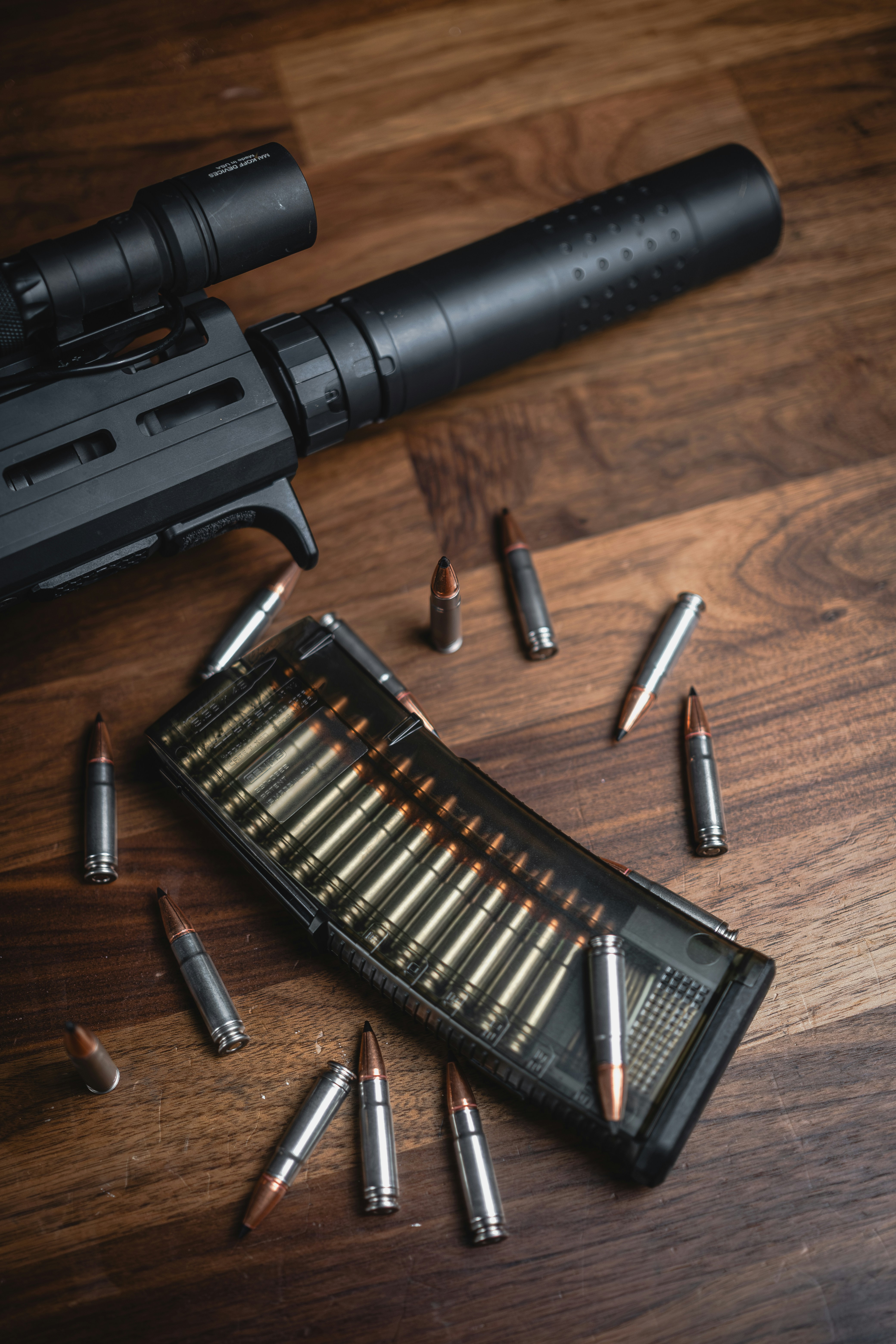
Choosing the right 300 Blackout bullet weight can be more confusing than it initially appears. Walk through the ammunition section of a sporting goods store or browse .300 Blackout ammunition online and you'll encounter everything from extremely lightweight supersonic loads to massive 200- and 220-grain subsonic bullets. Unlike cartridges where changing bullet weight produces relatively modest differences, moving from a 110-grain .300 Blackout load to a 220-grain load can fundamentally change how the cartridge behaves.
That's because .300 AAC Blackout was designed to operate across an unusually broad range of projectile weights and velocities. A lightweight 110-grain load can leave the muzzle at well over 2,000 feet per second from an appropriate barrel, producing relatively flat short-range performance and substantial muzzle energy. At the opposite end of the spectrum, a 220-grain load may travel at approximately half that velocity specifically so the bullet remains below the speed of sound.
Those aren't simply two different bullet weights. They represent two very different ways of using the same cartridge.
Between those extremes are popular 125-grain loads that provide an excellent balance of velocity and projectile weight, along with 147- and 150-grain ammunition commonly encountered in general-purpose and range-oriented loads. Each category has different strengths, and simply choosing the heaviest or fastest bullet doesn't necessarily mean you're choosing the best ammunition for your rifle.
The right answer depends on what you want your .300 Blackout to do.
This guide will break down 110 vs. 125 vs. 150 vs. 220 grain .300 Blackout, explain why their ballistics are so different, and show how bullet weight affects velocity, energy, trajectory, recoil, effective range, and suppressed performance.
Most importantly, we'll answer the question that matters when you're actually shopping for ammunition:
What grain .300 Blackout should you choose?
At a Glance
- 110 grain: Best suited to shooters prioritizing high supersonic velocity, flatter short-to-medium-range trajectory, and loads designed around lightweight projectiles.
- 125–150 grain: The middle ground, offering supersonic performance with different balances of velocity, bullet mass, cost, and intended use.
200–220 grain: The traditional subsonic end of .300 Blackout, especially important for shooters using suppressors and intentionally keeping velocity below the speed of sound.
Why Bullet Weight Matters So Much in 300 Blackout
Bullet weight matters in virtually every rifle cartridge, but it plays an unusually important role in 300 Blackout because the cartridge was designed to function with both supersonic and subsonic ammunition. Changing bullet weight can therefore affect far more than a few hundred feet per second of velocity or a slightly different trajectory.
With something like .308 Winchester, comparing 150-, 165-, and 180-grain ammunition generally means comparing three supersonic loads that occupy somewhat different positions within the same basic performance envelope. Their velocities, trajectories, and recoil characteristics differ, but they still behave broadly like conventional centerfire rifle ammunition.
The difference between a 110-grain and 220-grain .300 Blackout is far more dramatic. The 110-grain projectile may be traveling at more than twice the speed of a heavy subsonic load. That produces major differences in trajectory, time of flight, muzzle energy, downrange velocity, and the way the ammunition behaves when fired through a suppressed rifle.
This is why asking "What is the best grain for 300 Blackout?" doesn't have one universal answer. The best bullet weight depends heavily on whether you're looking for supersonic performance, subsonic operation, inexpensive range ammunition, short-range performance, or a particular bullet design.
There is another important distinction we need to make throughout this article: grain weight describes the mass of the bullet, not how the bullet is constructed or how it will perform on impact.
Two 110-grain bullets can behave very differently if one is an expanding projectile and the other uses a completely different construction. Bullet weight is an important part of ammunition selection, but it should never be treated as the only factor.
What Does "Grain" Mean in 300 Blackout Ammunition?
A grain is a unit of mass used to measure bullet weight, and it should not be confused with the amount of gunpowder inside the cartridge. When a box says "110 grain" or "220 grain," that number normally refers to the weight of the projectile itself.
There are 7,000 grains in one pound, so even relatively large differences in bullet weight represent small physical masses. In ballistics, however, those differences matter enormously because projectile mass interacts with velocity, bullet shape, construction, barrel length, and other factors to determine how a particular load performs.
With .300 Blackout, the grain number also gives you a useful initial clue about what kind of ammunition you're looking at. A 110-grain load is almost certainly intended for supersonic operation.
A 220-grain factory load is normally intended to remain subsonic under the conditions for which it was designed. Loads in the middle require a closer look at the specific ammunition.
That makes bullet weight one of the quickest ways to begin understanding a box of .300 Blackout ammunition but it isn't the whole story.
Understanding Supersonic vs. Subsonic 300 Blackout
Before comparing individual bullet weights, it's essential to understand the difference between supersonic and subsonic .300 Blackout, because this distinction explains much of the cartridge's enormous velocity range.
Supersonic ammunition travels faster than the local speed of sound. Because the speed of sound varies with atmospheric conditions, there isn't one universal velocity at which ammunition becomes supersonic everywhere, but approximately 1,125 fps under common conditions is a useful reference point. A typical lightweight .300 Blackout supersonic load travels far beyond that threshold.
Subsonic ammunition is intentionally loaded to keep the projectile below the speed of sound. This eliminates the bullet's supersonic ballistic crack, which is particularly valuable when ammunition is used with a suppressor. A suppressor can reduce the muzzle blast, but it cannot eliminate the sonic crack produced by a projectile traveling faster than sound.
This is why .300 Blackout uses such heavy bullets for subsonic ammunition. If manufacturers simply slowed a lightweight 110-grain bullet to approximately 1,000 fps, the resulting load would have relatively little projectile momentum and energy. Using a much heavier 200- or 220-grain projectile allows the cartridge to maintain considerably more bullet mass while remaining below the sound barrier.
That relationship between bullet weight and velocity is at the heart of .300 Blackout.
110 Grain 300 Blackout
110-grain .300 Blackout sits near the lightweight, high-velocity end of the cartridge's commonly available factory ammunition. These loads are overwhelmingly supersonic and are designed to take advantage of the velocity that can be achieved when the cartridge isn't trying to stay below the speed of sound.
Depending on the specific ammunition and barrel length, a 110-grain factory load can produce muzzle velocities roughly in the 2,100–2,400 fps range. Those numbers should be treated as representative rather than universal because .300 Blackout velocity can change considerably with barrel length and load selection.
That high initial velocity gives 110-grain ammunition one of the flatter trajectories available from .300 Blackout. It also generates substantial muzzle energy despite the relatively lightweight projectile because kinetic energy increases rapidly as velocity rises.
This makes 110-grain ammunition attractive when a shooter wants .300 Blackout to behave more like a conventional supersonic rifle cartridge rather than a specialized subsonic round. It minimizes some of the dramatic bullet drop associated with heavy subsonic ammunition and extends the distance over which the shooter can use a relatively straightforward trajectory.
Bullet construction becomes especially important in this weight class. There are numerous 110-grain projectiles designed for very different purposes, so a shooter shouldn't assume every 110-grain factory load will behave identically simply because the number on the box matches.
Typical Characteristics of 110 Grain 300 Blackout
- Supersonic: Yes
- Typical velocity: Roughly 2,100–2,400 fps depending on load and barrel
- Trajectory: Among the flattest commonly available .300 Blackout options
- Recoil: Relatively mild
- Primary advantage: High velocity and strong short-to-medium-range ballistic performance
- Primary disadvantage: Doesn't provide the subsonic sound characteristics that make heavy .300 Blackout ammunition popular with suppressors
What This Means
If your priority is supersonic .300 Blackout performance, 110 grain deserves serious consideration. It takes advantage of one of the cartridge's very different personalities: relatively lightweight .30-caliber bullets moving considerably faster than the heavy subsonic loads for which .300 Blackout is also famous.
125 Grain 300 Blackout
If 110 grain represents the lightweight end of common supersonic .300 Blackout, 125 grain occupies one of the cartridge's most useful middle positions. It gives up some velocity compared with lighter ammunition but adds projectile mass while remaining comfortably supersonic.
Representative 125-grain factory ammunition commonly produces velocities somewhere around 2,000–2,200 fps, again depending heavily on the specific load and barrel length. That keeps trajectory considerably flatter than heavy subsonic ammunition while retaining much of the velocity advantage shooters expect from supersonic .300 Blackout.
The appeal of 125 grain is balance. You're not pushing toward the lightest projectile possible, nor are you sacrificing substantial velocity in pursuit of maximum bullet weight. Instead, the load sits between those extremes and provides a combination of speed, mass, manageable recoil, and useful trajectory.
This weight class also demonstrates why selecting ammunition solely by grain weight can be misleading. Factory manufacturers offer different bullet constructions in and around the 125-grain range, and those designs can be optimized for very different applications. When evaluating two 125-grain loads, the projectile itself may matter just as much as the number printed on the box.
Typical Characteristics of 125 Grain 300 Blackout
- Supersonic: Yes
- Typical velocity: Roughly 2,000–2,200 fps depending on load and barrel
- Trajectory: Relatively flat by .300 Blackout standards
- Recoil: Mild to moderate
- Primary advantage: Excellent balance of velocity and bullet weight
- Primary disadvantage: Doesn't maximize either extreme of the cartridge's performance envelope
What This Means
For someone who wants general-purpose supersonic .300 Blackout ammunition, 125 grain is one of the most logical places to start. It gives up a little velocity compared with 110-grain loads while maintaining substantially more speed than the heavier ammunition categories.
150 Grain 300 Blackout
The 147- and 150-grain range occupies an interesting place in the .300 Blackout lineup. These bullets are substantially heavier than the popular 110- and 125-grain options but generally remain supersonic in conventional factory loads.
Velocity commonly falls somewhere around 1,800–2,000 fps, although the exact number again depends on ammunition and barrel length. Compared with 110 grain, that's a significant reduction in speed, and the difference becomes increasingly apparent as distance increases.
This is where shooters need to resist the temptation to assume heavier automatically means more powerful. A 150-grain projectile has more mass, but the lighter bullet's substantially higher velocity can result in greater muzzle energy depending on the specific loads being compared. The only accurate way to determine which produces more energy is to compare the actual velocity and bullet weight of the ammunition in question.
The 147- to 150-grain category is particularly common in range-oriented ammunition, partly because .308-inch projectiles in this weight range are widely produced. That can make these loads appealing for shooters who want conventional supersonic ammunition without paying for specialized premium projectiles every time they visit the range.
Trajectory is the compromise. The heavier projectile generally starts slower and experiences more drop than lightweight supersonic ammunition, especially as distance grows.
Typical Characteristics of 150 Grain 300 Blackout
- Supersonic: Generally yes
- Typical velocity: Roughly 1,800–2,000 fps depending on load and barrel
- Trajectory: More arched than 110- or 125-grain ammunition
- Recoil: Generally somewhat greater than lightweight supersonic loads
- Primary advantage: Heavier projectile with broad availability in range-oriented ammunition
- Primary disadvantage: Gives up velocity and trajectory without reaching the true subsonic category
What This Means
The 150-grain category makes sense when you specifically want heavier supersonic .300 Blackout ammunition, particularly for general range use. But it occupies a middle ground that isn't necessarily optimal for every shooter: it's slower than the lighter supersonic loads while still producing the sonic crack that heavy subsonic ammunition is designed to avoid.
220 Grain 300 Blackout
At 220 grains, we're dealing with an entirely different type of .300 Blackout ammunition. These loads are typically designed to remain subsonic, with velocities generally around 1,000 fps, depending on the specific ammunition, barrel, and environmental conditions.
That means a 220-grain bullet can weigh exactly twice as much as a 110-grain bullet while traveling at less than half the velocity.
This is what makes .300 Blackout such an unusual cartridge.
The purpose of a 220-grain load isn't to produce the flattest trajectory or highest muzzle energy possible. The purpose is to combine a heavy projectile with subsonic velocity, particularly when the rifle is being used with a suppressor.
Keeping the projectile below the sound barrier eliminates the supersonic crack created by the bullet itself. When combined with an effective suppressor, this can dramatically change the sound characteristics of the firearm compared with supersonic ammunition.
The tradeoff is equally dramatic.
Velocity is much lower.
Trajectory becomes considerably more arched.
Time of flight increases.
Energy is reduced compared with high-velocity supersonic loads.
And range estimation becomes increasingly important because the projectile can drop rapidly as distance increases.
That's why comparing 110 and 220 grain .300 Blackout purely by muzzle energy misses the point. They're designed around fundamentally different priorities.
Typical Characteristics of 220 Grain 300 Blackout
- Subsonic: Typically yes
- Typical velocity: Approximately 1,000 fps, load and conditions dependent
- Trajectory: Significantly more arched than supersonic ammunition
- Recoil: Different impulse due to the heavy projectile and load characteristics
- Primary advantage: Subsonic performance, especially when paired with a suppressor
- Primary disadvantage: Dramatically greater bullet drop and reduced velocity
What This Means
If your goal is to experience the subsonic side of .300 Blackout, 220 grain is one of the cartridge's signature bullet weights. If your priority is flatter trajectory, higher velocity, or easier hits as distance increases, lightweight supersonic ammunition makes considerably more sense.
What Happens as 300 Blackout Bullet Weight Increases?
Looking at all four categories together reveals the basic relationship that defines .300 Blackout ammunition.
As bullet weight increases from approximately 110 grains toward 220 grains, muzzle velocity generally decreases substantially. The lighter end of the spectrum is dominated by high-velocity supersonic ammunition, while the heaviest factory loads are often intentionally kept below the speed of sound.
In simplified terms:
- 110 grain: Lightweight and fast
- 125 grain: Balanced supersonic performance
- 147/150 grain: Heavier and slower, but generally still supersonic
- 200/220 grain: Heavy and typically subsonic
But that simple progression hides some important ballistic consequences.
As velocity falls, trajectory generally becomes more arched. The bullet takes longer to reach the target, and the shooter must account for increasingly significant drop as distance grows. Meanwhile, the heavier projectile changes recoil characteristics and can retain substantial momentum despite its reduced speed.
That's why the difference between these bullet weights becomes increasingly obvious once we stop looking at the ammunition sitting on a table and start looking at what happens 50, 100, 200, and 300 yards downrange.
Does a Heavier 300 Blackout Bullet Have More Energy?
Not necessarily, and this is one of the most important misconceptions to clear up.
Kinetic energy depends on both projectile mass and velocity. Increasing bullet weight increases one part of that equation, but reducing velocity decreases another—and velocity has an especially large influence on kinetic energy.
That's why a lightweight 110-grain supersonic .300 Blackout load can generate substantially more muzzle energy than a 220-grain subsonic load even though the subsonic projectile weighs twice as much.
This can seem counterintuitive until you remember just how enormous the velocity difference is. The 110-grain projectile may be traveling well over 2,000 fps, while the 220-grain bullet is intentionally being held to approximately 1,000 fps.
This is also why "heavier hits harder" is an overly simplistic way to evaluate ammunition. Projectile construction, velocity, energy, momentum, impact velocity, and the intended application all matter. Bullet weight by itself doesn't tell you how a particular load will perform.
Does a Heavier Bullet Mean More Recoil?
Generally, heavier projectiles can contribute to greater recoil, but comparing .300 Blackout loads isn't as simple as comparing bullet weights because the loads operate at dramatically different velocities and use different powder charges.
A 150-grain supersonic load and a 220-grain subsonic load don't simply represent the same ammunition with a heavier projectile installed. They're loaded around different performance goals.
This is another reason actual factory loads should be compared rather than assuming a direct relationship between grain weight and felt recoil.
Rifle weight, gas-system tuning, suppressor use, stock design, muzzle devices, and individual ammunition characteristics can all affect what the shooter actually feels.
The good news is that .300 Blackout is generally a manageable cartridge across its normal load spectrum, particularly when compared with full-power .30-caliber rifle cartridges.
110 vs. 125 vs. 150 vs. 220 Grain: The Story So Far
At this point, the four major weight categories begin to separate into distinct roles.
110 grain emphasizes velocity. It produces some of the fastest commonly available .300 Blackout ammunition and offers one of the flattest trajectories available from the cartridge.
125 grain gives up a little velocity while adding projectile mass, creating an attractive middle ground for shooters who want balanced supersonic performance.
147/150 grain moves farther toward the heavy side while generally remaining supersonic. These loads are frequently encountered in general-purpose and range ammunition, although their lower velocity produces more pronounced trajectory limitations than lighter supersonic loads.
220 grain changes the equation entirely. Instead of trying to maximize velocity, it uses a very heavy projectile at approximately subsonic speed, making it particularly important for suppressed shooting.
But we still haven't answered one of the most important questions:
How much difference does any of this actually make downrange?
A muzzle velocity printed on a box only tells us how the bullet begins its journey. What matters to the shooter is what happens afterward.
And that's where the differences between these four weights become much more dramatic.
300 Blackout Bullet Weights: Real-World Ballistics and Effective Range
The differences between 110-, 125-, 150-, and 220-grain .300 Blackout ammunition become much more obvious once the bullet leaves the muzzle. At close range, all four weights can put rounds on the same target without requiring dramatic sight adjustments. As distance increases, however, the velocity difference between lightweight supersonic ammunition and heavy subsonic ammunition produces completely different trajectories.
This is where understanding .300 Blackout requires more than looking at bullet weight or muzzle energy. A 220-grain projectile may weigh twice as much as a 110-grain bullet, but if it's traveling at roughly half the velocity, it will spend considerably more time in flight and experience dramatically more gravitational drop. Meanwhile, the lighter supersonic bullet begins faster and follows a much flatter path.
The important point is that there isn't one universal ".300 Blackout trajectory." A rifle loaded with 110-grain supersonic ammunition and the same rifle loaded with 220-grain subsonic ammunition can behave almost like two different ballistic systems.
300 Blackout at 50 Yards
At 50 yards, all of the major .300 Blackout weight classes are still well within the distance where trajectory is relatively easy to manage. The differences between supersonic and subsonic ammunition exist, but they haven't had enough flight time to become nearly as dramatic as they will farther downrange.
A 110-grain supersonic load is moving extremely quickly by .300 Blackout standards and reaches 50 yards with relatively little velocity loss. The same is true of 125-grain ammunition, while a 150-grain projectile begins somewhat slower but remains comfortably supersonic under normal conditions.
A 220-grain subsonic load is completely different. It starts around the speed of sound or below and is already operating at roughly half the muzzle velocity of many lightweight supersonic loads. Nevertheless, at only 50 yards, the resulting trajectory is still manageable when the rifle is properly zeroed for that ammunition.
This is one reason heavy subsonic ammunition is particularly well suited to relatively short-range suppressed shooting. The trajectory penalty exists, but it hasn't yet become difficult to compensate for.
What This Means
At 50 yards, bullet construction, reliability, zero, and intended use are generally more important than worrying about major trajectory differences. All four weight classes are operating within a distance where the shooter can easily account for their ballistic differences.
The real separation begins after this point.
300 Blackout at 100 Yards
At 100 yards, lightweight supersonic .300 Blackout ammunition still behaves much like shooters expect from a conventional rifle cartridge. A properly zeroed 110- or 125-grain load can provide a relatively straightforward trajectory, and 150-grain supersonic ammunition remains entirely manageable.
The 220-grain subsonic load begins showing its limitations more clearly.
Because the projectile is traveling so much slower, gravity has considerably more time to act on it before it reaches the target. The exact amount of drop depends heavily on muzzle velocity, ballistic coefficient, sight height, atmospheric conditions, and especially the distance at which the rifle was zeroed, so there is no responsible universal statement such as "220-grain .300 Blackout drops exactly X inches at 100 yards."
But the trend is unmistakable.
A heavy subsonic projectile will generally require substantially more trajectory compensation than a lightweight supersonic projectile as distance increases.
This is also where using a ballistic calculator becomes particularly useful for anyone switching regularly between supersonic and subsonic ammunition. A zero established for one load should not be assumed to work identically with another.
What This Means
At 100 yards, 110- and 125-grain ammunition remains extremely easy to use from a trajectory standpoint. The 150-grain category is still very practical, while 220-grain subsonic ammunition requires the shooter to become more conscious of the specific zero and trajectory of the load.
300 Blackout at 200 Yards
Move the target to 200 yards, and the differences become much more substantial.
This is still a very reasonable distance for quality supersonic .300 Blackout ammunition. Lightweight 110- and 125-grain loads retain enough velocity to provide manageable trajectories, although they don't shoot as flat as higher-velocity cartridges such as 5.56 NATO.
The 150-grain category begins showing more noticeable drop because of its lower starting velocity. It's certainly capable of reaching 200 yards, but the shooter must understand the trajectory rather than assuming it behaves like the lighter loads.
Heavy subsonic ammunition is another matter entirely.
A 220-grain projectile traveling around 1,000 fps spends dramatically more time reaching a 200-yard target than a 110-grain projectile traveling more than twice as fast. That additional flight time translates into significant bullet drop and makes precise range estimation increasingly important.
This doesn't mean a 220-grain projectile cannot physically travel 200 yards. It absolutely can.
The more useful question is whether that particular ammunition is well suited to the job.
For most shooters interested in ordinary target shooting at 200 yards, lightweight supersonic ammunition makes the task considerably easier.
What This Means
At 200 yards, I'd strongly favor 110- or 125-grain supersonic ammunition when trajectory and ease of use are priorities. The 150-grain category remains workable, but heavy subsonic ammunition increasingly becomes a specialized choice rather than the easiest option.
300 Blackout at 300 Yards
At 300 yards, the limitations and strengths of the cartridge become much easier to understand.
The .300 Blackout was never intended to compete with high-velocity long-range cartridges. Its strengths are efficiency from relatively short barrels, compatibility with the AR-15 platform, and the ability to operate with both supersonic and subsonic ammunition.
That doesn't mean it stops working at 300 yards.
A good 110- or 125-grain supersonic load can certainly be used at that distance, particularly when the shooter knows the rifle's trajectory and has an appropriate optic. However, bullet drop becomes increasingly significant compared with faster cartridges, and the shooter needs to make deliberate elevation corrections.
A 150-grain load generally requires even more compensation because it starts slower.
For 220-grain subsonic ammunition, 300 yards represents a very different challenge. The extremely low velocity creates a highly arched trajectory, long flight time, and substantial sensitivity to range-estimation errors. While the bullet can travel far beyond 300 yards, that doesn't make 300 yards an ideal practical operating distance for the load.
This distinction between maximum travel distance and useful effective range is extremely important.
What This Means
At 300 yards, lightweight supersonic .300 Blackout clearly makes the most sense of these categories for shooters who actually need to engage targets at that distance.
If 300 yards is your normal shooting distance rather than an occasional stretch, however, the larger question becomes whether .300 Blackout is the ideal cartridge for your needs in the first place.
Which 300 Blackout Grain Weight Has the Flattest Trajectory?
Among the common weights we're comparing, 110-grain supersonic ammunition generally provides the flattest trajectory, assuming we're comparing representative factory loads from similar barrel lengths. Its combination of low projectile weight and high muzzle velocity reduces flight time and therefore reduces the amount of drop the shooter must compensate for at typical .300 Blackout distances.
The 125-grain category follows closely and provides an excellent balance between projectile mass and velocity. For many shooters, the practical trajectory difference between a quality 110- and 125-grain load at short distances may be less important than differences in bullet construction, accuracy, or how reliably a particular rifle shoots the ammunition.
Moving toward 150 grains generally means giving up additional velocity, which produces a more arched trajectory. Jumping all the way to 220-grain subsonic ammunition produces the most dramatic difference because the projectile is intentionally prevented from reaching normal supersonic rifle velocities.
If trajectory is your primary concern, the basic ranking is therefore straightforward:
- Flattest: 110 grain
- Very good: 125 grain
- More drop: 147/150 grain
- Most drop: 200/220-grain subsonic
This shouldn't be interpreted as a quality ranking. The 220-grain load isn't "worse" because it drops more. It's simply optimized for a completely different purpose.
110 Grain vs. 125 Grain 300 Blackout
For shooters committed to supersonic ammunition, 110 vs. 125 grain is probably the most interesting comparison.
The 110-grain load generally provides higher muzzle velocity and a somewhat flatter trajectory. That makes it attractive when maximizing supersonic performance is the goal, particularly from the relatively short barrels commonly associated with .300 Blackout.
The 125-grain projectile sacrifices some velocity in exchange for additional bullet mass. In many factory loads, it occupies an excellent middle ground and provides conventional supersonic performance without moving as far toward either extreme of the cartridge's weight spectrum.
At relatively short distances, I wouldn't choose between these two weights based exclusively on a ballistic calculator. Specific bullet construction, accuracy from your rifle, reliability, cost, and intended use may matter more than the modest trajectory difference.
Once distance begins stretching toward 200 or 300 yards, the velocity advantage of lighter ammunition becomes increasingly useful.
What This Means
Choose 110 grain when maximizing velocity and obtaining the flattest practical .300 Blackout trajectory are priorities.
Choose 125 grain when you want a balanced supersonic load that combines good velocity with somewhat greater projectile mass.
125 Grain vs. 150 Grain 300 Blackout
The difference between 125 and 150 grain illustrates an important point about intermediate bullet weights.
Both are generally supersonic.
Neither provides the specialized subsonic performance associated with 200- and 220-grain ammunition.
The 125-grain load typically has the ballistic advantage because it can be launched faster, resulting in a flatter trajectory and shorter time of flight. The 150-grain load provides additional projectile mass but usually sacrifices a meaningful amount of velocity to achieve it.
That doesn't make 150-grain ammunition undesirable. Depending on the particular factory load, it may be economical, accurate, and perfectly suitable for range use.
But if someone asked which weight I'd choose purely for supersonic external ballistics, I'd generally favor the 125-grain category.
What This Means
The 125-grain category generally provides the better balance of velocity and trajectory.
The 147/150-grain category becomes attractive when ammunition price, availability, or a specific factory load matters more than maximizing ballistic efficiency.
110 Grain vs. 220 Grain 300 Blackout
This is the comparison that best explains the entire .300 Blackout cartridge.
A 110-grain supersonic load and a 220-grain subsonic load aren't merely different weights. They're essentially opposite ends of the .300 Blackout concept.
The 110-grain projectile is designed around velocity. Depending on the load and barrel, it may exceed 2,000 fps by a comfortable margin and produce substantial muzzle energy with a relatively flat trajectory.
The 220-grain projectile is designed around mass at low velocity. It weighs twice as much but is intentionally kept around or below the speed of sound.
That produces completely different characteristics.
The 110-grain load has:
- Higher velocity
- Flatter trajectory
- Shorter time of flight
- Greater muzzle energy in many representative load comparisons
- A supersonic ballistic crack
The 220-grain load has:
- Much lower velocity
- Significantly more bullet drop
- Longer time of flight
- Twice the projectile mass
- No supersonic crack when it remains below the speed of sound
Trying to declare one "better" without discussing the intended use misses the entire reason .300 Blackout exists.
Supersonic vs. Subsonic 300 Blackout
The supersonic vs. subsonic distinction is more important than the grain number alone when choosing .300 Blackout ammunition. Supersonic ammunition prioritizes velocity and conventional rifle-like external ballistics, while subsonic ammunition prioritizes staying below the speed of sound.
This creates two distinctly different shooting experiences from the same rifle.
With supersonic ammunition, .300 Blackout behaves much more like a conventional intermediate rifle cartridge. The projectile travels quickly, trajectory is comparatively flat, and practical shooting at 100–200 yards is straightforward.
With subsonic ammunition, the cartridge becomes specialized around low velocity. The bullet travels much more slowly, trajectory becomes dramatically more arched, and the absence of the supersonic crack becomes especially valuable when the firearm is suppressed.
This dual capability is one of the main reasons .300 Blackout became so popular.
A shooter can potentially use the same firearm with lightweight supersonic ammunition and then switch to heavy subsonic ammunition without changing the basic platform.
But that doesn't mean the ammunition is interchangeable from a ballistic standpoint.
Your zero can change.
Your trajectory changes.
Your point of impact can change.
Your effective operating distance changes.
And the way the rifle cycles can sometimes change depending on the firearm, gas system, suppressor, and ammunition.
Anyone regularly switching between supers and subs should know the ballistic behavior of both loads rather than assuming the rifle will place them at the same point of impact.
Why Suppressors Matter So Much With 300 Blackout
A suppressor reduces the sound generated by expanding propellant gases leaving the muzzle, but it cannot eliminate the sonic crack produced by a supersonic bullet traveling through the atmosphere. That's why heavy subsonic ammunition and suppressors complement each other so well.
Fire a lightweight 110-grain supersonic load through a suppressor and the suppressor can still reduce muzzle blast considerably, but the bullet itself remains supersonic and produces a ballistic crack.
Switch to a properly functioning 220-grain subsonic load and the projectile remains below the sound barrier, eliminating that component of the noise.
That distinction is crucial because people sometimes refer to "suppressed ammunition" as though adding a suppressor automatically makes any .300 Blackout load subsonic.
It doesn't.
A suppressor doesn't slow a 110-grain projectile from more than 2,000 fps to below the speed of sound. If the ammunition is supersonic before attaching the suppressor, it will generally remain supersonic afterward.
The ammunition itself must be loaded to remain subsonic.
Does 300 Blackout Need a Suppressor?
No. .300 Blackout does not require a suppressor, and lightweight supersonic ammunition works perfectly well without one in a properly configured firearm.
The cartridge's association with suppressors is so strong that some new shooters assume suppressed use is its only purpose. That's not the case.
Supersonic .300 Blackout offers several advantages regardless of whether a suppressor is installed, particularly its ability to produce useful .30-caliber performance from relatively short barrels while fitting within the AR-15 platform.
Where the suppressor becomes particularly interesting is with heavy subsonic ammunition.
Without a suppressor, you still get the trajectory and reduced velocity of a subsonic load, but you don't receive the full sound-reduction benefit that makes the combination so appealing.
In other words, you can absolutely shoot 220-grain subsonic ammunition without a suppressor.
But if your only goal is conventional unsuppressed shooting, there may be fewer reasons to accept its major ballistic compromises.
Barrel Length and 300 Blackout Bullet Weight
Barrel length can materially change .300 Blackout velocity, which is why muzzle-velocity figures should always be treated as load- and barrel-specific rather than universal numbers attached to a particular grain weight.
One of the cartridge's major advantages is its efficiency from relatively short barrels. It was designed to achieve useful performance without requiring the 16-, 18-, or 20-inch barrels commonly associated with many traditional rifle cartridges.
That's especially attractive for compact platforms.
Lightweight supersonic ammunition can achieve impressive velocity from shorter barrels, although adding barrel length can still increase velocity depending on the load.
Heavy subsonic ammunition is operating under a different constraint. Manufacturers are deliberately trying to keep velocity below the speed of sound, so maximizing muzzle velocity isn't necessarily desirable.
This is another example of why .300 Blackout can't be understood by applying one rule to every bullet weight.
With a 110-grain load, additional velocity is usually beneficial from an external-ballistics standpoint.
With a 220-grain subsonic load, pushing the bullet too fast could defeat the entire purpose of choosing subsonic ammunition.
Can Barrel Length Make Subsonic 300 Blackout Go Supersonic?
Potentially, a load that remains subsonic under one set of conditions can approach or cross the speed of sound under another, because actual muzzle velocity depends on ammunition, barrel length, temperature, atmospheric conditions, and normal ammunition-to-ammunition variation.
This is why reputable ammunition manufacturers specify test-barrel lengths and published velocities for their loads.
It's also why shooters who specifically require subsonic performance shouldn't assume that every box labeled with a heavy bullet weight will produce exactly the same velocity from every rifle.
If remaining subsonic matters to your setup, the most reliable approach is to choose ammunition specifically marketed for subsonic operation and, when precise verification matters, measure actual velocity from your firearm with a chronograph.
Which Grain Weight Is Best for a Short Barrel?
There isn't one universal answer because .300 Blackout was specifically designed to work well from short barrels across very different ammunition types.
For supersonic performance from a short barrel, lightweight 110- and 125-grain ammunition is extremely attractive because it maintains the high-velocity side of the cartridge's personality.
For suppressed subsonic shooting, 200- to 220-grain ammunition is the obvious category to consider because the goal changes from maximizing velocity to maintaining subsonic operation with a heavy projectile.
The least compelling answer, purely from a specialization standpoint, may be the middle 147/150-grain category. It doesn't achieve the velocity of the lighter bullets or the subsonic characteristics of the heavy bullets.
That doesn't make it bad ammunition. It simply means its strengths tend to revolve more around the particular factory load, price, availability, and range use rather than occupying one of the cartridge's two performance extremes.
Effective Range: 110 vs. 125 vs. 150 vs. 220 Grain
The term "effective range" needs to be used carefully because there isn't one fixed distance at which a bullet suddenly becomes ineffective. Target size, accuracy requirements, bullet design, retained velocity, environmental conditions, rifle configuration, and intended use all matter.
For target shooting, however, we can make some useful practical distinctions.
110 Grain
The 110-grain category provides one of the best options for extending the practical distance of .300 Blackout because its high muzzle velocity creates a comparatively flat trajectory.
For shooters who regularly want to reach 200–300 yards, this is one of the weight categories I'd examine first.
125 Grain
The 125-grain category remains very capable at similar distances while sacrificing some velocity for additional projectile mass.
For general supersonic use from close range through approximately 200 yards and potentially farther, it offers an excellent balance.
147/150 Grain
The 150-grain category remains capable of reaching several hundred yards, but its slower velocity means the shooter will generally need to compensate for more drop.
For ordinary range use at 100–200 yards, that may not matter very much.
200/220 Grain
Heavy subsonic ammunition is best thought of as a shorter-range specialized load rather than an alternative way to obtain the same trajectory as supersonic ammunition.
It can physically travel hundreds of yards, but trajectory becomes increasingly difficult to manage as distance grows. For many shooters, its practical appeal is strongest at relatively close ranges where subsonic operation matters more than flat trajectory.
So Which Weight Wins the Ballistics Comparison?
If we're evaluating external ballistics alone, lightweight supersonic ammunition wins.
The 110-grain category generally provides the highest velocity and flattest trajectory, making it particularly attractive as distance increases.
The 125-grain category is probably the best overall balance between velocity and projectile mass for shooters who specifically want supersonic ammunition.
The 147/150-grain category gives up some ballistic efficiency but remains useful, particularly for range ammunition and shooters who find an accurate, affordable load their rifle likes.
The 220-grain category loses badly if the contest is simply velocity, trajectory, or muzzle energy—but that's the wrong contest. Its entire reason for existing is to provide a very heavy projectile at subsonic velocity, especially for suppressed firearms.
And that brings us to the final decision.
Because the question isn't really:
Which .300 Blackout grain weight produces the best numbers?
It's:
Which .300 Blackout grain weight best matches what you're actually trying to do with your rifle?
Which 300 Blackout Bullet Weight Should You Choose?
After comparing 110-, 125-, 150-, and 220-grain .300 Blackout, the most important takeaway is that there is no single best grain weight for every shooter. These loads are designed around very different priorities, and choosing the right one starts with deciding what you actually want the rifle to do.
If your priority is maximum supersonic velocity and the flattest trajectory available from .300 Blackout, the 110-grain category is the strongest choice. If you want a more balanced supersonic load with slightly more bullet mass, 125 grain is extremely appealing. If you want heavier, often lower-cost range ammunition and don't mind giving up some velocity, 147- to 150-grain loads can make sense. And if your goal is subsonic performance with a suppressor, the 200- to 220-grain category is where .300 Blackout becomes truly distinctive.
That sounds simple, but bullet construction, barrel length, reliability, and your specific rifle still matter. The grain number should narrow your options, not make the entire decision for you.
Best 300 Blackout Grain for General Supersonic Use
For a shooter who wants one general-purpose supersonic .300 Blackout load, I would start in the 110- to 125-grain range.
The 110-grain category gives you the highest velocity and generally the flattest trajectory of the major weights we've discussed. That makes it especially attractive if your rifle sees targets at 100, 200, or occasionally 300 yards and you want to minimize how much elevation correction is required.
The 125-grain category sacrifices a modest amount of speed while adding projectile mass. For many shooters, that balance makes 125 grain one of the most versatile supersonic weights available. It still delivers a relatively straightforward trajectory, remains comfortable to shoot, and gives ammunition manufacturers plenty of flexibility in projectile design.
If I were buying a new .300 Blackout rifle and wasn't specifically building around subsonic suppressed use, 110 and 125 grain would be the first two categories I'd test. I'd then let accuracy, reliability, bullet design, and current price determine which specific factory load earned a permanent place in the rifle.
Quick Recommendation
Maximum velocity: 110 grain
Best balanced supersonic option: 125 grain
Best 300 Blackout Grain for Range Shooting
For routine range use, price and reliability can matter more than squeezing out the final bit of ballistic performance. That's where the 147- and 150-grain category becomes more interesting than it may look on a trajectory chart.
These loads generally start slower than 110- or 125-grain ammunition and therefore produce more bullet drop as distance increases. If your entire goal is maximizing external ballistics, that isn't an advantage. But recreational shooting often happens at 25, 50, or 100 yards, where a modest difference in trajectory may be nearly irrelevant.
What may matter much more is whether a particular 150-grain load is significantly cheaper than premium 110- or 125-grain ammunition and whether your rifle shoots it reliably.
That's why I wouldn't call 150 grain the "best-performing" .300 Blackout weight, but I would absolutely consider it for high-volume practice if the economics make sense.
A shooter who practices with affordable 150-grain ammunition and understands the point-of-impact difference before switching to another load may get far more value than someone who burns through expensive premium ammunition for every range session.
Quick Recommendation
For inexpensive practice, 147/150 grain can be an excellent option when priced competitively.
Just don't assume your zero will remain identical when switching back to a significantly lighter or heavier load.
Best 300 Blackout Grain for Suppressed Shooting
For shooters specifically interested in suppressed subsonic .300 Blackout, heavy bullets in the 200- to 220-grain range are the defining category.
The goal here is fundamentally different from supersonic ammunition. Instead of maximizing velocity, the ammunition is intentionally loaded so the projectile remains below the speed of sound under its intended operating conditions.
The heavy projectile helps maintain useful mass while operating at those much lower velocities.
When combined with an effective suppressor, this eliminates the projectile's supersonic ballistic crack while the suppressor reduces the muzzle blast. That's the combination responsible for much of .300 Blackout's reputation as an exceptionally suppressor-friendly cartridge.
The tradeoff is substantial. Heavy subs have much more bullet drop, longer flight times, and far less forgiving trajectories as distance increases.
For a shooter primarily interested in suppressed use at relatively short distances, those compromises may be completely acceptable.
For someone whose priority is ordinary unsuppressed shooting at 200 or 300 yards, they usually make much less sense.
Quick Recommendation
Suppressed subsonic use: 200–220 grain
Classic choice: 220 grain
Best 300 Blackout Grain for an Unsuppressed Rifle
If you don't use a suppressor and have no specific reason to keep your ammunition subsonic, lightweight supersonic ammunition usually makes the most practical sense.
That generally pushes the decision back toward 110 or 125 grains.
Without a suppressor, you're not taking full advantage of the sound-related benefit that makes heavy subsonic ammunition so attractive. You would still accept the lower velocity, greater bullet drop, and shorter practical range of a subsonic load, but without realizing the complete suppressed shooting experience that makes those tradeoffs worthwhile.
That doesn't mean you cannot fire 220-grain subsonic ammunition through an unsuppressed .300 Blackout. You can, assuming the ammunition and firearm are compatible and functioning correctly.
The question is why you would choose it.
For ordinary unsuppressed range shooting, the external-ballistics advantage of lighter supersonic ammunition generally makes it the more straightforward choice.
Best 300 Blackout Grain for a Short Barrel
One of .300 Blackout's defining advantages is how well it can perform from relatively short barrels, but the best grain weight still depends on whether you're building around supersonic or subsonic ammunition.
For a short-barreled rifle intended primarily for supersonic use, 110- and 125-grain ammunition remains very attractive. These loads preserve the high-velocity side of the cartridge's performance envelope and can make very efficient use of the compact platform.
For a short suppressed setup, heavy 200- to 220-grain subsonic ammunition becomes a completely different but equally logical choice.
In other words, the short barrel itself doesn't tell you what bullet weight to buy.
The mission of the firearm does.
A compact supersonic .300 Blackout and a compact suppressed subsonic .300 Blackout may look almost identical externally while using dramatically different ammunition.
110 Grain vs. 125 Grain: Which Would I Pick?
If I had to choose between 110 and 125 grain for general supersonic .300 Blackout, I'd make the decision based on the rifle and the specific factory ammunition rather than declaring one weight universally superior.
The 110-grain category gives you the ballistic advantage. It normally offers greater velocity, less drop, and a shorter time of flight.
The 125-grain category gives you a little more projectile mass while still preserving good supersonic performance.
If two loads were equally accurate, equally reliable, and similarly priced, I'd generally lean toward 110 grain when trajectory matters most and 125 grain when I want the more balanced all-around supersonic option.
But I'd happily choose an exceptionally accurate 125-grain load over a mediocre 110-grain load, or vice versa.
That's why testing actual ammunition matters more than simply buying according to the number on the box.
150 Grain vs. 220 Grain: Which Makes More Sense?
These two weights are sometimes compared simply because they're both "heavy" relative to lightweight .300 Blackout, but they occupy very different roles.
A 150-grain load is generally still supersonic. It behaves like a slower conventional rifle load, produces a sonic crack, and offers a trajectory that falls somewhere between the lightweight supers and heavy subs.
A 220-grain load is typically intentionally subsonic. Its purpose is not to compete with 150 grain on velocity or trajectory. It's meant to provide a heavy projectile while staying below the sound barrier.
So the decision is actually easy.
If you want general range ammunition and find an affordable 150-grain load your rifle likes, 150 grain can make perfect sense.
If you're building around suppressed subsonic performance, choose the 220-grain category.
They aren't really competitors.
Common Mistakes When Choosing 300 Blackout Ammo
The biggest mistake is assuming heavier automatically means better. A 220-grain bullet weighs twice as much as a 110-grain bullet, but the lightweight supersonic load may still produce substantially greater muzzle energy because of its much higher velocity.
Another common mistake is assuming all ammunition with the same grain weight performs the same way. Bullet construction matters enormously. A projectile designed to expand is fundamentally different from an FMJ or match-style projectile even when both weigh exactly 125 grains.
Shooters also sometimes switch between supersonic and subsonic ammunition without verifying their point of impact. The trajectory difference can be dramatic, and the rifle's zero with one load should never be assumed to apply perfectly to another.
Finally, don't assume that buying heavy ammunition automatically means it will remain subsonic from every firearm under every condition. If subsonic performance specifically matters, use ammunition designed and labeled for that purpose and verify actual performance when precision matters.
Should You Zero a 300 Blackout for Supersonic or Subsonic Ammo?
If you primarily shoot one type of ammunition, zero the rifle around that load.
A rifle used almost exclusively with 110- or 125-grain supersonic ammunition should generally be zeroed and confirmed with the specific supersonic load you actually intend to use.
Likewise, a suppressed rifle built primarily around heavy subsonic ammunition should be zeroed with the subsonic load.
The situation becomes more complicated if you regularly switch between the two.
Because the velocities and trajectories are so different, supersonic and subsonic ammunition can produce substantially different points of impact even from the same firearm. Shooters who use both should document the difference and know the appropriate hold or optic adjustment rather than expecting the same zero to work perfectly.
Some shooters use optics with multiple reticles, programmable ballistic systems, or recorded elevation adjustments to make switching easier.
The equipment isn't the important part.
Knowing where your ammunition actually impacts is.
Should You Practice With the Same 300 Blackout Ammo You Rely On?
Ideally, you should at least confirm your rifle's reliability, accuracy, and zero with the exact ammunition you intend to rely on, even if you use cheaper ammunition for most of your practice.
Premium ammunition can become expensive quickly. There's nothing unreasonable about practicing fundamentals with a more economical load.
However, switching bullet weights or bullet designs can change point of impact, recoil impulse, feeding behavior, and overall accuracy.
That means a rifle that runs perfectly with inexpensive 150-grain range ammunition shouldn't automatically be assumed to behave identically with a completely different 110-grain load.
Test the ammunition.
Confirm your zero.
Verify reliability.
Those basic steps matter more than any theoretical ranking of bullet weights.
Is 220 Grain Always Quieter Than 110 Grain?
In a suppressed firearm, a properly subsonic 220-grain load usually eliminates the supersonic crack that a 110-grain supersonic load produces. That can create a substantial difference in perceived sound.
But "quieter" still depends on more than bullet weight.
The suppressor matters.
The firearm matters.
The gas system matters.
The ammunition matters.
The environment matters.
And the sound at the shooter's ear can differ from the sound perceived downrange.
The important distinction is simpler: a supersonic bullet creates a sonic crack that a suppressor cannot remove. A projectile that remains subsonic does not create that crack.
That's why heavy subsonic .300 Blackout and suppressors are so closely associated.
Is 300 Blackout Better With Heavy or Light Bullets?
Neither is inherently better.
Light bullets maximize the supersonic side of .300 Blackout. Heavy bullets maximize the subsonic side.
That's one of the defining features of the cartridge.
If you tried to optimize .300 Blackout around one single bullet weight, you'd miss much of what made it successful in the first place.
The cartridge can behave like a relatively fast, compact .30-caliber intermediate round with lightweight ammunition, then transform into a heavy, low-velocity subsonic cartridge by simply changing ammunition.
Few mainstream rifle cartridges offer that kind of flexibility from one platform.
Frequently Asked Questions:
What Is the Best Grain for 300 Blackout?
There is no single best weight. For general supersonic use, 110 to 125 grains is an excellent starting point. For suppressed subsonic shooting, 200 to 220 grains is the traditional choice.
Is 110 Grain 300 Blackout Supersonic?
Yes. Common 110-grain factory loads are generally supersonic and are among the fastest widely available .300 Blackout options.
Is 150 Grain 300 Blackout Subsonic?
Generally, no. Most conventional 147- and 150-grain factory ammunition is supersonic. Always check the manufacturer's specifications for the particular load.
Is 220 Grain 300 Blackout Always Subsonic?
220-grain .300 Blackout ammunition is commonly designed for subsonic operation, but actual velocity varies with ammunition, barrel length, temperature, and other conditions. Check the specific load rather than assuming based solely on bullet weight.
What Grain 300 Blackout Is Best for a Suppressor?
Heavy 200- to 220-grain subsonic ammunition is usually the category shooters choose when maximizing the benefits of a suppressed .300 Blackout.
Which Shoots Flatter, 110 or 220 Grain?
The 110-grain supersonic load shoots dramatically flatter because of its much greater muzzle velocity.
Which Has More Muzzle Energy, 110 or 220 Grain?
A representative 110-grain supersonic load can produce significantly more muzzle energy than a 220-grain subsonic load despite weighing half as much. The exact comparison depends on the actual velocities of the two loads.
Is 125 Grain Better Than 150 Grain 300 Blackout?
For external ballistics, 125 grain generally has the advantage because of its higher velocity and flatter trajectory. A 150-grain load may still make sense when price, availability, or a particular factory load is the priority.
How Far Can 300 Blackout Shoot?
The bullet can travel far beyond normal practical shooting distances, but useful range depends heavily on the load. Lightweight supersonic ammunition is much easier to use at 200–300 yards than heavy subsonic ammunition, which develops substantially greater bullet drop.
Final Verdict: 110 vs. 125 vs. 150 vs. 220 Grain 300 Blackout
The biggest lesson from comparing 110, 125, 150, and 220 grain .300 Blackout ammunition is that grain weight changes far more than the number printed on the box.
At 110 grains, the cartridge emphasizes velocity. These loads deliver the flattest trajectories and some of the strongest conventional supersonic performance available from .300 Blackout.
At 125 grains, the cartridge becomes more balanced. You retain good velocity while gaining projectile mass, making this one of the most versatile supersonic weight classes.
At 147 to 150 grains, velocity falls further while the projectile becomes heavier. These loads may be particularly attractive for range shooting when cost and availability are favorable, although they don't dominate either the high-velocity or subsonic ends of the spectrum.
At 200 to 220 grains, .300 Blackout becomes something completely different. Heavy projectiles traveling below the speed of sound produce the subsonic performance that has become one of the cartridge's defining characteristics, especially when paired with a suppressor.
So what should you buy?
If you want maximum supersonic velocity and the flattest trajectory, start with 110 grain.
If you want a balanced supersonic load, start with 125 grain.
If you want economical heavier range ammunition, investigate the 147/150-grain category.
If you want subsonic ammunition for a suppressed rifle, look toward 200–220 grains, with 220 grain remaining one of the most recognizable choices.
And regardless of weight, don't forget the most important rule:
Choose the specific load based on bullet design, reliability, accuracy, and intended use not grain weight alone.
Ready to compare current .300 Blackout ammunition prices?
Browse current 110-, 125-, 150-, and 220-grain .300 Blackout loads from multiple online retailers to compare prices and find the ammunition that makes the most sense for your rifle.