
'%3e%3cpath%20d='M25.8906%2030.68L16.0006%2025L6.14062%2030.68V4.55C6.14063%203.75435%206.4567%202.99129%207.0193%202.42868C7.58191%201.86607%208.34498%201.55%209.14063%201.55H22.8906C23.6863%201.55%2024.4493%201.86607%2025.0119%202.42868C25.5746%202.99129%2025.8906%203.75435%2025.8906%204.55V30.68ZM9.14063%203.55C8.87541%203.55%208.62105%203.65536%208.43352%203.84289C8.24598%204.03043%208.14063%204.28478%208.14063%204.55V27.23L16.0006%2022.72L23.8806%2027.23V4.55C23.8806%204.28478%2023.7753%204.03043%2023.5877%203.84289C23.4002%203.65536%2023.1458%203.55%2022.8806%203.55H9.14063Z'%20fill='white'/%3e%3cpath%20d='M9.14063%202.55H22.8906C23.4211%202.55%2023.9298%202.76071%2024.3048%203.13579C24.6799%203.51086%2024.8906%204.01957%2024.8906%204.55V8.62H7.14062V4.55C7.14063%204.01957%207.35134%203.51086%207.72641%203.13579C8.10148%202.76071%208.61019%202.55%209.14063%202.55Z'%20fill='%238A3301'/%3e%3cpath%20d='M25.8906%209.62H6.14062V4.55C6.14063%203.75435%206.4567%202.99129%207.0193%202.42868C7.58191%201.86607%208.34498%201.55%209.14063%201.55H22.8906C23.6863%201.55%2024.4493%201.86607%2025.0119%202.42868C25.5746%202.99129%2025.8906%203.75435%2025.8906%204.55V9.62ZM8.14063%207.62H23.8906V4.55C23.8906%204.28478%2023.7853%204.03043%2023.5977%203.84289C23.4102%203.65536%2023.1558%203.55%2022.8906%203.55H9.14063C8.87541%203.55%208.62105%203.65536%208.43352%203.84289C8.24598%204.03043%208.14063%204.28478%208.14063%204.55V7.62Z'%20fill='white'/%3e%3cpath%20d='M16%2020.25C15.7348%2020.25%2015.4804%2020.1446%2015.2929%2019.9571C15.1054%2019.7696%2015%2019.5152%2015%2019.25V14.07C15%2013.8048%2015.1054%2013.5504%2015.2929%2013.3629C15.4804%2013.1754%2015.7348%2013.07%2016%2013.07C16.2652%2013.07%2016.5196%2013.1754%2016.7071%2013.3629C16.8946%2013.5504%2017%2013.8048%2017%2014.07V19.25C17%2019.5152%2016.8946%2019.7696%2016.7071%2019.9571C16.5196%2020.1446%2016.2652%2020.25%2016%2020.25Z'%20fill='white'/%3e%3cpath%20d='M18.5999%2017.66H13.4199C13.1547%2017.66%2012.9004%2017.5546%2012.7128%2017.3671C12.5253%2017.1796%2012.4199%2016.9252%2012.4199%2016.66C12.4199%2016.3948%2012.5253%2016.1404%2012.7128%2015.9529C12.9004%2015.7654%2013.1547%2015.66%2013.4199%2015.66H18.5999C18.8651%2015.66%2019.1195%2015.7654%2019.307%2015.9529C19.4946%2016.1404%2019.5999%2016.3948%2019.5999%2016.66C19.5999%2016.9252%2019.4946%2017.1796%2019.307%2017.3671C19.1195%2017.5546%2018.8651%2017.66%2018.5999%2017.66Z'%20fill='white'/%3e%3c/g%3e%3cdefs%3e%3cclipPath%20id='clip0_29353_35'%3e%3crect%20width='32'%20height='32'%20fill='white'/%3e%3c/clipPath%3e%3c/defs%3e%3c/svg%3e) Wishlist
Wishlist
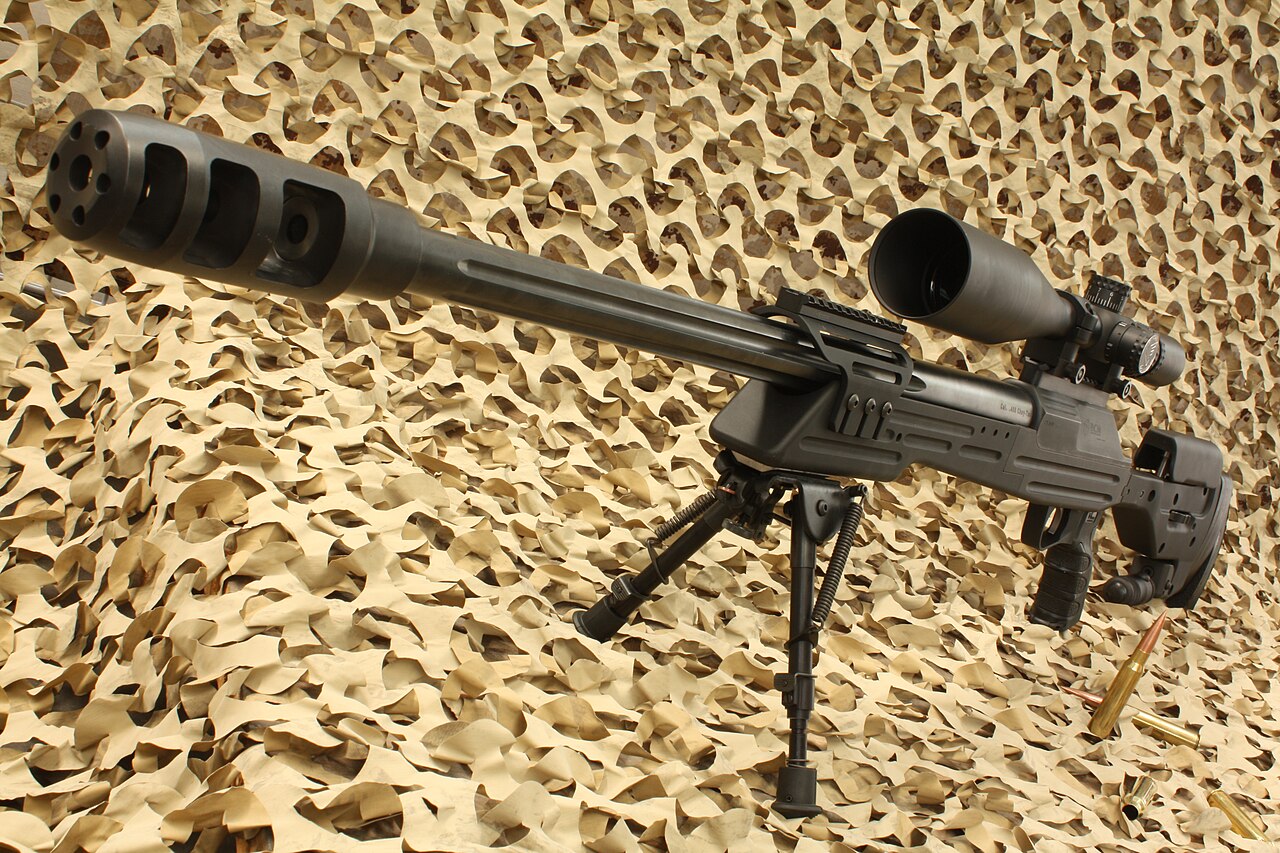
The .338 Lapua Magnum has a reputation that few rifle cartridges can match. It's powerful, expensive, and closely associated with extreme-distance shooting. But the numbers behind that reputation are arguably more interesting than the reputation itself.
A typical .338 Lapua Magnum load launches a heavy bullet at roughly 2,600 to 3,000 feet per second, depending on bullet weight and ammunition. That's impressive at the muzzle, but the cartridge's real strength is how well its aerodynamic bullets retain velocity and energy as distance increases.
At 500 yards, some .338 Lapua loads are still traveling faster than many familiar rifle cartridges do at considerably shorter distances. At 1,000 yards, properly designed match bullets can remain supersonic while retaining substantial energy.
But not every .338 Lapua load performs the same way. A 250-grain bullet generally starts faster than a 300-grain bullet, while a heavier, more aerodynamic projectile may retain its velocity more efficiently downrange.
So what actually happens between 100 and 1,000 yards? Let's look at the factory ballistics, compare the most common bullet weights, and examine how distance changes the cartridge's performance.
Quick Answer: How Does 338 Lapua Perform at 1,000 Yards?
The .338 Lapua Magnum is designed for serious long-range performance, and its ability to retain velocity is one of its greatest strengths.
A published Outdoor Life ballistic example using a 285-grain Hornady ELD Match bullet starts at 2,700 fps and retains approximately 1,678 fps at 1,000 yards. That means the bullet is still traveling comfortably above the speed of sound under typical atmospheric conditions.
Here are the key figures from that example:
- Bullet weight → 285 grains
- Muzzle velocity → 2,700 fps
- Velocity at 500 yards → 2,166 fps
- Velocity at 1,000 yards → 1,678 fps
- Velocity retained at 1,000 yards → Approximately 62%
- Estimated energy at 1,000 yards → Approximately 1,780 ft-lbs
The energy figure is calculated from the published velocity and bullet weight. The example comes from an author's handload rather than factory ammunition, so it should not be confused with Hornady's factory specifications.
The important takeaway is that the .338 Lapua doesn't rely solely on an enormous muzzle-energy figure. Its heavy, streamlined bullets can preserve a remarkable amount of their original velocity across long distances.
338 Lapua Ballistics at a Glance
Before examining individual loads, it helps to understand the cartridge itself.
The .338 Lapua Magnum was developed during the 1980s and became widely recognized for long-range precision shooting. Its combination of a large cartridge case, heavy .338-caliber bullets, and high ballistic coefficients allows it to deliver substantial performance at distances where many conventional rifle cartridges lose velocity rapidly.
Basic 338 Lapua Magnum Specifications:
- Cartridge → .338 Lapua Magnum
- Bullet diameter → .338 inch
- Common bullet weights → 250, 285, and 300 grains
- Typical factory muzzle velocity → Approximately 2,580 to 2,950 fps for the loads discussed here
- Typical muzzle energy → Approximately 4,400 to 4,830 ft-lbs
- Cartridge type → Centerfire rifle
- Primary applications → Long-range target shooting and specialized hunting
These are representative figures, not universal specifications for every .338 Lapua load.
One detail that deserves attention is bullet weight. The difference between a 250-grain and 300-grain projectile is substantial, but a heavier bullet isn't automatically better at every distance. The bullet's shape, ballistic coefficient, muzzle velocity, and intended purpose all influence the results.
That is why we'll examine specific factory loads rather than treating all .338 Lapua ammunition as interchangeable.
338 Lapua 250 Grain Ballistics
The 250-grain bullet is one of the most established options for .338 Lapua Magnum. It offers high muzzle velocity, substantial energy, and a long history in precision rifle ammunition.
Federal's Gold Medal Match ammunition provides a useful factory example. Its 250-grain Sierra MatchKing load is listed at 2,950 fps from the manufacturer's test conditions.
Federal Gold Medal Match, 250-Grain Sierra MatchKing:
- Bullet weight → 250 grains
- Bullet type → Sierra MatchKing BTHP
- Muzzle velocity → 2,950 fps
- Muzzle energy → Approximately 4,830 ft-lbs
- Published G1 ballistic coefficient → 0.587
Downrange Velocity:
- Muzzle → 2,950 fps
- 100 yards → 2,789 fps
- 200 yards → 2,634 fps
- 300 yards → 2,484 fps
- 400 yards → 2,339 fps
- 500 yards → 2,199 fps
These are Federal's published velocity figures for this specific factory load.
The 250-grain bullet loses approximately 751 fps over its first 500 yards, but it is still traveling at nearly 2,200 fps at that distance. That's an important distinction between muzzle performance and downrange performance. The cartridge starts with tremendous energy, but its ability to preserve velocity is what makes it especially interesting.
Using Federal's published velocities, the load retains approximately 2,685 ft-lbs of energy at 500 yards. That's about 56% of its original muzzle energy.
It also demonstrates why bullet design matters. Even though this is a relatively heavy projectile, it still experiences considerable drag. A different 250-grain bullet with a higher ballistic coefficient could retain velocity differently, even when launched at a similar muzzle speed.
The 250-grain category remains appealing because it combines high initial velocity with a substantial bullet. For shooters comparing factory match ammunition, it is one of the most recognizable starting points.
338 Lapua 285 Grain Ballistics
The 285-grain category is particularly interesting because it sits between the faster 250-grain loads and the heavier 300-grain options.
Hornady's 285-grain ELD Match is a good example of how modern bullet design can influence long-range performance. The projectile features a streamlined profile intended to reduce aerodynamic drag, helping it preserve velocity as it travels downrange.
Hornady publishes detailed factory ballistics for this ammunition, making it one of the strongest examples for a consistent comparison.
Hornady Match, 285-Grain ELD Match:
- Bullet weight → 285 grains
- Bullet type → ELD Match
- Muzzle velocity → 2,745 fps
- Muzzle energy → 4,768 ft-lbs
- Test barrel → 24 inches
- Trajectory zero → 200 yards
Downrange Ballistics:
- 100 yards → 2,636 fps | 4,397 ft-lbs | +1.8 inches
- 200 yards → 2,530 fps | 4,049 ft-lbs | 0 inches
- 300 yards → 2,426 fps | 3,723 ft-lbs | −7.2 inches
- 400 yards → 2,324 fps | 3,418 ft-lbs | −20.3 inches
- 500 yards → 2,225 fps | 3,133 ft-lbs | −39.8 inches
Figures are from Hornady's published factory specifications. The last number on each line represents bullet path relative to a 200-yard zero.
What makes this load particularly interesting is how closely its downrange velocity approaches the faster 250-grain example.
The Hornady 285-grain load starts 205 fps slower than Federal's 250-grain MatchKing. At 500 yards, however, Hornady lists the 285-grain bullet at 2,225 fps, compared with Federal's 2,199 fps for the 250-grain load.
That doesn't mean every 285-grain bullet will outperform every 250-grain bullet. These are two different factory loads using different bullet designs. But it illustrates why muzzle velocity alone can be misleading.
The 285-grain ELD Match retains approximately 81% of its initial velocity at 500 yards, while retaining about 66% of its original muzzle energy.
For anyone interested in long-range ballistics, that's the central attraction of modern, high-ballistic-coefficient bullets. They may start slower than lighter projectiles, yet preserve their speed efficiently enough to become competitive farther downrange.
338 Lapua 300 Grain Ballistics
The 300-grain bullet represents the heavier end of commonly available .338 Lapua match ammunition.
These bullets generally launch more slowly than 250-grain alternatives, but many are designed with aerodynamic profiles that favor velocity retention over long distances.
Federal's 300-grain Sierra MatchKing load is a useful example because its factory velocity figures are published alongside the company's 250-grain offering.
Federal Gold Medal Match, 300-Grain Sierra MatchKing:
- Bullet weight → 300 grains
- Bullet type → Sierra MatchKing BTHP
- Muzzle velocity → 2,580 fps
- Muzzle energy → Approximately 4,433 ft-lbs
- Published G1 ballistic coefficient → 0.768
Downrange Velocity:
- Muzzle → 2,580 fps
- 100 yards → 2,466 fps
- 200 yards → 2,355 fps
- 300 yards → 2,247 fps
- 400 yards → 2,143 fps
- 500 yards → 2,040 fps
The 300-grain bullet begins considerably slower than the 250-grain example, yet loses only 540 fps over 500 yards.
That works out to approximately 79% of its original muzzle velocity retained at 500 yards.
The slower starting velocity also means the 300-grain load does not automatically have more muzzle energy. In these particular Federal examples, the faster 250-grain load actually produces more energy at the muzzle.
This is an important reminder that bullet weight alone does not determine ballistic performance. Velocity plays a major role in kinetic energy, while bullet design influences how quickly velocity is lost.
At extended distances, the aerodynamic advantages of a heavier match bullet may become increasingly valuable. But the actual result depends on the specific load, not simply whether the box says 250 or 300 grains.
250 vs 285 vs 300 Grain: Which Retains Velocity Best?
Now that we've examined three factory loads, the differences become easier to understand.
The 250-grain Federal MatchKing begins with the highest velocity of our examples. At 2,950 fps, it starts significantly faster than either the Hornady 285-grain or Federal 300-grain load.
But the advantage changes as the bullets travel downrange.
Factory Velocity Comparison
250-Grain Federal MatchKing:
- Muzzle → 2,950 fps
- 300 yards → 2,484 fps
- 500 yards → 2,199 fps
285-Grain Hornady ELD Match:
- Muzzle → 2,745 fps
- 300 yards → 2,426 fps
- 500 yards → 2,225 fps
300-Grain Federal MatchKing:
- Muzzle → 2,580 fps
- 300 yards → 2,247 fps
- 500 yards → 2,040 fps
These examples reveal something important: the 285-grain Hornady load overtakes the 250-grain Federal load in velocity by 500 yards, despite starting slower.
The 300-grain Federal load retains a high percentage of its starting velocity, but it does not catch either of the other examples within the manufacturer's published 500-yard data.
That doesn't make the 300-grain bullet inferior. It simply means that its greater weight and aerodynamic design need to be evaluated alongside its lower initial velocity.
The most important lesson is that ballistic coefficient and muzzle velocity must be considered together. A heavier bullet with a high ballistic coefficient may preserve its velocity very efficiently, but a lighter bullet with a significant head start can remain faster for a substantial distance.
For long-range ammunition comparisons, the specific factory load matters more than the bullet-weight category by itself.
What Happens to 338 Lapua at 1,000 Yards?
The .338 Lapua Magnum's performance at 1,000 yards is one of the main reasons the cartridge developed such a strong reputation.
To examine that distance, we need to distinguish published factory ammunition data from independently calculated long-range examples.
Hornady's accessible factory product chart for its 285-grain ELD Match extends to 500 yards. For a longer-distance example, Outdoor Life published a ballistic profile for a 285-grain Hornady ELD Match bullet launched at 2,700 fps.
The example uses an author's handload rather than Hornady factory ammunition. Its results therefore illustrate the bullet's long-range potential under that particular set of conditions, not the guaranteed performance of a factory cartridge.
285-Grain ELD Match: Published Long-Range Example:
- Muzzle → 2,700 fps
- 500 yards → 2,166 fps
- 1,000 yards → 1,678 fps
- Velocity retained at 1,000 yards → Approximately 62%
- Calculated energy at 1,000 yards → Approximately 1,780 ft-lbs
At 1,000 yards, the bullet is still moving at a substantial velocity. More importantly, it remains supersonic under typical atmospheric conditions.
The speed of sound changes with air temperature and other environmental conditions, so the exact point where a bullet becomes transonic is not a fixed distance.
As bullets slow toward the speed of sound, changes in aerodynamic behavior can make consistent long-range performance more challenging. One reason high-ballistic-coefficient .338 Lapua bullets are popular is their ability to remain above that region for considerable distances.
But velocity retention is only part of the story. Bullet drop and wind drift become increasingly important as the distance grows.
How Much Does 338 Lapua Drop at 1,000 Yards?
Bullet drop is one of the most frequently misunderstood parts of a ballistics chart.
A bullet begins falling under gravity as soon as it leaves the barrel. But the amount of drop shown on an ammunition chart depends on how the rifle is sighted in, the bullet's velocity, its aerodynamic properties, and the environmental conditions used in the calculation.
That is why two reputable sources can publish different trajectory figures for the same cartridge without either necessarily being wrong.
Millett Sights published a calculated trajectory for a 250-grain .338 Lapua BTHP match bullet, using a 100-yard zero and specified environmental assumptions.
250-Grain Match Bullet: Calculated Trajectory:
- 100 yards → 0 inches
- 300 yards → −9.9 inches
- 500 yards → −42.0 inches
- 800 yards → −145.0 inches
- 1,000 yards → −262.0 inches
These are rounded values from Millett's calculated example using a 100-yard zero, a 24-inch assumed barrel, sea-level conditions, and a temperature of 59°F. They are not universal figures for all 250-grain ammunition.
At 1,000 yards, the calculated bullet path is approximately 262 inches below the 100-yard line of sight. That is nearly 22 feet.
It sounds enormous, but the number makes more sense when you consider how long the bullet has been traveling and how much its velocity has changed.
There is also a critical distinction between bullet drop and scope adjustment. The numbers above describe the bullet's calculated path relative to the sight line. They should not be confused with a universal set of sight adjustments for every rifle.
Actual trajectory varies with the ammunition, rifle, sight height, zero distance, altitude, and atmospheric conditions.
How Much Does Wind Affect 338 Lapua at Long Range?
The .338 Lapua is known for resisting wind drift, particularly when loaded with aerodynamic match bullets. But resisting wind does not mean being unaffected by it.
As a bullet travels farther, it spends more time in flight. Even a relatively steady crosswind can produce substantial horizontal displacement over long distances.
Millett's 250-grain example also includes calculated drift for a 10 mph crosswind.
250-Grain Match Bullet: 10 MPH Wind Drift:
- 100 yards → 0 inches in the published reference
- 300 yards → 4.6 inches
- 500 yards → 13.5 inches
- 800 yards → 37.5 inches
- 1,000 yards → 62.0 inches
These figures belong to the same calculated example used in the previous section. Actual wind drift depends on wind direction, velocity, bullet design, and environmental conditions.
The interesting part isn't simply that wind drift increases with distance. It's how dramatically the effect grows over the final several hundred yards.
Between 500 and 1,000 yards, the published drift increases from 13.5 inches to 62 inches. That's a reminder that the last half of a long-range bullet's flight can introduce far more uncertainty than the first half.
This is also why a cartridge with impressive ballistic specifications doesn't eliminate the difficulty of shooting at extreme distances. Environmental conditions remain a major part of long-range precision.
Why Barrel Length and Ballistic Coefficient Matter
Two factors deserve particular attention when comparing .338 Lapua ammunition: barrel length and ballistic coefficient.
Barrel length can influence muzzle velocity because it changes how long expanding propellant gases act on the bullet. However, the relationship isn't identical for every cartridge or load. A longer barrel does not guarantee a specific velocity increase, and a shorter barrel doesn't automatically reduce velocity by a predictable amount.
This matters because published factory velocities usually come from a manufacturer's designated test barrel. Hornady identifies a 24-inch test barrel for the 285-grain ELD Match data discussed earlier.
A different rifle may produce a different muzzle velocity even with the same ammunition.
Ballistic coefficient, commonly abbreviated BC, describes how efficiently a projectile overcomes aerodynamic drag. In general, a bullet with a higher ballistic coefficient retains velocity more effectively than a similar bullet with a lower coefficient when other relevant factors are comparable.
However, BC figures must be interpreted carefully. G1 and G7 are different drag models, and their numerical values should not be compared directly as though they use the same scale.
The shape of the bullet matters as much as its weight. That is why a carefully designed 285-grain match bullet can outperform a different 250-grain bullet in velocity retention, even when the lighter bullet starts faster.
Is 338 Lapua Magnum Worth the Cost?
The .338 Lapua Magnum offers impressive ballistic performance, but that performance comes with practical tradeoffs.
The ammunition is substantially larger and generally more expensive than common rifle cartridges. Rifles chambered for .338 Lapua are often heavier, and recoil is significant compared with cartridges such as .308 Winchester or 6.5 Creedmoor.
The cartridge also produces considerable muzzle blast, particularly in rifles equipped with muzzle brakes.
For someone who primarily shoots at 100 or 200 yards, much of the .338 Lapua's long-range capability may go unused. There are many smaller cartridges capable of excellent accuracy at those distances with less recoil and lower ammunition costs.
At longer distances, however, the appeal becomes easier to understand. Heavy match bullets, substantial retained energy, and the ability to remain supersonic well beyond ordinary rifle distances give the cartridge capabilities that smaller rounds may not match in the same way.
That doesn't mean the .338 Lapua is automatically the most accurate cartridge. Accuracy depends on the rifle, ammunition, shooter, and conditions. A larger cartridge doesn't guarantee tighter groups.
The cartridge's real advantage is its combination of bullet weight, velocity, and aerodynamic efficiency, particularly when the distances become substantial.
For anyone comparing .338 Lapua ammunition, it is worth looking beyond bullet weight alone. Different factory loads can produce noticeably different velocity and energy figures, even when their projectiles weigh the same.
Final Thoughts: What Makes 338 Lapua Ballistics So Impressive?
The .338 Lapua Magnum's reputation is supported by substantial ballistic performance, but the most impressive part isn't simply its muzzle energy.
The real story is what happens after the bullet leaves the barrel.
A 250-grain match load can start at nearly 3,000 fps and still retain considerable velocity at 500 yards. A modern 285-grain ELD Match bullet can preserve its speed efficiently enough to become competitive with lighter loads downrange. And heavy 300-grain match bullets demonstrate how manufacturers balance bullet weight, muzzle velocity, and aerodynamic design.
At 1,000 yards, the cartridge remains a serious long-range performer, although trajectory, wind drift, and atmospheric conditions become increasingly important.
There is no single .338 Lapua ballistic profile that accurately represents every factory load. Bullet weight matters, but so do bullet construction, ballistic coefficient, barrel length, and test conditions.
The biggest takeaway is simple: .338 Lapua's strength is not just how fast its bullets start, but how well carefully designed bullets continue performing downrange.
Information provided by AmmoBrowser is for general informational and educational purposes only. Ammunition specifications, ballistics, performance, pricing, and availability can vary by manufacturer, load, firearm, barrel length, and other conditions. While we strive to provide accurate and current information, AmmoBrowser makes no guarantee regarding its completeness or accuracy. Always follow firearm and ammunition manufacturer instructions, verify that ammunition is compatible with your firearm, and follow all applicable laws and safe firearm handling practices.
Published trajectory and wind-drift figures are illustrative and should not be used as a substitute for verified data specific to an individual firearm, ammunition load, and shooting environment.