
'%3e%3cpath%20d='M25.8906%2030.68L16.0006%2025L6.14062%2030.68V4.55C6.14063%203.75435%206.4567%202.99129%207.0193%202.42868C7.58191%201.86607%208.34498%201.55%209.14063%201.55H22.8906C23.6863%201.55%2024.4493%201.86607%2025.0119%202.42868C25.5746%202.99129%2025.8906%203.75435%2025.8906%204.55V30.68ZM9.14063%203.55C8.87541%203.55%208.62105%203.65536%208.43352%203.84289C8.24598%204.03043%208.14063%204.28478%208.14063%204.55V27.23L16.0006%2022.72L23.8806%2027.23V4.55C23.8806%204.28478%2023.7753%204.03043%2023.5877%203.84289C23.4002%203.65536%2023.1458%203.55%2022.8806%203.55H9.14063Z'%20fill='white'/%3e%3cpath%20d='M9.14063%202.55H22.8906C23.4211%202.55%2023.9298%202.76071%2024.3048%203.13579C24.6799%203.51086%2024.8906%204.01957%2024.8906%204.55V8.62H7.14062V4.55C7.14063%204.01957%207.35134%203.51086%207.72641%203.13579C8.10148%202.76071%208.61019%202.55%209.14063%202.55Z'%20fill='%238A3301'/%3e%3cpath%20d='M25.8906%209.62H6.14062V4.55C6.14063%203.75435%206.4567%202.99129%207.0193%202.42868C7.58191%201.86607%208.34498%201.55%209.14063%201.55H22.8906C23.6863%201.55%2024.4493%201.86607%2025.0119%202.42868C25.5746%202.99129%2025.8906%203.75435%2025.8906%204.55V9.62ZM8.14063%207.62H23.8906V4.55C23.8906%204.28478%2023.7853%204.03043%2023.5977%203.84289C23.4102%203.65536%2023.1558%203.55%2022.8906%203.55H9.14063C8.87541%203.55%208.62105%203.65536%208.43352%203.84289C8.24598%204.03043%208.14063%204.28478%208.14063%204.55V7.62Z'%20fill='white'/%3e%3cpath%20d='M16%2020.25C15.7348%2020.25%2015.4804%2020.1446%2015.2929%2019.9571C15.1054%2019.7696%2015%2019.5152%2015%2019.25V14.07C15%2013.8048%2015.1054%2013.5504%2015.2929%2013.3629C15.4804%2013.1754%2015.7348%2013.07%2016%2013.07C16.2652%2013.07%2016.5196%2013.1754%2016.7071%2013.3629C16.8946%2013.5504%2017%2013.8048%2017%2014.07V19.25C17%2019.5152%2016.8946%2019.7696%2016.7071%2019.9571C16.5196%2020.1446%2016.2652%2020.25%2016%2020.25Z'%20fill='white'/%3e%3cpath%20d='M18.5999%2017.66H13.4199C13.1547%2017.66%2012.9004%2017.5546%2012.7128%2017.3671C12.5253%2017.1796%2012.4199%2016.9252%2012.4199%2016.66C12.4199%2016.3948%2012.5253%2016.1404%2012.7128%2015.9529C12.9004%2015.7654%2013.1547%2015.66%2013.4199%2015.66H18.5999C18.8651%2015.66%2019.1195%2015.7654%2019.307%2015.9529C19.4946%2016.1404%2019.5999%2016.3948%2019.5999%2016.66C19.5999%2016.9252%2019.4946%2017.1796%2019.307%2017.3671C19.1195%2017.5546%2018.8651%2017.66%2018.5999%2017.66Z'%20fill='white'/%3e%3c/g%3e%3cdefs%3e%3cclipPath%20id='clip0_29353_35'%3e%3crect%20width='32'%20height='32'%20fill='white'/%3e%3c/clipPath%3e%3c/defs%3e%3c/svg%3e) Wishlist
Wishlist
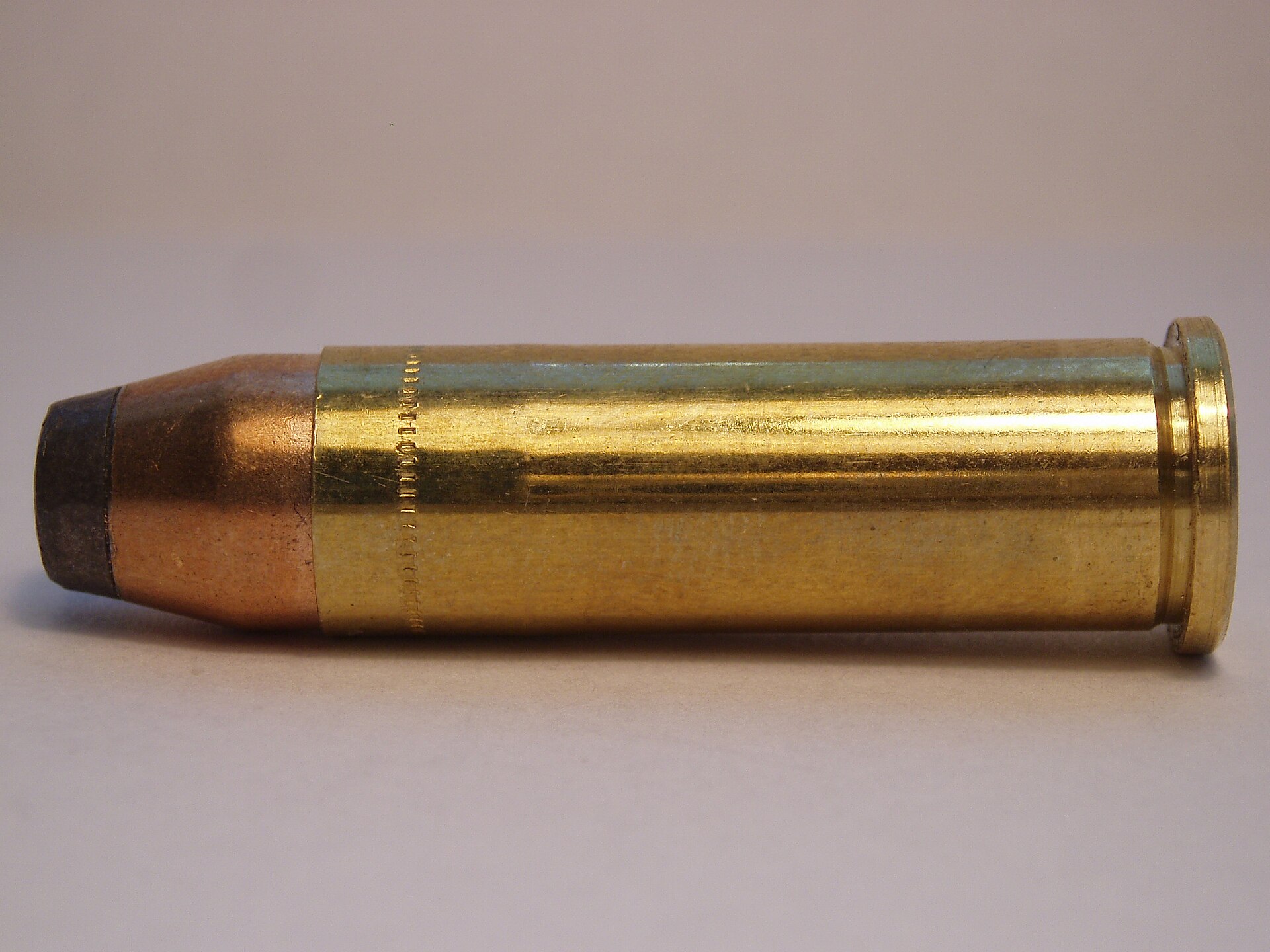
If you knew nothing about handgun ammunition and saw a box of .38 Special sitting next to a box of .38 Super, you could be forgiven for assuming one was simply a hotter version of the other. Maybe .38 Special is the standard load and .38 Super is the faster, more powerful upgrade.
That would make sense.
It would also be completely wrong.
The .38 Special and .38 Super come from different cartridge families, were developed decades apart, and are most closely associated with entirely different types of handguns. One became one of America's classic revolver cartridges. The other became a high velocity semiautomatic round with an especially devoted following among competition shooters.
What makes the comparison even more interesting is that their bullets aren't necessarily all that different. Both cartridges can be loaded with a 130 grain projectile, for example. Yet representative factory loads using that same bullet weight can produce dramatically different velocity and energy.
So despite two confusingly similar names, this isn't really a story about two versions of the same cartridge.
It's the story of two completely different ways to build a .38 caliber handgun round.
Quick Answer: .38 Super vs .38 Special
The easiest way to understand the difference is this:
.38 Special is primarily a revolver cartridge known for manageable recoil, versatility, and a history stretching back to the end of the 19th century. .38 Super is a higher velocity semiautomatic pistol cartridge that arrived several decades later and produces substantially more velocity and energy with comparable bullet weights.
They are not interchangeable.
The .38 Special has a rimmed case and is most strongly associated with revolvers. The .38 Super comes from the .38 ACP lineage and is most strongly associated with semiautomatic pistols, particularly the 1911 platform.
Ballistically, the difference can be enormous. Target Barn's comparison of Remington UMC 130 grain FMJ loads lists the .38 Special at 800 fps and 185 foot pounds of muzzle energy, while the 130 grain .38 Super is listed at 1,215 fps and 426 foot pounds. That's essentially the same bullet weight traveling more than 400 fps faster.
The .38 Special generally gives you the softer shooting experience. The .38 Super gives you considerably more speed and energy.
But those numbers only make sense once you understand how two cartridges with such similar names ended up being so different.
They Aren't Really Siblings
The names are probably responsible for most of the confusion.
"Special" and "Super" sound like marketing terms describing different versions of the same basic product. If ammunition naming followed any kind of sensible logic, that might actually be true.
Cartridge names rarely cooperate.
The .38 Special is the older design. Smith & Wesson developed it at the end of the 1890s from the .38 Long Colt lineage. Its long case made sense in an era when black powder was still part of the ammunition landscape, and it became closely associated with Smith & Wesson's Military & Police revolver and generations of revolvers that followed.
The .38 Super arrived roughly three decades later.
Its family tree goes in another direction entirely. John Browning's earlier .38 Automatic cartridge, later commonly known as .38 ACP, appeared around the beginning of the 20th century for early Colt semiautomatic pistols. The higher performance cartridge that became known as the Super .38 arrived for the Colt Government Model around 1929.
So .38 Super was not created by taking .38 Special and increasing its performance.
The cartridges simply ended up with names that make them sound far more closely related than they actually are.
Even the early naming of .38 Super adds another wrinkle. Period Colt material referred to the pistol and cartridge using terms such as Super .38, while ".38 Super" eventually became the familiar modern wording. American Rifleman's historical material includes Colt advertising for the new Super .38 dating to 1929.
That history is more than trivia. It explains nearly everything that follows.
One cartridge evolved around the revolver.
The other evolved around the semiautomatic pistol.
The Same 130 Grain Bullet Tells the Story
You could compare dozens of different loads and make this section unnecessarily complicated. There is a much easier way to see what's happening.
Compare 130 grain to 130 grain.
Target Barn lists a Remington UMC 130 grain .38 Special FMJ at a muzzle velocity of 800 fps and muzzle energy of 185 foot pounds.
The Remington UMC 130 grain .38 Super FMJ in the same comparison is listed at 1,215 fps and 426 foot pounds.
That is a huge difference.
And because the bullets weigh the same, we don't have to wonder whether .38 Super is achieving the result simply by firing an unusually light projectile.
It's moving essentially the same bullet mass dramatically faster.
That increased velocity also affects trajectory. A faster projectile generally spends less time in flight over a given distance, which means gravity has less time to pull it downward. For ordinary handgun distances, trajectory probably isn't going to be the deciding factor for most shooters, but the .38 Super's high velocity was part of what made the cartridge distinctive from the beginning.
Early advertising emphasized its velocity, trajectory and penetration, and those characteristics became a major part of the Super .38's identity.
The numbers also demonstrate why looking only at caliber names tells you so little about ammunition performance.
Both say .38.
Both can fire a 130 grain bullet.
Their muzzle energy can be worlds apart.
Their Bullet Weights Overlap More Than You Might Expect
This is another place where the comparison gets interesting.
You might expect .38 Super's additional velocity to come from using much lighter bullets than .38 Special. There are differences in their typical ammunition, but there is also a surprising amount of overlap.
Common .38 Super ammunition can be found around 115 grains, 124 or 125 grains, 130 grains and 147 grains, with other weights available depending on the load. The 130 grain projectile has particularly deep historical roots in the cartridge.
.38 Special covers an even broader traditional range. You'll commonly encounter ammunition around 110, 125, 130, 148 and 158 grains, among other choices.
The 148 grain wadcutter has a long connection to precision target shooting, while the 158 grain projectile is one of the traditional heavyweights associated with .38 Special. Lighter 110 and 125 grain bullets are common in other types of ammunition.
So the cartridges actually meet in the middle.
A 125 grain .38 Special and a 125 grain .38 Super aren't unusual concepts. Neither is 130 grain ammunition in both calibers.
That makes bullet weight a particularly bad way to guess how these cartridges perform.
The number of grains printed on the box tells you how much the projectile weighs. It does not tell you how fast the cartridge launches it.
And with .38 Special versus .38 Super, that distinction matters a lot.
.38 Super Turns Up the Speed
The .38 Super's personality has always revolved around velocity.
It was a genuinely fast semiautomatic pistol cartridge for its era, and even today its performance remains impressive when compared with .38 Special.
Depending on the particular load and barrel, .38 Super ammunition can push conventional handgun bullets well beyond the velocities normally associated with standard pressure .38 Special ammunition. Target Barn's examples include a 115 grain .38 Super load listed at more than 1,400 fps from a 4.3 inch barrel, although that is a particularly energetic load and shouldn't be treated as representative of every box of .38 Super.
That last part matters.
There is no single ".38 Super velocity" any more than there is one .38 Special velocity. Bullet weight, projectile construction, ammunition manufacturer and barrel length all influence the result.
But the broader pattern is unmistakable.
When bullet weights are comparable, .38 Super generally operates in a much faster performance class than standard .38 Special.
That is not an accident. It's fundamental to what the cartridge is.
.38 Special Takes the Softer Approach
The ballistic chart makes .38 Super look like it has everything going its way.
Then you get to recoil.
More velocity and energy generally have consequences, and one of them is the amount of recoil the shooter has to manage. When firearm weight is reasonably comparable, .38 Special is normally the softer shooting cartridge.
Target Barn calculated recoil energy for several loads using a roughly 37 ounce .38 Special revolver and a similarly weighted .38 Super 1911. Its .38 Special examples ranged from about 2.27 to 3.37 foot pounds of recoil energy, while its .38 Super examples were around 5.3 to 5.48 foot pounds.
Those numbers need context.
Calculated recoil energy is not the same thing as perceived recoil. Grip shape, firearm design, action, shooter technique and other factors affect what recoil actually feels like.
Most importantly, gun weight matters enormously.
Put .38 Special into a lightweight snub nose revolver and it may feel surprisingly sharp. Put .38 Super into a heavy, full size steel 1911 and the gun's weight helps manage the cartridge's greater recoil.
So saying ".38 Special recoils less" is generally useful when comparing similar conditions, but it doesn't mean every .38 Special firearm will feel softer than every .38 Super firearm.
The gun around the cartridge gets a vote.
.38 Special Became the Do Almost Everything .38
If .38 Super has the more impressive ballistic numbers, .38 Special has the broader résumé.
Over more than a century, .38 Special has served in police revolvers, defensive handguns, target pistols and recreational firearms. It became deeply embedded in American revolver culture, and its manageable recoil helped make it useful to shooters with very different goals.
Target shooting is an especially important part of that history.
The classic 148 grain wadcutter is closely associated with precision .38 Special shooting. Wadcutters cut clean holes in paper targets, making scoring easier, and mild target loads helped establish the cartridge's reputation for accuracy and pleasant shooting.
The cartridge's range of bullet weights also lets manufacturers build ammunition around very different purposes. A light target load and a defensive .38 Special load may share a cartridge designation while providing noticeably different shooting experiences.
There's another reason .38 Special remains useful today: many firearms chambered for .357 Magnum are designed to also fire .38 Special ammunition. That can give owners of compatible .357 Magnum revolvers a lower recoil option for practice and recreational shooting.
Compatibility should always be confirmed with the firearm manufacturer rather than assumed simply because a cartridge physically fits.
That broader flexibility is part of why .38 Special has endured.
It doesn't need spectacular velocity to be useful.
.38 Super Found a Very Different Home
The modern .38 Super story is much more specialized, and arguably more interesting because of it.
The cartridge never became the universal semiautomatic pistol round that cartridges such as 9mm eventually became. Instead, it developed an especially strong following among shooters who could take advantage of its particular characteristics.
One of the biggest examples is action pistol competition.
American Rifleman's historical material describes modern .38 Super pistols built around the cartridge's predominant role in action pistol shooting, and the cartridge became strongly associated with highly modified competition pistols.
There are technical reasons competitors became interested in it, but you don't need to turn this into a competition rulebook to understand the appeal.
.38 Super offered a combination of high velocity, semiautomatic operation and useful magazine capacity in 1911 style pistols. Competition shooters found ways to take advantage of those characteristics, and the cartridge developed an identity that .38 Special never really shared.
That's one of the strangest things about this comparison.
One cartridge became synonymous with classic revolvers and wadcutter target loads.
The other found a second life in high performance competition pistols.
The names still sound almost interchangeable.
What About Ordinary Range Shooting?
For recreational shooting, neither cartridge needs to prove anything on a ballistic chart.
This is where the firearm itself may matter more than the ammunition's maximum performance.
A full size .38 Special revolver with mild ammunition can be an exceptionally pleasant range combination. Recoil can be modest, and the cartridge has a long reputation for accurate target shooting.
A full size .38 Super pistol can also be very enjoyable, but the experience is different. You're getting the operation of a semiautomatic handgun combined with a faster cartridge and a noticeably different recoil impulse.
The practical difference is ammunition selection.
.38 Special remains a mainstream revolver cartridge with a broad range of factory ammunition. .38 Super is much more specialized. Target Barn notes that .38 Super ammunition can be considerably less common at ordinary sporting goods stores, although online shopping makes niche cartridges much easier to find than they once were.
That's something worth considering if you plan to shoot frequently.
A cartridge can be fascinating, accurate and powerful, but if you're constantly hunting for ammunition, that becomes part of the ownership experience too.
What About Defensive Use?
Both cartridges have histories connected with personal protection, but they approach the job very differently.
.38 Special remains closely associated with defensive revolvers, including compact models. Its relatively modest recoil can be an advantage, although very lightweight revolvers can make even .38 Special feel sharp.
The ammunition itself also matters enormously. Standard pressure loads, +P ammunition, different bullet weights and different projectile designs can perform very differently. Firearms also differ in whether they're rated for particular ammunition, so the manufacturer's guidance matters.
The .38 Super brings substantially more velocity and energy to the conversation. Historically, that performance was one of its major selling points. The cartridge developed a reputation for penetration and high velocity early in its life.
But choosing between these cartridges for defensive use isn't really just choosing between two ballistic numbers.
You're also choosing between firearm platforms.
A compact .38 Special revolver and a full size .38 Super 1911 are very different things to carry, operate and shoot. The firearm may drive the decision before the cartridge ever does.
That's another reason this comparison is so unusual.
Most caliber debates ask which cartridge you'd rather put in roughly comparable guns.
With .38 Special and .38 Super, the guns themselves are often part of the fundamental difference.
Can You Shoot .38 Super in a .38 Special?
No.
This deserves its own section because the names make the mistake far too easy to imagine.
.38 Super and .38 Special are different cartridges and are not interchangeable. The .38 Special is a long, rimmed cartridge primarily designed around revolvers. The .38 Super has a shorter case and belongs to a semiautomatic cartridge family. Their dimensions, operating characteristics and intended firearms differ.
Do not choose ammunition because the caliber name looks close enough.
Use only ammunition specifically identified as compatible with your firearm by its manufacturer.
The same caution matters when discussing .38 Super and the older .38 ACP. Those cartridges are much more closely related dimensionally, but their operating pressures are not the same. A cartridge fitting into a chamber does not establish that it is safe to fire there.
With ammunition, "it fits" and "it's safe" are two very different statements.
So Why Do Both Still Exist?
This is probably the most interesting question.
If .38 Super is so much faster, why didn't it replace .38 Special?
Because cartridges don't exist in isolation.
The .38 Special already had a huge installed base of revolvers and decades of institutional and civilian use. Its manageable recoil, accuracy and versatility gave shooters plenty of reasons to keep using it. And because the cartridge doesn't chase maximum velocity, it works extremely well for applications where maximum velocity isn't necessary.
The .38 Super solved a different problem.
It put considerably more velocity into a semiautomatic pistol cartridge and eventually found shooters who valued exactly that combination. Its role in competition gave it a reason to survive even after other semiautomatic cartridges became far more common.
So neither cartridge really had to eliminate the other.
They weren't competing for exactly the same job in the first place.
Which One Makes More Sense?
This is one comparison where declaring an overall winner would miss the point.
If you're looking for a traditional revolver cartridge with manageable recoil, a huge history behind it and a broad range of uses, .38 Special fits that description.
If you're interested in a high velocity semiautomatic cartridge, particularly in a 1911 style or competition oriented pistol, that's where .38 Super becomes interesting.
If you're simply comparing performance, .38 Super clearly produces substantially greater velocity and energy with similar bullet weights.
If you're comparing recoil under similar conditions, .38 Special generally asks less of the shooter.
And if you're choosing between actual firearms, the revolver versus semiautomatic distinction may matter more to you than any of those numbers.
That's why the names are so misleading.
.38 Super isn't really a "super" .38 Special. And .38 Special isn't simply a slower .38 Super.
They're different cartridges that happened to end up with confusingly similar names.
Similar Names, Completely Different Personalities
There may not be two handgun cartridges that demonstrate the weirdness of ammunition naming quite as neatly as these.
.38 Special traces its roots to the revolver world of the late 19th century. It became a police cartridge, a target cartridge, a recreational cartridge and one of the most recognizable revolver rounds ever made.
.38 Super came from a different family and a different era. It took the semiautomatic route, emphasized velocity and energy, and eventually became particularly associated with 1911 style pistols and action shooting competition. Historical Colt advertising from 1929 was already emphasizing the Super .38 as a powerful, high performance automatic pistol.
More than anything, that explains why this comparison survives.
The two cartridges look like they should be closely related.
They aren't.
They can fire bullets weighing almost exactly the same.
They don't perform the same.
And more than a century after .38 Special appeared and nearly a century after .38 Super followed, both still have shooters who appreciate them for very different reasons.
That's not because one failed to replace the other. It's because they were never really trying to do the same job.
Information provided by AmmoBrowser is for general informational and educational purposes only. Ammunition specifications, ballistics, performance, pricing, and availability can vary by manufacturer, load, firearm, barrel length, and other conditions. While we strive to provide accurate and current information, AmmoBrowser makes no guarantee regarding its completeness or accuracy. Always follow firearm and ammunition manufacturer instructions, verify that ammunition is compatible with your firearm, and follow all applicable laws and safe firearm handling practices.