
'%3e%3cpath%20d='M25.8906%2030.68L16.0006%2025L6.14062%2030.68V4.55C6.14063%203.75435%206.4567%202.99129%207.0193%202.42868C7.58191%201.86607%208.34498%201.55%209.14063%201.55H22.8906C23.6863%201.55%2024.4493%201.86607%2025.0119%202.42868C25.5746%202.99129%2025.8906%203.75435%2025.8906%204.55V30.68ZM9.14063%203.55C8.87541%203.55%208.62105%203.65536%208.43352%203.84289C8.24598%204.03043%208.14063%204.28478%208.14063%204.55V27.23L16.0006%2022.72L23.8806%2027.23V4.55C23.8806%204.28478%2023.7753%204.03043%2023.5877%203.84289C23.4002%203.65536%2023.1458%203.55%2022.8806%203.55H9.14063Z'%20fill='white'/%3e%3cpath%20d='M9.14063%202.55H22.8906C23.4211%202.55%2023.9298%202.76071%2024.3048%203.13579C24.6799%203.51086%2024.8906%204.01957%2024.8906%204.55V8.62H7.14062V4.55C7.14063%204.01957%207.35134%203.51086%207.72641%203.13579C8.10148%202.76071%208.61019%202.55%209.14063%202.55Z'%20fill='%238A3301'/%3e%3cpath%20d='M25.8906%209.62H6.14062V4.55C6.14063%203.75435%206.4567%202.99129%207.0193%202.42868C7.58191%201.86607%208.34498%201.55%209.14063%201.55H22.8906C23.6863%201.55%2024.4493%201.86607%2025.0119%202.42868C25.5746%202.99129%2025.8906%203.75435%2025.8906%204.55V9.62ZM8.14063%207.62H23.8906V4.55C23.8906%204.28478%2023.7853%204.03043%2023.5977%203.84289C23.4102%203.65536%2023.1558%203.55%2022.8906%203.55H9.14063C8.87541%203.55%208.62105%203.65536%208.43352%203.84289C8.24598%204.03043%208.14063%204.28478%208.14063%204.55V7.62Z'%20fill='white'/%3e%3cpath%20d='M16%2020.25C15.7348%2020.25%2015.4804%2020.1446%2015.2929%2019.9571C15.1054%2019.7696%2015%2019.5152%2015%2019.25V14.07C15%2013.8048%2015.1054%2013.5504%2015.2929%2013.3629C15.4804%2013.1754%2015.7348%2013.07%2016%2013.07C16.2652%2013.07%2016.5196%2013.1754%2016.7071%2013.3629C16.8946%2013.5504%2017%2013.8048%2017%2014.07V19.25C17%2019.5152%2016.8946%2019.7696%2016.7071%2019.9571C16.5196%2020.1446%2016.2652%2020.25%2016%2020.25Z'%20fill='white'/%3e%3cpath%20d='M18.5999%2017.66H13.4199C13.1547%2017.66%2012.9004%2017.5546%2012.7128%2017.3671C12.5253%2017.1796%2012.4199%2016.9252%2012.4199%2016.66C12.4199%2016.3948%2012.5253%2016.1404%2012.7128%2015.9529C12.9004%2015.7654%2013.1547%2015.66%2013.4199%2015.66H18.5999C18.8651%2015.66%2019.1195%2015.7654%2019.307%2015.9529C19.4946%2016.1404%2019.5999%2016.3948%2019.5999%2016.66C19.5999%2016.9252%2019.4946%2017.1796%2019.307%2017.3671C19.1195%2017.5546%2018.8651%2017.66%2018.5999%2017.66Z'%20fill='white'/%3e%3c/g%3e%3cdefs%3e%3cclipPath%20id='clip0_29353_35'%3e%3crect%20width='32'%20height='32'%20fill='white'/%3e%3c/clipPath%3e%3c/defs%3e%3c/svg%3e) Wishlist
Wishlist
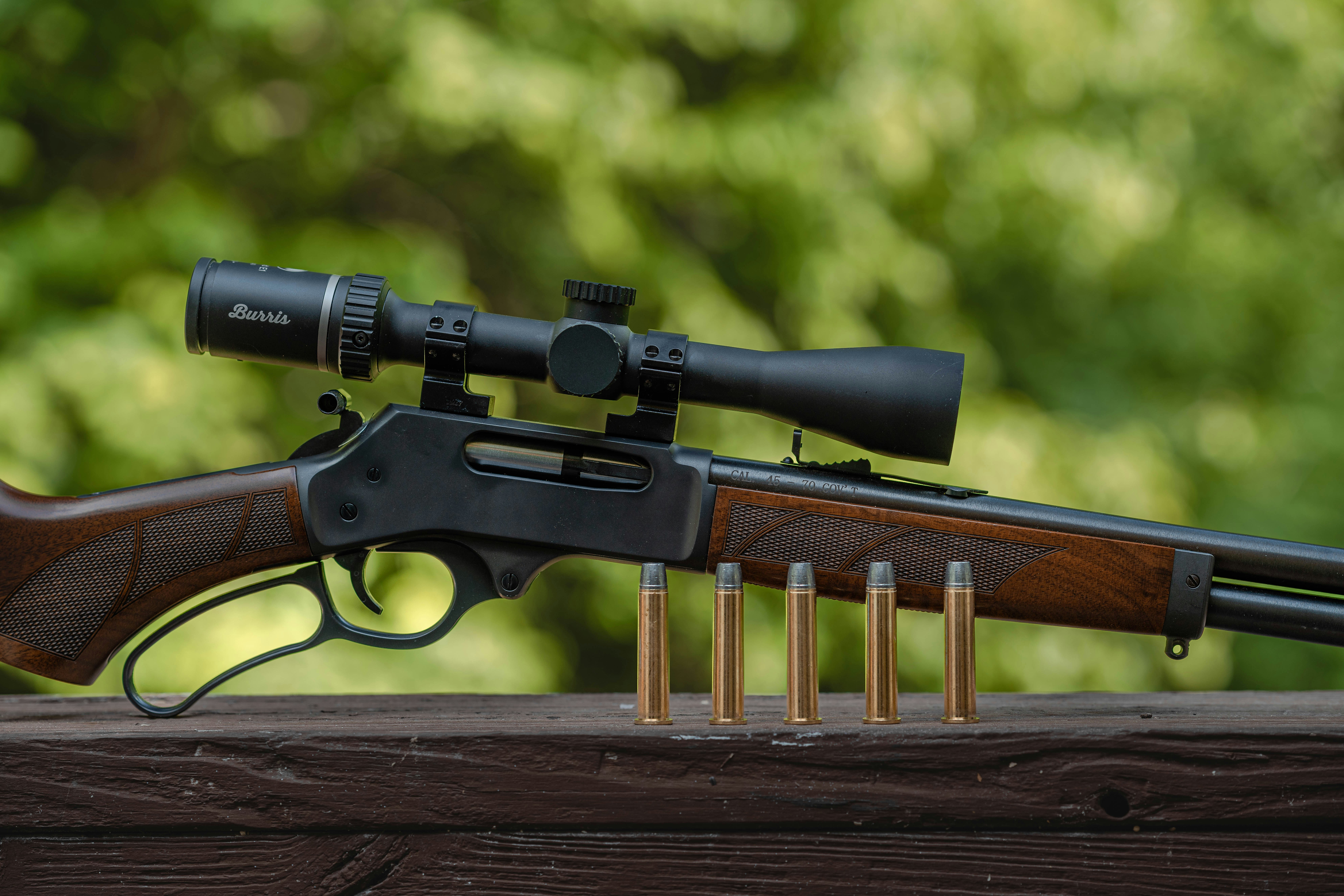
The .450 Marlin and .45-70 Government seem like they should be easy cartridges to compare. Both fire large, heavy bullets. Both are strongly associated with lever-action rifles. Both deliver the kind of close-range power that has made big-bore rifles popular with hunters for generations.
Look a little deeper, however, and the comparison becomes much more interesting.
The .45-70 dates all the way back to 1873, when black powder and single shot military rifles were the norm. The .450 Marlin didn't appear until more than a century later. It was introduced in 2000 specifically to provide modern, high-performance big-bore ballistics from lever-action rifles without creating the ammunition compatibility concerns that come with loading the much older .45-70 to significantly higher pressures.
You might assume that makes the .450 Marlin the obvious winner.
It doesn't.
Modern .45-70 ammunition has transformed what the old cartridge can accomplish when fired from appropriate modern rifles. At the same time, the enormous popularity of .45-70 has given shooters something .450 Marlin has never been able to match: an exceptionally broad selection of ammunition, rifles, bullet weights, and power levels.
That creates an unusual comparison. The newer cartridge may have been designed to solve some of the older cartridge's limitations, yet the 150-year-old .45-70 remains vastly more popular.
So what does the .450 Marlin actually give you? How much more powerful is it? Does it shoot flatter? Which has more recoil? And if you're carrying one through thick timber after deer, elk, or other big game, does any of that make a meaningful difference?
Let's find out.
The Short Answer
If you're looking strictly at conventional factory ammunition, .450 Marlin was designed as the higher-performance cartridge. It pushes heavy bullets at substantial velocities and does so without the enormous variation in allowable .45-70 performance created by the age and diversity of firearms chambered for the older cartridge.
But that's only half the story.
The .45-70 is considerably more versatile and far easier to support. There are mild loads suitable for older firearms, conventional hunting ammunition, and much more powerful loads intended specifically for strong modern actions. Ammunition and rifles are also substantially easier to find, which becomes a major advantage if you actually plan to shoot the rifle regularly rather than simply compare numbers on a ballistic chart.
For hunting, both cartridges deliver tremendous short-to-moderate-range capability with appropriate ammunition. The .450 Marlin offers serious power in a purpose-built modern package, while the .45-70 provides an enormous range of ammunition choices and can approach similar performance levels with loads specifically designed for appropriate modern firearms.
Sportsman's Warehouse likewise notes the .450 Marlin's ballistic advantage in its comparison while giving .45-70 a substantial edge in ammunition availability.
So if you're expecting a simple winner, this comparison isn't going to give you one.
That's exactly what makes it interesting.
If .45-70 Already Existed, Why Was .450 Marlin Invented?
This is the question that makes the entire comparison make sense.
By modern standards, the original .45-70 Government cartridge was relatively mild. It was developed during the black-powder era and chambered in firearms that were never designed for the pressures modern rifles can safely withstand.
But the cartridge never disappeared.
As stronger rifles became available, ammunition manufacturers and handloaders discovered that the large .45-70 case was capable of considerably more performance when ammunition was loaded specifically for modern firearms.
That created a problem.
A modern lever-action rifle could safely handle ammunition far more powerful than ammunition appropriate for an antique Trapdoor Springfield. Yet both firearms were marked .45-70 Government.
The cartridge name alone couldn't tell you which performance level was appropriate for the rifle.
The .450 Marlin approached that problem from a completely different direction. Instead of producing another high-performance .45-70 load that might find its way into an unsuitable firearm, the new cartridge used different case dimensions so it could not simply be substituted for .45-70 ammunition. Big Bore Fan's comparison highlights this as one of the fundamental reasons behind the .450 Marlin's design.
That distinction is important because the .450 Marlin wasn't created because the .45-70 couldn't produce serious power.
It was created in large part because modern .45-70 could.
The idea was essentially to package that kind of big-bore performance in a modern cartridge designed around rifles capable of handling it from the beginning.
More than two decades later, that history remains one of the biggest differences between the two cartridges.
What Is the .45-70 Government?
The .45-70 Government is one of the oldest centerfire rifle cartridges still in widespread use.
Its name comes from the conventions of the black-powder era. The original cartridge used a .45-caliber bullet over approximately 70 grains of black powder, hence ".45-70." It was adopted by the U.S. military in 1873 and became closely associated with the Springfield Trapdoor rifle.
Yet describing .45-70 solely as an antique cartridge misses what makes it so unusual.
It survived.
Hunters continued using it. Lever-action rifles kept it relevant. Modern manufacturers introduced new rifles chambered for it, and ammunition companies developed loads ranging from relatively mild traditional offerings to substantially more powerful hunting ammunition intended for strong modern firearms.
As a result, today's .45-70 market covers an enormous performance spectrum.
That can be an advantage because shooters have so many options, but it also means you have to pay attention to exactly what ammunition you're buying. A load intended for a strong modern lever action isn't automatically appropriate for every firearm chambered in .45-70 simply because the cartridge fits.
Always follow the ammunition manufacturer's firearm recommendations and your rifle manufacturer's instructions.
For the modern hunter, though, that broad ammunition selection is one of the .45-70's greatest strengths. You can choose bullet weight and power level around the rifle, game, recoil tolerance, and intended use instead of being locked into one narrow performance window.
What Is the .450 Marlin?
The .450 Marlin is almost the philosophical opposite of the .45-70.
Instead of being an old cartridge adapted to modern firearms, it was designed from the beginning as a modern big-bore cartridge.
Introduced in 2000, the .450 Marlin was developed to provide powerful performance from lever-action rifles while maintaining a clear dimensional distinction from .45-70 Government. It uses a belted case, but the belt serves an especially important purpose beyond its appearance: the case design helps prevent the cartridge from being chambered in firearms intended for .45-70.
The result was a cartridge capable of launching heavy .45-caliber bullets with impressive authority while eliminating much of the confusion surrounding the different performance levels of .45-70 ammunition.
On paper, it was an excellent idea.
In the marketplace, things became more complicated.
The .45-70 already had more than a century of history behind it. There were countless rifles in circulation, hunters knew the cartridge, ammunition manufacturers supported it, and modern .45-70 loads continued getting better.
The .450 Marlin therefore found itself competing against the very cartridge whose limitations it had been designed to address.
That's a difficult battle to win.
And it helps explain why .450 Marlin remains respected among big-bore enthusiasts without approaching the enormous popularity of .45-70.
.450 Marlin vs. .45-70 Ballistics
This is where comparisons can become misleading if we aren't careful.
It's tempting to grab one box of .450 Marlin, one box of .45-70, compare the muzzle velocities, and declare a winner. But because .45-70 ammunition is produced across such a broad range of performance levels, the specific loads being compared matter enormously.
Sportsman's Warehouse compared representative hunting loads and found the .450 Marlin producing greater velocity and energy than the .45-70 load in its comparison. That reflects one of the reasons .450 Marlin was created: strong big-bore performance without having to distinguish among different firearm strength categories.
But a modern high-performance .45-70 load designed specifically for a strong contemporary rifle can dramatically narrow that gap.
That's the key point.
The .450 Marlin has a more consistently high-performance identity. The .45-70 has a much wider performance envelope.
Depending on the ammunition you choose, .45-70 can feel like a relatively mild old-fashioned woods cartridge or an extremely serious modern big-bore hunting round.
That makes ammunition selection much more important than simply reading the cartridge name stamped on the barrel.
Power and Energy
Nobody buys either of these cartridges because they're looking for a mild little varmint round.
Both are built around heavy bullets carrying substantial momentum and energy, and both have earned reputations as serious hunting cartridges.
The .450 Marlin's advantage is that substantial power is essentially baked into its identity. It was designed around modern pressures and strong firearms, so factory ammunition doesn't have to accommodate rifles manufactured during the 19th century.
The .45-70 is different because manufacturers have to clearly distinguish between ammunition appropriate for different firearm types. Standard factory loads can be noticeably milder, while specialty loads intended for modern rifles can deliver dramatically more performance.
For hunters, this means looking only at the caliber stamped on the rifle isn't enough.
Look at the actual ammunition.
Bullet weight matters. Velocity matters. Bullet construction matters. And with .45-70 in particular, the firearm for which the ammunition was designed matters enormously.
When comparing appropriate modern hunting loads, both cartridges have far more power than most hunters need for ordinary deer hunting. The distinction becomes more meaningful when larger game, heavy bullets, difficult shot angles, or situations demanding substantial penetration enter the conversation.
And that's where we're going next.
Recoil: Neither One Is Shy
There’s no getting around it: both of these cartridges have some kick.
A big part of the appeal of .450 Marlin and .45-70 is that they launch heavy bullets from relatively compact rifles, often lever actions. That combination can make recoil feel considerably different from what someone is accustomed to with cartridges such as .243 Winchester, .308 Winchester, or 6.5 Creedmoor.
How much that bothers you is extremely personal. Some hunters genuinely enjoy shooting a hard-hitting lever gun and don't consider the recoil excessive. Others find that after a handful of rounds from the bench, the novelty wears off quickly. Rifle weight, stock design, recoil pads, ammunition, and the individual shooter all make a difference.
This is one area where .45-70 has a practical advantage for many shooters. Because there's such a wide variety of ammunition available, you aren't necessarily stuck shooting the hottest loads every time you go to the range. Someone can practice with relatively moderate ammunition and reserve heavier hunting loads for when they're actually needed.
The .450 Marlin tends to attract shooters who already know what they're signing up for. If you're buying one, chances are you're specifically looking for a powerful big-bore rifle rather than something you'll casually shoot all afternoon.
What Hunters Tend to Like About the .45-70
Ask a group of .45-70 owners why they like the cartridge and you'll probably get a dozen different answers.
For some, it's history. There's something undeniably appealing about carrying a cartridge that dates back to the 1870s yet remains completely relevant more than 150 years later.
For others, it's the lever-action rifle itself. A relatively short .45-70 lever gun can be easy to carry through woods and brush, and many hunters simply prefer the feel and handling of a traditional lever action over a long bolt-action rifle.
But probably the biggest reason people stick with .45-70 is choice.
There are numerous rifles chambered for it and a broad selection of factory ammunition. You can find different bullet weights, different bullet designs, and loads intended for different performance levels. If you walk into a reasonably well-stocked gun store looking for big-bore ammunition, you're much more likely to find .45-70 than .450 Marlin.
That matters more than a ballistic chart might suggest.
A cartridge can look fantastic on paper, but hunters have to live with it after they buy the rifle. They need ammunition. They want to practice. They may want to experiment with different loads. And if they're traveling for a hunt and their ammunition gets lost or forgotten, being able to find another box locally can suddenly become very important.
That's one reason .45-70 has such a loyal following. It's not necessarily the best at one specific thing. It's just remarkably easy to live with.
What .450 Marlin Owners Tend to Like
The appeal of the .450 Marlin is somewhat different.
People who choose it generally aren't looking for the most common cartridge on the shelf. They're attracted to the fact that the .450 Marlin was designed specifically as a modern, hard-hitting big-bore cartridge.
There's also a certain appeal to owning something less common. Not every rifle has to be the cartridge everyone else owns, and .450 Marlin has developed a dedicated following among shooters who appreciate powerful lever guns and unusual cartridges.
Its simplicity is appealing too. You don't have the same enormous range of performance levels associated with .45-70 ammunition. The .450 Marlin was designed from the beginning around serious performance, and that's largely what people buying one are looking for.
In other words, a .45-70 owner might tell you how versatile the cartridge is.
A .450 Marlin owner is more likely to tell you that's exactly why they bought a .450 Marlin.
There's nothing wrong with either philosophy.
Which One Makes More Sense for Deer Hunting?
For deer, this comparison almost becomes a question of how much rifle you really want.
Both cartridges are more than capable of taking deer with appropriate hunting ammunition and responsible shot placement. You don't need the full potential of either cartridge to hunt a whitetail effectively.
That means other considerations start becoming more important.
A hunter who spends most of the season walking through thick timber may appreciate a compact lever-action rifle that's quick to shoulder and easy to carry. Both cartridges fit that role beautifully.
But if deer are your primary quarry, I'd generally lean toward .45-70 simply because of the ammunition selection. There's little reason to accept the more limited availability of .450 Marlin unless you specifically want that cartridge.
The .45-70 gives you more freedom to choose a load appropriate for the game and your recoil tolerance rather than buying a cartridge primarily because it produces maximum big-bore performance.
That doesn't make .450 Marlin a bad deer cartridge.
Quite the opposite.
It's simply more capability than most deer hunters need, and .45-70 gives the average hunter more options.
Where .450 Marlin Starts Making More Sense
The argument for .450 Marlin becomes more compelling when the hunter's priorities shift toward larger game and maximum big-bore performance.
This is where people who love the cartridge tend to appreciate it most. They wanted a powerful lever-action cartridge, and they weren't particularly concerned that ammunition would be harder to find or that the rifle would recoil more than a typical deer rifle.
For hunters pursuing larger game in environments where shots tend to be relatively close, a heavy, hard-hitting bullet from a compact rifle can be extremely appealing. That's the world the .450 Marlin was built for.
But there's an important reality here.
Modern .45-70 ammunition designed for strong contemporary rifles can also provide tremendous performance. So choosing .450 Marlin isn't necessarily about gaining a capability that .45-70 can never provide.
It's more about wanting the cartridge itself and appreciating what it was designed to do.
That distinction is important because it explains why .450 Marlin has loyal fans despite never becoming nearly as popular as .45-70.
What About Range?
Neither cartridge would be my first recommendation if your main goal is shooting across enormous open fields.
That's not really their personality.
These cartridges feel most at home in places where shots are reasonably close and a heavy bullet is more valuable than an extremely flat trajectory. Think timber, brush, wooded hillsides, and other environments where a compact rifle can be more useful than a long-range setup.
That doesn't mean the bullets suddenly stop working at some arbitrary distance. It simply means trajectory becomes increasingly important as range grows, and there are plenty of other hunting cartridges designed specifically to make longer shots easier.
This is another area where I wouldn't obsess over a few inches of drop on a ballistic chart.
If your hunting normally happens at distances where trajectory differences between these cartridges become a major concern, I'd probably be considering a different cartridge altogether.
For the environment they're best suited to, both work extremely well.
The Biggest Advantage of .45-70 Isn't Ballistics
If I had to identify one reason I'd recommend .45-70 to more people, it wouldn't be velocity or energy.
It would be availability.
The .45-70 has survived long enough to become an institution. Rifle manufacturers continue chambering firearms for it, ammunition manufacturers continue developing loads for it, and shooters continue buying it.
That ecosystem matters.
If you own the rifle for twenty years, you want to know you'll still have ammunition choices. If one load doesn't shoot particularly well, you want another option. If prices increase, you want multiple manufacturers competing for your business.
The .450 Marlin simply can't compete with .45-70 in that department.
For an enthusiast who specifically wants a .450 Marlin, that may not matter at all.
For someone trying to choose their first big-bore lever-action rifle, it matters quite a bit.
So Who Should Buy the .450 Marlin?
I'd choose .450 Marlin because you want a .450 Marlin, not because someone convinced you that .45-70 isn't powerful enough.
That's probably the simplest way to put it.
If you appreciate uncommon cartridges, like powerful lever-action rifles, want a cartridge designed specifically around modern big-bore performance, and don't mind shopping around for ammunition, the .450 Marlin has a lot of personality.
It's also the kind of cartridge that tends to appeal to experienced shooters who already own several rifles. They may already have a .308, .30-06, .45-70, or other common hunting rifle and simply want something different.
For that shooter, ammunition availability isn't necessarily a dealbreaker.
It's part of owning something unusual.
Who Should Buy the .45-70?
For most hunters choosing between these two cartridges, I'd steer toward .45-70.
Not because it's dramatically more powerful.
Not because it's dramatically more accurate.
And certainly not because the .450 Marlin is somehow a bad cartridge.
I'd choose it because .45-70 gives you more options.
More rifles.
More ammunition.
More bullet choices.
More performance levels.
And a much larger community of shooters using the cartridge.
That versatility makes it easier to own, easier to practice with, and easier to tailor to the type of hunting you actually do.
There's also something pretty remarkable about buying a cartridge introduced in 1873 and knowing it can still hold its own against a cartridge designed more than a century later.
Is the .450 Marlin Still Worth Owning?
Absolutely, for the right person.
This is where I think some cartridge comparisons get things wrong. A cartridge doesn't have to outsell another cartridge to justify its existence.
The .450 Marlin accomplished something interesting. It took the idea of a powerful big-bore lever-action cartridge and created a modern solution without the baggage of different pressure levels associated with more than a century of .45-70 firearms.
The marketplace simply decided that most shooters were comfortable sticking with .45-70.
That doesn't erase what makes .450 Marlin interesting.
If anything, its relative rarity may make it more appealing to enthusiasts today. There are plenty of people who enjoy owning cartridges that aren't sitting on every shelf at every sporting-goods store.
Just understand what you're getting into.
If easy ammunition availability is important, .45-70 wins.
If owning something distinctive matters more, .450 Marlin becomes much easier to appreciate.
Final Thoughts
The .450 Marlin vs. .45-70 debate looks like a contest between an old cartridge and its modern replacement.
But that's not really what happened.
The .450 Marlin arrived with a clever idea: deliver serious modern big-bore performance in a cartridge specifically designed for rifles capable of handling it. It avoided some of the complications created by the enormous age range and strength differences among firearms chambered for .45-70.
Then the .45-70 simply refused to go away.
Modern rifles became stronger. Modern ammunition became more capable. Hunters continued buying it. Manufacturers continued supporting it. And the cartridge developed a level of versatility the newer .450 Marlin could never quite overcome.
For the average hunter choosing between the two today, I'd take the .45-70. Its ammunition availability, rifle selection, versatility, and ability to range from moderate loads to serious modern hunting ammunition make it difficult to beat.
But I'd completely understand the person standing next to me who chose the .450 Marlin instead.
Sometimes the practical choice isn't the most interesting choice.
And the .450 Marlin is definitely interesting.
Already know which one fits your needs? Compare current .450 Marlin and .45-70 ammunition prices from trusted online retailers on AmmoBrowser and see what's available before choosing your next load.
Frequently Asked Questions
Is .450 Marlin more powerful than .45-70?
It depends heavily on the ammunition being compared. The .450 Marlin was designed around powerful modern performance, so it can considerably outperform traditional or moderate .45-70 loads. However, high-performance .45-70 ammunition made specifically for appropriate modern rifles can close much of that gap. Always follow both the ammunition and firearm manufacturer's compatibility recommendations.
Why isn't .450 Marlin as popular as .45-70?
The .450 Marlin entered a market where .45-70 already had more than a century of history, a huge number of rifles in circulation, and extensive ammunition support. Modern .45-70 loads also continued improving, reducing one of the biggest reasons shooters might have had to switch cartridges.
Which is better for deer hunting?
Both have more than enough capability for deer with appropriate hunting ammunition and proper shot placement. For most deer hunters, I'd lean toward .45-70 because its broader ammunition selection makes it easier to choose a load that fits the rifle, game, and shooter's recoil preference.
Does .450 Marlin have more recoil?
Both can produce substantial recoil, and the exact experience depends on rifle weight, stock design, ammunition, and the shooter. Neither should be chosen because you're looking for an especially soft-shooting hunting rifle.
Is .450 Marlin ammunition hard to find?
Compared with .45-70, yes. That's one of the most important practical differences between the cartridges. .45-70 enjoys much broader manufacturer and retailer support, while .450 Marlin owners may have to search more carefully and buy ammunition when they find a load they like.
Is .45-70 good for larger game?
With appropriate modern hunting ammunition in a firearm designed for that ammunition, .45-70 can be a highly capable big-game cartridge. The enormous variation in .45-70 loads makes it especially important to choose ammunition appropriate for both the game and the specific firearm.
Should I buy a .450 Marlin if I already own a .45-70?
From a purely practical standpoint, probably not. There's substantial overlap between them, particularly when modern high-performance .45-70 ammunition enters the comparison. But if you enjoy unusual cartridges and powerful lever guns, practicality probably isn't the only reason you're considering one.
Disclaimer
Information provided by AmmoBrowser is for general informational and educational purposes only. Ammunition specifications, ballistics, performance, pricing, and availability can vary by manufacturer, load, firearm, barrel length, and other conditions. While we strive to provide accurate and current information, AmmoBrowser makes no guarantee regarding its completeness or accuracy. Always follow firearm and ammunition manufacturer instructions, verify that ammunition is compatible with your firearm, and follow all applicable laws and safe firearm-handling practices.