
 Wishlist

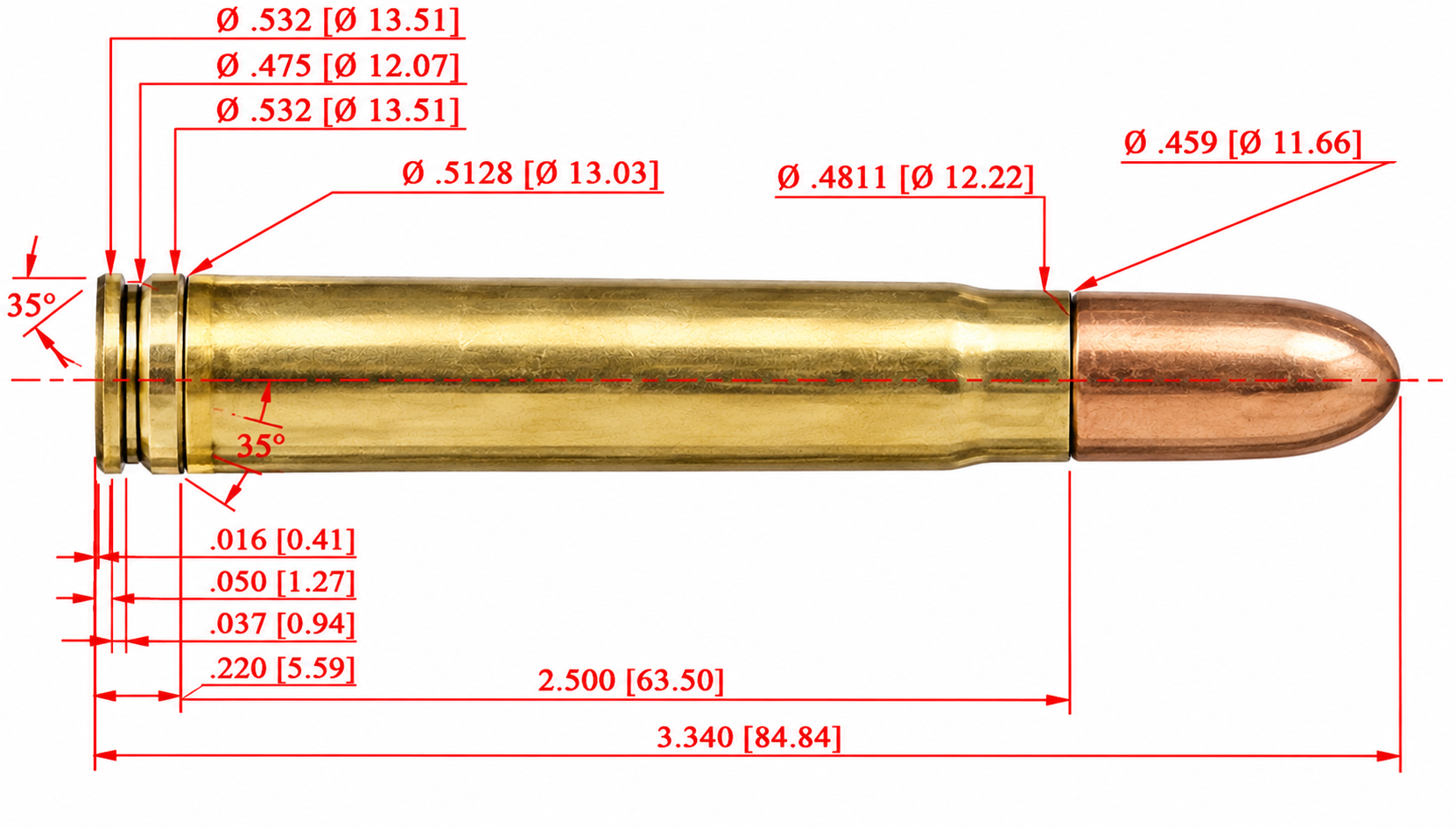
Some rifle cartridges are designed for accuracy. Others are built for speed, flat trajectories, or versatility. The .458 Winchester Magnum was created with a very different purpose in mind: delivering a heavy bullet with enough penetration to handle some of the largest and most dangerous animals on earth.
We're talking about bullets weighing around 500 grains, muzzle energy exceeding 5,000 foot-pounds, and recoil that can make even experienced shooters reconsider their definition of a powerful rifle. The .458 Magnum doesn't rely on blistering velocity to achieve its performance. Instead, it combines substantial bullet weight with a large diameter and enough speed to deliver tremendous energy at the relatively short distances associated with dangerous-game hunting.
But here's what makes this cartridge interesting. Despite its impressive numbers, the .458 Winchester Magnum has spent much of its existence defending its reputation. Early ammunition sometimes failed to deliver the advertised velocity, competitors developed more powerful alternatives, and modern hunters have access to cartridges that are easier to shoot and considerably less expensive.
Yet the .458 Winchester Magnum is still around, nearly 70 years after its introduction. It's still used for dangerous game, still supported by major ammunition manufacturers, and still capable of producing performance that most hunters will never need.
So how powerful is the .458 Magnum really? What does that power accomplish, and when does it become more of a disadvantage than a benefit?
How Powerful Is the 458 Winchester Magnum?
The traditional .458 Winchester Magnum load fires a 500-grain bullet at approximately 2,100 to 2,150 feet per second, generating roughly 4,900 to 5,130 foot-pounds of muzzle energy. That's considerably more energy than a typical .308 Winchester or .30-06 Springfield hunting load, although those cartridges were designed for very different purposes.
To put the bullet weight into perspective, a common .308 Winchester hunting load might use a 150- or 165-grain bullet. The .458 Winchester Magnum's traditional 500-grain projectile weighs approximately three times as much. It's also considerably wider, measuring .458 inch in diameter compared with the .308-inch bullet used by the .308 Winchester.
The .458 Magnum's strength comes from moving that much mass at substantial velocity. Its large bullets are designed for penetration and controlled terminal performance rather than the aerodynamic efficiency associated with modern long-range cartridges.
That distinction matters. A cartridge can produce enormous muzzle energy without being particularly well suited for long-distance shooting. The .458 Winchester Magnum is a perfect example.
Its primary purpose is dangerous-game hunting, where heavy bullets, appropriate construction, and dependable penetration are often more important than a flat trajectory.
The History Behind the 458 Magnum
Winchester introduced the .458 Winchester Magnum in 1956, during a period when American manufacturers were developing new magnum rifle cartridges for hunters who wanted more power and versatility.
The company's goal was ambitious. It wanted to provide performance comparable to established British dangerous-game cartridges, including the .450 Nitro Express and .470 Nitro Express, without requiring hunters to purchase expensive double rifles or specialized magnum-length bolt actions.
Winchester accomplished this by developing a relatively short belted cartridge based on the .375 H&H Magnum case. With a case length of 2.50 inches, the new cartridge could function in a standard-length bolt-action rifle. The Winchester Model 70 African became one of the most recognizable rifles chambered for it.
That was a significant advantage. Dangerous-game hunters could purchase a comparatively affordable repeating rifle capable of firing a heavy .458-caliber bullet, rather than investing in a much more expensive double rifle.
The original advertised performance was equally impressive. Winchester claimed a 510-grain bullet traveling at 2,150 fps, generating approximately 5,236 ft-lbs of muzzle energy. On paper, the cartridge delivered the kind of power traditionally associated with established African safari rifles.
Unfortunately, the first years of the .458 Winchester Magnum weren't entirely smooth.
The Early Problems That Nearly Ruined Its Reputation
The .458 Winchester Magnum developed a controversial reputation because some early ammunition failed to achieve the advertised velocity. The original cartridge was designed around a substantial powder charge packed into a relatively short case, and the propellants available at the time weren't always ideal for that application.
Reports of compressed powder charges, inconsistent ignition, and reduced velocities became part of the cartridge's history. Some ammunition reportedly produced velocities closer to 1,850 fps instead of the advertised 2,150 fps.
That difference might not sound dramatic until you calculate the energy.
510-Grain Bullet Energy Comparison:
1,850 fps: 3,876 ft-lbs
2,000 fps: 4,529 ft-lbs
2,150 fps: 5,236 ft-lbs
A 510-grain bullet traveling at 1,850 fps produces approximately 1,360 fewer foot-pounds of energy than the same bullet traveling at 2,150 fps. For a cartridge intended to handle large, potentially dangerous animals, that was a meaningful shortfall.
The problem wasn't that the .458 Winchester Magnum suddenly became ineffective at lower velocities. Heavy bullets can still penetrate effectively at moderate speeds, particularly when their construction is appropriate. The concern was that hunters couldn't always count on ammunition delivering the performance they had been promised.
The controversy also helped inspire the development of the .458 Lott, which uses a longer case to provide additional powder capacity.
Fortunately, modern .458 Winchester Magnum ammunition is very different from the earliest production loads. Improvements in propellants, manufacturing consistency, and bullet construction have addressed many of the original concerns.
Today's cartridge deserves to be evaluated on modern ammunition performance rather than judged entirely by problems from the 1950s and 1960s.
458 Winchester Magnum Ballistics: What Does a 500-Grain Bullet Actually Do?
The traditional 500-grain load is the best place to understand what makes the .458 Winchester Magnum so powerful.
Hornady's 500-grain DGX Bonded ammunition provides a useful factory example. This is a controlled-expansion dangerous-game bullet designed to retain its integrity while penetrating large animals.
Hornady 500-Grain DGX Bonded Ballistics:
Muzzle: 2,140 fps | 5,080 ft-lbs
100 yards: 1,995 fps | 4,420 ft-lbs
200 yards: 1,857 fps | 3,820 ft-lbs
300 yards: 1,719 fps | 3,290 ft-lbs
400 yards: 1,591 fps | 2,810 ft-lbs
500 yards: 1,467 fps | 2,390 ft-lbs
The first thing worth noticing is how much energy the bullet carries at relatively short distances. At 100 yards, the 500-grain projectile still delivers approximately 4,420 ft-lbs. Even at 200 yards, it retains roughly 3,820 ft-lbs.
But the other side of the equation is equally important. By 500 yards, the bullet has lost more than 670 fps from its original muzzle velocity. Although it still carries substantial energy, its relatively low ballistic coefficient means it sheds velocity much faster than the streamlined bullets commonly used for long-range precision shooting.
This is why the .458 Winchester Magnum shouldn't be judged by the same standards as a .300 PRC or .338 Lapua Magnum. Those cartridges emphasize aerodynamic efficiency and performance across considerable distances. The .458 Magnum was designed to deliver a heavy, large-diameter bullet with dependable terminal performance at much shorter ranges.
A 500-grain .458 bullet doesn't need to be particularly fast by modern magnum standards to generate enormous energy. Its weight does much of the work.
Does Bullet Weight Make a Difference?
Although 500-grain bullets are closely associated with the .458 Winchester Magnum, they're not the only option. Modern ammunition and component bullets are available in a variety of weights, allowing the cartridge to deliver different combinations of velocity, energy, and terminal performance.
Lighter bullets can often be driven considerably faster than traditional 500-grain projectiles. Depending on bullet design, that additional velocity can produce flatter trajectories and impressive muzzle-energy figures.
A 2025 Shooting Times article by Joseph von Benedikt examined the cartridge's modern capabilities, including several examples using lighter bullets and updated propellants.
Representative 458 Winchester Magnum Performance:
350 grains: 2,500 fps | 4,858 ft-lbs
404 grains: 2,530 fps | 5,740 ft-lbs
450 grains: 2,250 fps | 5,059 ft-lbs
500 grains: 2,165 fps | 5,205 ft-lbs
The 404-grain example is particularly interesting because it produces more muzzle energy than the traditional 500-grain load despite using a lighter bullet. That's possible because velocity plays such a significant role in kinetic energy.
However, the load with the most muzzle energy isn't automatically the most effective hunting load.
Bullet construction matters enormously with large-bore cartridges. A conventional expanding bullet, a bonded bullet, and a monolithic solid can behave very differently when they strike an animal. Some are intended to expand and transfer energy through a large wound channel, while others prioritize maintaining their shape and penetrating deeply.
Modern bullet designs have expanded what the .458 Winchester Magnum can accomplish, but choosing the appropriate bullet remains more important than simply selecting the load with the highest advertised energy.
458 Magnum Recoil: The Part Nobody Forgets
You can't talk about the .458 Winchester Magnum without discussing recoil.
A full-power .458 Magnum generates substantially more recoil than common hunting cartridges, and the difference is difficult to ignore. Even experienced shooters who are comfortable with a .30-06 or .300 Winchester Magnum may find the .458 uncomfortable, particularly during extended range sessions.
The recoil isn't surprising when you consider what's happening. The rifle is launching a projectile weighing approximately half an ounce at more than 2,000 fps, while propellant gases contribute additional rearward momentum.
Published recoil calculations help illustrate the difference.
Representative Free-Recoil Energy:
375 H&H Magnum: Approximately 37 ft-lbs
416 Rigby: Approximately 58 ft-lbs
458 Winchester Magnum: Approximately 62 ft-lbs
A separate calculation using a 500-grain bullet traveling at 2,140 fps from a 10-pound rifle produces approximately 65 ft-lbs of free-recoil energy, depending on the assumptions used.
That's a substantial amount of recoil, but there's an important distinction between calculated recoil energy and how recoil actually feels.
Rifle weight plays a major role. A heavier rifle generally moves rearward more slowly and produces less free-recoil energy when firing the same ammunition. Stock design, fit, recoil-pad construction, and the shooter's position also influence comfort.
This helps explain why some experienced shooters describe a .458 Winchester Magnum as feeling sharper than a more powerful .458 Lott, while others report the opposite. The cartridge's calculated recoil is only part of the experience.
A well-designed, heavier .458 rifle may be more comfortable than a lighter rifle firing a less powerful cartridge.
There's also a practical consequence to recoil that matters more than the numbers. Heavy recoil can make practice unpleasant and encourage flinching, which makes accurate shooting more difficult. A powerful rifle offers little advantage if the shooter cannot consistently place shots where they need to go.
For anyone considering a .458 Winchester Magnum, recoil tolerance is one of the most important factors to evaluate. The cartridge's power is impressive, but becoming comfortable with that power requires practice.
What Is the 458 Winchester Magnum Used For?
The .458 Winchester Magnum was created for dangerous-game hunting, and that remains its primary purpose.
It became particularly associated with African safaris, where hunters pursuing Cape buffalo, elephant, and other dangerous animals needed ammunition capable of penetrating substantial muscle and bone.
For Cape buffalo, controlled-expansion bullets are commonly used because they can combine deep penetration with significant tissue damage.
The important point is that these applications demand different bullet characteristics. A cartridge's diameter and energy alone don't determine whether a particular load is appropriate.
The .458 Winchester Magnum's reputation comes from its ability to launch heavy bullets designed for these demanding situations, not merely from its impressive muzzle-energy figure.
It also offers a practical advantage over some traditional safari cartridges. Because it was developed for standard-length bolt-action rifles, hunters could obtain substantial dangerous-game performance without purchasing a specialized magnum-length action or an expensive double rifle.
That accessibility was one of the reasons the cartridge became so popular.
What About Hunting in North America?
The .458 Winchester Magnum has also been used for North American animals such as brown bear, moose, and bison. Its heavy bullets and substantial penetration capabilities certainly make it powerful enough for these animals, but that doesn't necessarily mean it's the most practical choice.
A large coastal brown bear is an example where some hunters may appreciate a heavy, large-diameter bullet. Moose and bison are also substantial animals, and the cartridge has more than enough capability when loaded with an appropriate hunting bullet.
However, hunters have many other options that offer adequate performance with less recoil, lower ammunition cost, and flatter trajectories.
The .458 Magnum makes the most sense when its particular combination of bullet weight, diameter, and penetration provides a meaningful advantage, or when a hunter already owns the rifle and enjoys using it.
For ordinary North American hunting, its power is rarely a necessity.
Is the 458 Magnum Overkill for Deer and Elk?
For most deer hunting, the .458 Winchester Magnum is unquestionably more cartridge than necessary.
That doesn't mean it can't be used successfully. With appropriate ammunition and accurate shot placement, a .458 Magnum is fully capable of taking deer. But its advantages are difficult to justify when compared with smaller hunting cartridges.
A typical whitetail deer simply doesn't require the penetration capability of a cartridge developed for African dangerous game. The additional recoil, rifle weight, and ammunition expense offer little practical benefit.
Elk are much larger animals, but the same general argument still applies. Modern hunting cartridges such as the .30-06 Springfield, .300 Winchester Magnum, and numerous others can provide excellent performance on elk with considerably less recoil.
The .458 Winchester Magnum also has a relatively curved trajectory compared with modern long-range hunting cartridges. Its heavy bullets tend to lose velocity more quickly, making longer-distance shooting less convenient.
For hunters who enjoy traditional big-bore rifles, those disadvantages may be acceptable. Some simply appreciate the experience of hunting with a powerful, historically significant cartridge.
But if the question is whether a typical deer or elk hunter actually needs a .458 Winchester Magnum, the answer is no.
It's a specialized cartridge, and there's nothing wrong with recognizing that.
458 Winchester Magnum vs 458 Lott: Is More Power Always Better?
The .458 Lott is the cartridge most frequently compared with the .458 Winchester Magnum, and for good reason.
The Lott was developed partly in response to concerns about the Winchester cartridge's early ammunition performance. Its longer case provides additional powder capacity, making it easier to achieve higher velocities with heavy bullets.
A traditional comparison uses a 500-grain projectile:
458 Winchester Magnum, 500-Grain Bullet
Muzzle velocity: Approximately 2,150 fps
Muzzle energy: Approximately 5,130 ft-lbs
Case length: 2.50 inches
458 Lott, 500-Grain Bullet:
Muzzle velocity: Approximately 2,300 fps
Muzzle energy: Approximately 5,870 ft-lbs
Case length: 2.80 inches
These are representative performance levels rather than a comparison of two specific factory loads.
The Lott produces approximately 740 additional foot-pounds of muzzle energy in this example, which is a meaningful increase. But that extra performance also produces more recoil when comparable ammunition is fired from rifles of the same weight.
The Lott's greater powder capacity gives it an advantage when maximum velocity is the goal. The Winchester Magnum, meanwhile, offers substantial performance in a shorter cartridge that fits standard-length bolt actions.
Modern ammunition has also made the original Winchester cartridge considerably more capable than it was during its early years.
So which cartridge is better?
That depends on whether the additional velocity and energy provide a meaningful benefit for the intended use. If the .458 Winchester Magnum already delivers the necessary performance, the Lott's additional power may simply bring additional recoil.
And that's exactly the kind of tradeoff that makes the .458 Winchester Magnum such an interesting cartridge.
Why the 458 Winchester Magnum Still Matters
Despite its early problems and the availability of more powerful alternatives, the .458 Winchester Magnum has remained relevant for nearly seven decades.
That's an impressive achievement for a cartridge developed around such a specialized purpose.
Its longevity comes partly from its practical design. It offers serious dangerous-game performance in a relatively compact cartridge, and rifles chambered for it have historically been more accessible than many traditional safari rifles.
Modern ammunition has also expanded its capabilities. Improved propellants and bullet construction have helped address the problems that affected its early reputation, while lighter bonded and monolithic bullets provide additional options beyond traditional 500-grain loads.
The cartridge remains powerful enough for its intended role without requiring the additional case capacity of the .458 Lott.
Of course, it isn't particularly economical to own or shoot. Factory ammunition is specialized, prices are generally high compared with common hunting cartridges, and availability varies by manufacturer and bullet design.
Those differences make ammunition selection especially important. A 400-grain expanding bullet and a 500-grain solid may share the same cartridge designation, but they're designed for different applications.
Final Thoughts: How Much Power Is Too Much?
The .458 Winchester Magnum makes a strong argument that the usefulness of power depends entirely on what you're trying to accomplish.
For dangerous-game hunting, its heavy bullets, large diameter, and substantial energy are exactly what the cartridge was designed to provide. When used with appropriate ammunition, it offers the penetration and terminal performance that have made it a recognized big-bore hunting cartridge for generations.
For deer hunting, ordinary target shooting, or most North American hunting situations, the same power becomes much harder to justify. Heavy recoil, expensive ammunition, and a relatively curved trajectory make it less convenient than cartridges designed for those purposes.
And while the .458 Lott can produce even greater velocity and energy, the Winchester Magnum demonstrates that maximum power isn't always necessary.
The cartridge has survived early ammunition problems, decades of criticism, and competition from newer designs because it continues to do the job it was originally created to do.
The .458 Magnum isn't too powerful for its intended purpose. It's simply more powerful than most hunters will ever need.
That's what makes it fascinating. It isn't trying to be the fastest, flattest-shooting, or most versatile rifle cartridge available. It's a specialized tool built around a very demanding application, and nearly 70 years later, it still has a place.
Information provided by AmmoBrowser is for general informational and educational purposes only. Ammunition specifications, ballistics, performance, pricing, and availability can vary by manufacturer, load, firearm, barrel length, and other conditions. While we strive to provide accurate and current information, AmmoBrowser makes no guarantee regarding its completeness or accuracy.
Always follow firearm and ammunition manufacturer instructions, verify that ammunition is compatible with your firearm, and follow all applicable laws and safe firearm handling practices. Ballistic and recoil figures are illustrative and should not be treated as guaranteed performance in an individual firearm. Handload performance examples are not loading instructions.