
'%3e%3cpath%20d='M25.8906%2030.68L16.0006%2025L6.14062%2030.68V4.55C6.14063%203.75435%206.4567%202.99129%207.0193%202.42868C7.58191%201.86607%208.34498%201.55%209.14063%201.55H22.8906C23.6863%201.55%2024.4493%201.86607%2025.0119%202.42868C25.5746%202.99129%2025.8906%203.75435%2025.8906%204.55V30.68ZM9.14063%203.55C8.87541%203.55%208.62105%203.65536%208.43352%203.84289C8.24598%204.03043%208.14063%204.28478%208.14063%204.55V27.23L16.0006%2022.72L23.8806%2027.23V4.55C23.8806%204.28478%2023.7753%204.03043%2023.5877%203.84289C23.4002%203.65536%2023.1458%203.55%2022.8806%203.55H9.14063Z'%20fill='white'/%3e%3cpath%20d='M9.14063%202.55H22.8906C23.4211%202.55%2023.9298%202.76071%2024.3048%203.13579C24.6799%203.51086%2024.8906%204.01957%2024.8906%204.55V8.62H7.14062V4.55C7.14063%204.01957%207.35134%203.51086%207.72641%203.13579C8.10148%202.76071%208.61019%202.55%209.14063%202.55Z'%20fill='%238A3301'/%3e%3cpath%20d='M25.8906%209.62H6.14062V4.55C6.14063%203.75435%206.4567%202.99129%207.0193%202.42868C7.58191%201.86607%208.34498%201.55%209.14063%201.55H22.8906C23.6863%201.55%2024.4493%201.86607%2025.0119%202.42868C25.5746%202.99129%2025.8906%203.75435%2025.8906%204.55V9.62ZM8.14063%207.62H23.8906V4.55C23.8906%204.28478%2023.7853%204.03043%2023.5977%203.84289C23.4102%203.65536%2023.1558%203.55%2022.8906%203.55H9.14063C8.87541%203.55%208.62105%203.65536%208.43352%203.84289C8.24598%204.03043%208.14063%204.28478%208.14063%204.55V7.62Z'%20fill='white'/%3e%3cpath%20d='M16%2020.25C15.7348%2020.25%2015.4804%2020.1446%2015.2929%2019.9571C15.1054%2019.7696%2015%2019.5152%2015%2019.25V14.07C15%2013.8048%2015.1054%2013.5504%2015.2929%2013.3629C15.4804%2013.1754%2015.7348%2013.07%2016%2013.07C16.2652%2013.07%2016.5196%2013.1754%2016.7071%2013.3629C16.8946%2013.5504%2017%2013.8048%2017%2014.07V19.25C17%2019.5152%2016.8946%2019.7696%2016.7071%2019.9571C16.5196%2020.1446%2016.2652%2020.25%2016%2020.25Z'%20fill='white'/%3e%3cpath%20d='M18.5999%2017.66H13.4199C13.1547%2017.66%2012.9004%2017.5546%2012.7128%2017.3671C12.5253%2017.1796%2012.4199%2016.9252%2012.4199%2016.66C12.4199%2016.3948%2012.5253%2016.1404%2012.7128%2015.9529C12.9004%2015.7654%2013.1547%2015.66%2013.4199%2015.66H18.5999C18.8651%2015.66%2019.1195%2015.7654%2019.307%2015.9529C19.4946%2016.1404%2019.5999%2016.3948%2019.5999%2016.66C19.5999%2016.9252%2019.4946%2017.1796%2019.307%2017.3671C19.1195%2017.5546%2018.8651%2017.66%2018.5999%2017.66Z'%20fill='white'/%3e%3c/g%3e%3cdefs%3e%3cclipPath%20id='clip0_29353_35'%3e%3crect%20width='32'%20height='32'%20fill='white'/%3e%3c/clipPath%3e%3c/defs%3e%3c/svg%3e) Wishlist
Wishlist
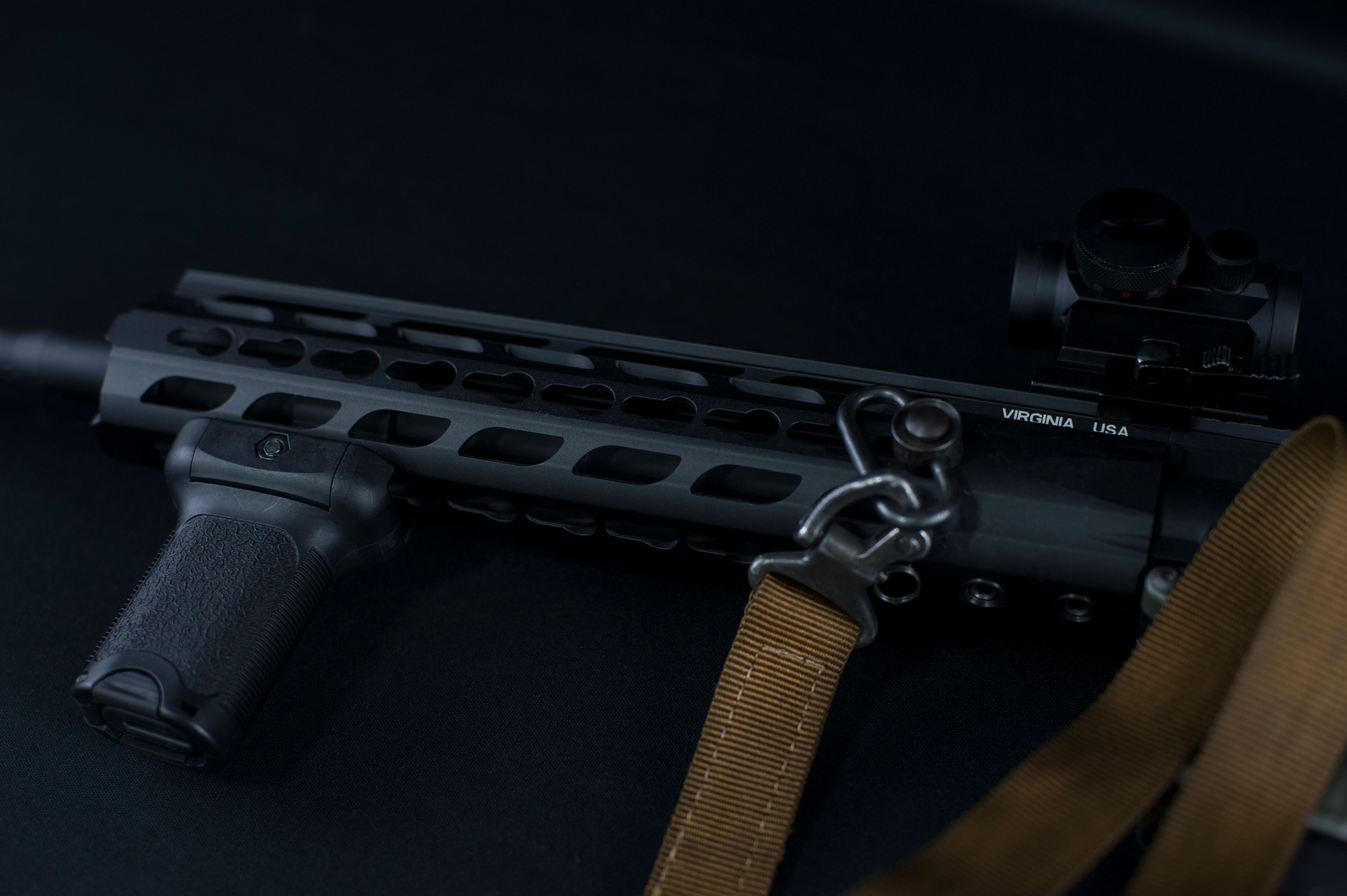
Most AR-15 cartridges are built around a familiar idea: relatively small bullets moving fast. The .50 Beowulf goes in almost the opposite direction. It puts a half-inch-diameter bullet weighing several hundred grains into the AR-15 platform, creating a rifle that looks familiar in your hands but behaves very differently once you pull the trigger.
That difference is a big part of the attraction. Alexander Arms' published data for a 300-grain FTX load from a 16-inch barrel lists a muzzle velocity of 1,793 fps and muzzle energy of about 2,141 ft-lbs. At 50 yards, that same load is listed at roughly 1,619 fps and 1,745 ft-lbs. Those aren't numbers you'd normally associate with an AR-15 chambered in a small, high-velocity cartridge.
But raw power isn't enough to explain why people buy .50 Beowulf. It also comes with significant compromises. Ammunition can be expensive and harder to find than mainstream rifle rounds.
Recoil is considerably more noticeable than 5.56. Magazine capacity is lower, and the trajectory becomes increasingly arched as distances stretch out. One of the most popular responses in an AR-15 owner discussion essentially summed up the contradiction: the cartridge can be impractical and expensive while still being extraordinarily enjoyable to shoot.
That's what makes .50 Beowulf worth examining. It isn't simply an oversized novelty, and it isn't a do everything rifle cartridge either. It occupies a much more interesting place between the two.
Quick Answer: What Is .50 Beowulf Good For?
The .50 Beowulf is best understood as a big-bore, short-to-moderate-range cartridge for the AR-15 platform. Hunting is one of its clearest practical applications, especially when a large, heavy projectile is desirable, and Alexander Arms promotes the cartridge for hunting and large-animal protection. It's also popular with shooters who simply want a dramatically different AR experience.
What it doesn't offer is equally important. This isn't the cartridge to choose because you want inexpensive practice ammunition, minimal recoil, high magazine capacity or a flat trajectory for long-range shooting.
In other words, .50 Beowulf gives you an enormous projectile from a relatively compact AR platform, but that comes at the expense of ammunition cost, recoil, capacity and trajectory.
What Makes .50 Beowulf So Different?
The .50 Beowulf was developed by Alexander Arms as a big-bore cartridge for the AR-15. Its .500-inch bullet diameter immediately separates it from the cartridges most people associate with that platform, but bullet weight makes the difference even easier to appreciate.
Consider a typical 5.56 cartridge using a 55-, 62- or 77-grain projectile. With .50 Beowulf, bullets weighing several hundred grains are normal. Alexander Arms publishes ballistic information for 300- and 400-grain loads, among others. Rather than depending primarily on high velocity, the Beowulf combines tremendous projectile mass with a very large frontal diameter.
That changes the character of the rifle. The concept has more in common with traditional big-bore cartridges than it does with a conventional 5.56 AR, yet it remains packaged around the AR-15 platform. For shooters who like the ergonomics and familiarity of an AR but want something much larger at the other end of the barrel, that's a compelling combination.
How Much Power Does .50 Beowulf Really Have?
It's easy to get carried away with ballistic numbers here, so the useful ones are fairly simple.
Alexander Arms lists its 300-grain FTX load at 1,793 fps from a 16-inch barrel, producing approximately 2,141 ft-lbs of energy at the muzzle. At 50 yards, the manufacturer's data lists about 1,619 fps and 1,745 ft-lbs.
Those figures make it clear that this isn't merely a giant bullet stuffed into an AR for entertainment. There is substantial performance behind it.
At the same time, muzzle energy shouldn't be treated as a universal score for ranking cartridges. The Beowulf's defining characteristic is the combination of considerable energy with a very large, very heavy projectile moving at moderate velocity. That produces a completely different ballistic profile from smaller, faster rifle cartridges.
This distinction becomes particularly important when people ask one of the questions Google is showing for .50 Beowulf: is it stronger than .308?
There isn't a clean yes-or-no answer because "stronger" doesn't tell us enough. .50 Beowulf fires a much larger and heavier projectile at lower velocity. .308 Winchester typically launches a considerably lighter bullet at much greater velocity and maintains a far flatter trajectory as distance increases. They're cartridges built around different strengths rather than direct substitutes for one another.
.50 Beowulf vs. 5.56: Is the Beowulf Really That Much More Powerful?
If we're talking about bullet diameter, projectile weight and close-range energy, there's an enormous difference between the two.
That doesn't mean .50 Beowulf is somehow a superior replacement for 5.56.
For most of the things people regularly do with an AR, 5.56 has tremendous advantages. Recoil is lighter, ammunition is much less expensive, capacity is greater, availability is better, and the trajectory is substantially flatter. You can spend a long afternoon practicing with 5.56 without feeling like every trigger pull needs to be entered into the household budget.
The Beowulf makes sense for a different reason. Instead of asking how efficiently you can put lots of rounds downrange, you're asking how much projectile you can send from an AR-15-sized platform.
If your priority is high-volume recreational shooting, 5.56 wins easily. If you're specifically looking for a big-bore AR with a heavy projectile for an appropriate hunting application or simply because you want something dramatically different the Beowulf becomes much more interesting.
What Does Shooting a .50 Beowulf Feel Like?
This is one of those cartridges where a ballistic chart can only tell half the story.
Fire a .50 Beowulf after spending the day shooting 5.56 and nobody is going to have to tell you which rifle you just picked up. The recoil and blast are substantially more noticeable, and every shot feels more consequential. For some owners, that's precisely the point.
It's also important not to confuse the ".50" in .50 Beowulf with .50 BMG. Sharing a nominal bullet diameter does not make the cartridges remotely equivalent. They're dramatically different in cartridge dimensions, firearms and performance.
What's more revealing is the way actual owners talk about the Beowulf. In the discussion you found, shooters openly criticized ammunition expense, limited capacity and performance at extended distances while also describing the rifle as exceptionally fun. Another owner discussion similarly characterized big-bore ARs as something people sometimes buy simply because they want one rather than because they've identified a job that absolutely requires it.
That sentiment tells us something useful. A large percentage of Beowulf buyers probably aren't sitting down with a spreadsheet and determining that it is objectively the most efficient cartridge available.
They want a big-bore AR.
There's nothing wrong with that, especially because the cartridge has enough genuine capability that the fun doesn't have to be its only justification.
Where .50 Beowulf Makes Sense for Hunting
Hunting is probably the easiest place to make a practical argument for .50 Beowulf. Sending a very large projectile weighing several hundred grains at moderate velocity can be useful when hunting game at appropriate distances, and Alexander Arms specifically promotes the cartridge for hunting.
The manufacturer's 300-grain FTX data helps put its capabilities in perspective. Using a 16-inch barrel and a 10-inch vital zone for deer, Alexander Arms calculates a 205-yard maximum point-blank range under its stated conditions. That doesn't mean every hunter should consider 205 yards an automatic hunting distance, but it does show why describing the Beowulf as nothing more than a 50- or 100-yard cartridge is too simplistic.
The important part is that .50 Beowulf still isn't a conventional long-range hunting cartridge. Its lower velocity and relatively modest ballistic coefficient mean trajectory becomes increasingly important as distance increases. In open country where long shots are common, plenty of flatter-shooting cartridges make more sense.
Put that same cartridge in woods or other environments where shots are normally closer, however, and its strengths line up much better with the job.
Hunters should also remember that ballistic suitability and legal suitability aren't the same thing. Regulations vary by state, hunting area, season and species. Always verify current local hunting rules rather than assuming .50 Beowulf is legal simply because it is powerful enough for the game being pursued.
What Is the Practical Range of .50 Beowulf?
"Range" is another place where discussions about this cartridge can get misleading.
A bullet can physically travel much farther than the distance at which a particular shooter, rifle and load make sense for a particular application. So asking how far a .50 Beowulf bullet can fly isn't nearly as useful as asking where its trajectory and retained performance remain appropriate for what you're doing.
Alexander Arms' 300-grain FTX data demonstrates the difference nicely. With the manufacturer's deer-sized 10-inch vital-zone calculation, maximum point-blank range is 205 yards. The company calculates longer maximum point-blank ranges when using the larger vital zones associated with bigger game, which is why a single "effective range" number doesn't tell the whole story.
And trajectory becomes increasingly dramatic beyond those moderate distances. Alexander Arms' 200-yard-zero data for the same 300-grain load shows approximately 31.1 inches of drop by 300 yards under the conditions used for its chart.
So the simple takeaway for someone shopping for a Beowulf is this:
Think of it primarily as a short-to-moderate-range big-bore cartridge, not as a long-range rifle round.
.50 Beowulf Ammo: The Part of Ownership You Should Consider Before Buying the Rifle
A big-bore rifle isn't particularly useful without ammunition, and this is one area where .50 Beowulf ownership looks very different from owning a 5.56, 9mm or .308.
Availability isn't nearly as broad, and ammunition is generally expensive enough that the cost per shot becomes something you'll notice. Owners repeatedly mention ammunition cost and availability when discussing the drawbacks of the cartridge.
Load selection matters too. You're likely to encounter bullets weighing several hundred grains, and a heavier number printed on the box doesn't automatically mean it's the best ammunition for your purpose. Bullet construction, intended use and reliable function all matter.
For recreational range use, the priorities may be price and dependable operation. For hunting, projectile construction and suitability for the game you're pursuing become much more important. That's why .50 Beowulf is a cartridge where it makes sense to look at ammunition availability before buying the rifle rather than treating ammo as an afterthought.
The Biggest Everyday Drawback: Cost
The rifle may get you into .50 Beowulf, but ammunition determines how often you're going to shoot it.
This isn't an obvious choice for someone who wants to spend every weekend burning through hundreds of inexpensive rounds. Even shooters who enjoy the cartridge frequently identify ammunition expense as one of the downsides.
That matters differently depending on why you own the rifle. A hunter doesn't necessarily need to fire hundreds of rounds every month for a hunting rifle to remain useful. Someone buying primarily for frequent recreational range sessions may care about cost per round a great deal more.
It leads to a better question than simply asking whether .50 Beowulf is "good."
Does .50 Beowulf fit the way you're actually going to use the rifle?
For some shooters, absolutely. For others, ammunition cost alone could make a more common cartridge the better choice.
Yes, the Recoil Is Noticeable
Anyone moving from a normal 5.56 AR to .50 Beowulf should expect a significant change.
You're launching a projectile weighing several hundred grains, and the shooting experience reflects that. Perceived recoil can vary with the particular rifle, ammunition, muzzle device, stock, rifle weight and shooting position, so there isn't one universal description that applies to every Beowulf.
Alexander Arms describes Beowulf recoil as relatively mild when comparing it with traditional big-bore cartridges offering similar performance. That's useful context, but it's important to interpret the comparison correctly. "Mild for a big bore" doesn't mean "feels like 5.56."
For shooters who enjoy big-bore rifles, that extra recoil may actually be part of the attraction. Someone who is particularly recoil-sensitive would be better served by trying one before buying if that opportunity is available.
What About Accuracy?
There's no reason a .50 Beowulf can't provide useful accuracy within the kinds of distances for which it is intended. As with any cartridge, results depend on the rifle, ammunition and shooter.
The bigger issue isn't whether the cartridge can group shots. It's understanding its trajectory.
As distance increases, the bullet's drop becomes much more significant than it would with a flatter-shooting high-velocity cartridge. A mechanically accurate rifle won't compensate for a shooter misjudging distance or failing to account for trajectory.
For hunting and recreational shooting at sensible distances, that's manageable. For someone whose main goal is building a long-range precision AR, there are far more natural cartridge choices.
Is .50 Beowulf Mostly About Having Fun?
There are two easy ways to get this cartridge wrong.
One is to dismiss it as nothing but a novelty. That ignores the fact that it fires extremely heavy, large-diameter bullets with substantial energy and has legitimate hunting applications.
The other is to pretend that everyone buying a Beowulf has some highly specialized practical requirement for it.
Owner discussions make it pretty clear that enjoyment is a major part of the cartridge's appeal. Shooters will criticize its cost, capacity and trajectory and then tell you how much they enjoy firing it.
That isn't really a contradiction.
Not every firearm purchase has to be the objectively most efficient solution available. Sometimes people want something unusual because the shooting experience itself is part of the reason they go to the range. The Beowulf simply has the advantage of combining that entertainment value with enough real capability that it can also serve a serious purpose.
So, Does .50 Beowulf Actually Make Sense?
For the right shooter, yes.
Someone who hunts at appropriate distances and wants a large-bore cartridge in an AR-15-sized package has a legitimate reason to consider it. So does the shooter who specifically wants a big-bore AR and accepts the costs and limitations that come with it.
But if your priorities are low recoil, cheap ammunition, high capacity and versatility across a wide range of distances, the argument becomes much harder to make.
That's really the Beowulf bargain. You give up some of the qualities that make ordinary AR cartridges so convenient in exchange for a very large, very heavy projectile from a familiar semiautomatic platform.
If that's what you're looking for, .50 Beowulf suddenly stops looking ridiculous and starts looking pretty interesting.
Frequently Asked Questions
What is a .50 Beowulf good for?
The .50 Beowulf is particularly suited to applications at short-to-moderate distances where a large, heavy projectile is useful. Hunting is one of its main practical applications, and recreational shooters also choose it specifically for the big-bore AR experience. Alexander Arms promotes the cartridge for hunting and large-animal protection.
Is .50 Beowulf stronger than 5.56?
If "stronger" refers to bullet diameter, projectile weight and close-range energy, .50 Beowulf is in a completely different class. That doesn't make it better at everything. 5.56 offers lower recoil, less expensive ammunition, higher capacity and a flatter trajectory.
Is .50 Beowulf stronger than .308?
There isn't a useful universal yes-or-no answer. The Beowulf launches a much larger and heavier projectile at lower velocity, while .308 Winchester generally provides much greater velocity and a better longer-range trajectory. The better cartridge depends on the job.
How heavy are .50 Beowulf bullets?
Several-hundred-grain projectiles are normal for the cartridge. Alexander Arms publishes data for both 300- and 400-grain loads, among others.
Is .50 Beowulf a long-range cartridge?
Long-range shooting isn't its primary strength. Its large, relatively slow projectile has a more arcing trajectory than conventional high-velocity rifle cartridges, making the Beowulf much more naturally suited to short-to-moderate distances.
Is .50 Beowulf the same thing as .50 BMG?
No. The cartridges are completely different. Both use approximately half-inch-diameter projectiles, but .50 BMG is vastly larger and belongs to an entirely different category of firearm and ballistic performance. The cartridges are not interchangeable.
Final Verdict
The easiest way to misunderstand .50 Beowulf is to judge it by the same standards you'd use for an ordinary AR cartridge.
If cheap ammunition is the goal, it loses. If you want minimal recoil, it loses again. If you want a flat-shooting cartridge for longer distances or maximum magazine capacity, there are clearly better choices.
But those aren't the reasons .50 Beowulf exists.
Its appeal is that it takes the familiar AR-15 concept and pushes it in a completely different direction. Instead of small bullets and high velocity, you get an enormous projectile with substantial short-range performance. That gives the cartridge legitimate hunting capability while also creating a shooting experience unlike a conventional AR.
It won't make sense for everyone, and it doesn't need to.
For the shooter who specifically wants a big-bore AR and understands what comes with it, .50 Beowulf remains a very hard cartridge to ignore.
Disclaimer
Information provided by AmmoBrowser is for general informational and educational purposes only. Ammunition specifications and performance can vary by manufacturer, load, firearm, barrel length, environmental conditions and other factors. Always verify ammunition compatibility with your firearm, follow the firearm and ammunition manufacturer's instructions, observe safe firearm-handling practices, and check current laws and hunting regulations applicable to your location.