
'%3e%3cpath%20d='M25.8906%2030.68L16.0006%2025L6.14062%2030.68V4.55C6.14063%203.75435%206.4567%202.99129%207.0193%202.42868C7.58191%201.86607%208.34498%201.55%209.14063%201.55H22.8906C23.6863%201.55%2024.4493%201.86607%2025.0119%202.42868C25.5746%202.99129%2025.8906%203.75435%2025.8906%204.55V30.68ZM9.14063%203.55C8.87541%203.55%208.62105%203.65536%208.43352%203.84289C8.24598%204.03043%208.14063%204.28478%208.14063%204.55V27.23L16.0006%2022.72L23.8806%2027.23V4.55C23.8806%204.28478%2023.7753%204.03043%2023.5877%203.84289C23.4002%203.65536%2023.1458%203.55%2022.8806%203.55H9.14063Z'%20fill='white'/%3e%3cpath%20d='M9.14063%202.55H22.8906C23.4211%202.55%2023.9298%202.76071%2024.3048%203.13579C24.6799%203.51086%2024.8906%204.01957%2024.8906%204.55V8.62H7.14062V4.55C7.14063%204.01957%207.35134%203.51086%207.72641%203.13579C8.10148%202.76071%208.61019%202.55%209.14063%202.55Z'%20fill='%238A3301'/%3e%3cpath%20d='M25.8906%209.62H6.14062V4.55C6.14063%203.75435%206.4567%202.99129%207.0193%202.42868C7.58191%201.86607%208.34498%201.55%209.14063%201.55H22.8906C23.6863%201.55%2024.4493%201.86607%2025.0119%202.42868C25.5746%202.99129%2025.8906%203.75435%2025.8906%204.55V9.62ZM8.14063%207.62H23.8906V4.55C23.8906%204.28478%2023.7853%204.03043%2023.5977%203.84289C23.4102%203.65536%2023.1558%203.55%2022.8906%203.55H9.14063C8.87541%203.55%208.62105%203.65536%208.43352%203.84289C8.24598%204.03043%208.14063%204.28478%208.14063%204.55V7.62Z'%20fill='white'/%3e%3cpath%20d='M16%2020.25C15.7348%2020.25%2015.4804%2020.1446%2015.2929%2019.9571C15.1054%2019.7696%2015%2019.5152%2015%2019.25V14.07C15%2013.8048%2015.1054%2013.5504%2015.2929%2013.3629C15.4804%2013.1754%2015.7348%2013.07%2016%2013.07C16.2652%2013.07%2016.5196%2013.1754%2016.7071%2013.3629C16.8946%2013.5504%2017%2013.8048%2017%2014.07V19.25C17%2019.5152%2016.8946%2019.7696%2016.7071%2019.9571C16.5196%2020.1446%2016.2652%2020.25%2016%2020.25Z'%20fill='white'/%3e%3cpath%20d='M18.5999%2017.66H13.4199C13.1547%2017.66%2012.9004%2017.5546%2012.7128%2017.3671C12.5253%2017.1796%2012.4199%2016.9252%2012.4199%2016.66C12.4199%2016.3948%2012.5253%2016.1404%2012.7128%2015.9529C12.9004%2015.7654%2013.1547%2015.66%2013.4199%2015.66H18.5999C18.8651%2015.66%2019.1195%2015.7654%2019.307%2015.9529C19.4946%2016.1404%2019.5999%2016.3948%2019.5999%2016.66C19.5999%2016.9252%2019.4946%2017.1796%2019.307%2017.3671C19.1195%2017.5546%2018.8651%2017.66%2018.5999%2017.66Z'%20fill='white'/%3e%3c/g%3e%3cdefs%3e%3cclipPath%20id='clip0_29353_35'%3e%3crect%20width='32'%20height='32'%20fill='white'/%3e%3c/clipPath%3e%3c/defs%3e%3c/svg%3e) Wishlist
Wishlist
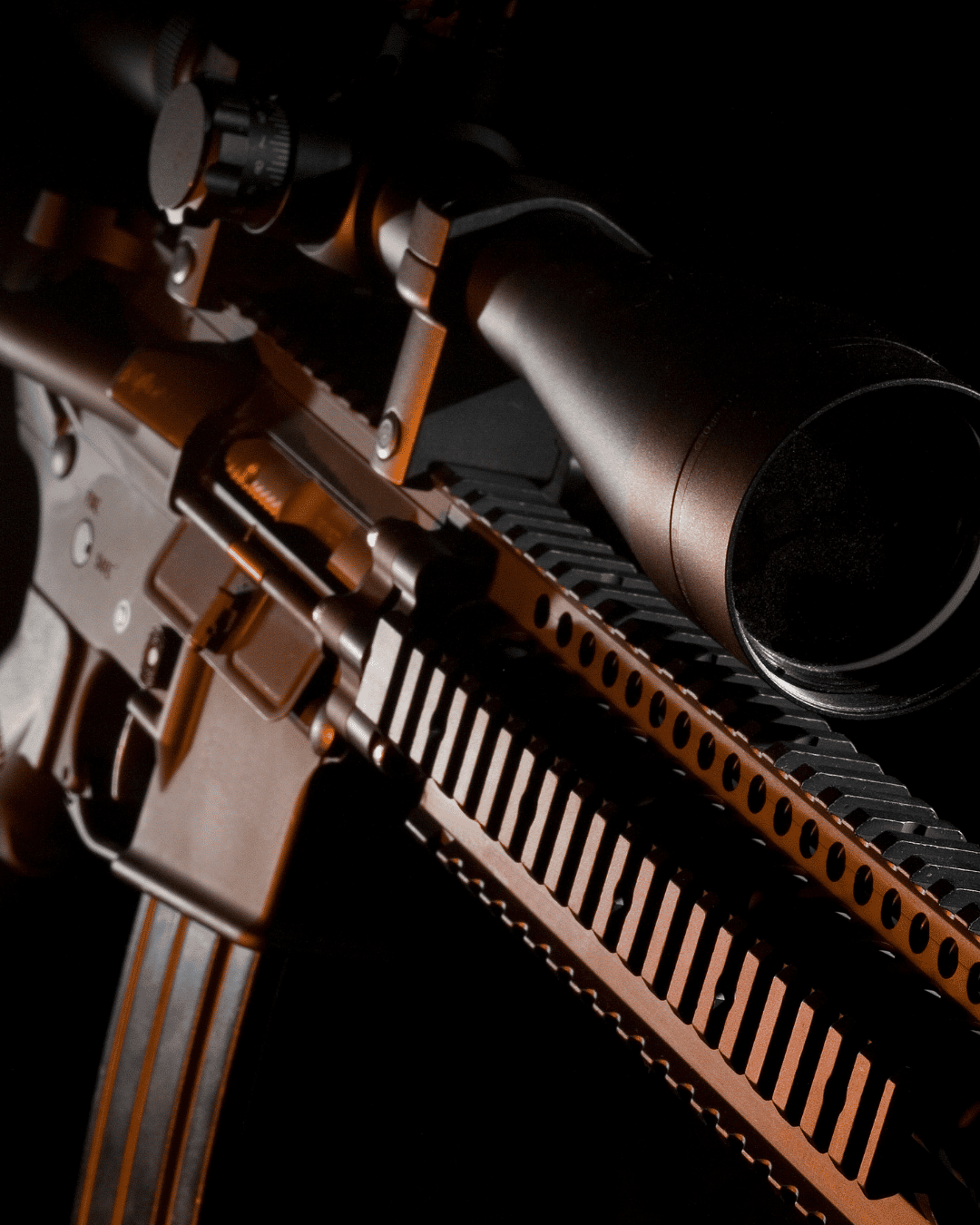
Put .50 Beowulf and .458 SOCOM next to a typical 5.56 cartridge and there's no mistaking what you're looking at.
These are big-bore AR cartridges.
Both were developed around the idea of putting a dramatically larger, heavier projectile into the AR-15 platform. Both can generate more than 2,000 ft-lbs of muzzle energy with certain loads. Both develop substantial recoil. Both lose velocity relatively quickly compared with flatter-shooting rifle cartridges. And neither is something most shooters choose because they want cheap ammunition for a Saturday afternoon at the range.
That makes .50 Beowulf vs .458 SOCOM look like a straightforward contest.
The .50 Beowulf has the bigger bullet, so surely it's the more powerful cartridge.
Not necessarily.
Once you get past the enormous projectile diameters and impressive muzzle-energy numbers, these cartridges are much closer than their names suggest. In one multi-load comparison, .50 Beowulf started with considerably more average muzzle energy, but the advantage had almost disappeared by 200 yards. The .458 SOCOM loads also showed slightly better average ballistic coefficients and retained velocity well enough to erase much of the Beowulf's initial advantage.
And that's where this comparison gets interesting.
Choosing between .458 SOCOM and .50 Beowulf is less about finding the cartridge with the biggest number and more about deciding what kind of big-bore AR you actually want.
Quick Answer
.458 SOCOM is probably the more versatile choice for most shooters specifically looking for a big-bore AR, while .50 Beowulf makes sense for someone who wants maximum big-bore character and likes the idea of firing a true .50-caliber projectile from an AR-15-sized platform.
Ballistically, they're remarkably close.
.50 Beowulf uses a larger .500-inch projectile, compared with the .458-inch projectile used by .458 SOCOM. Representative .50 Beowulf loads can produce more muzzle energy, but that advantage isn't universal and tends to shrink as distance increases. Sniper Country's multi-load averages put muzzle energy at 2,467 ft-lbs for .50 Beowulf versus 2,064 for .458 SOCOM, but by 200 yards the averages were essentially identical: 1,052 versus 1,056 ft-lbs.
Where .458 SOCOM becomes particularly attractive is ammunition and projectile versatility. The enormous ecosystem of .458-inch rifle bullets gives the cartridge options spanning relatively light supersonic ammunition through extremely heavy subsonic loads.
.50 Beowulf counters with an enormous projectile, impressive close-range energy and an experience that's difficult to duplicate.
If the only question is “Which one hits harder?”, the answer depends heavily on the ammunition.
If the question is “Which one would we choose as the more versatile cartridge?”, we'd lean toward .458 SOCOM.
.50 Beowulf and .458 SOCOM Were Built Around the Same Big Idea
These cartridges have different histories, but they ultimately attack a similar problem.
How do you get dramatically more projectile mass and short-range power out of an AR-15-sized rifle?
The answer wasn't simply to increase velocity.
It was to make the bullet enormous.
.458 SOCOM emerged in the early 2000s and was designed around a .458-inch-diameter projectile. Its development is commonly associated with a desire for greater terminal effectiveness than 5.56 while retaining the basic dimensions and familiarity of the AR platform.
.50 Beowulf arrived from Alexander Arms around the same period and took the concept even further in projectile diameter, using a .500-inch bullet.
Both cartridges consequently look almost comical beside 5.56.
But neither requires moving all the way up to the substantially larger AR-10 platform.
That's their shared appeal.
You get a much bigger bullet while staying within the basic AR-15 envelope.
The cartridges simply go about accomplishing that goal differently.
The Biggest Difference Is Right in the Name
The obvious distinction is projectile diameter.
.458 SOCOM — .458 inch
.50 Beowulf — .500 inch
That makes .50 Beowulf a legitimate .50-caliber cartridge, which admittedly accounts for some of its appeal.
There's something inherently ridiculous—in a fun way—about telling someone that the AR you're holding fires a .50-cal.
But don't confuse bullet diameter with overall power.
.50 BMG is also a .50-caliber cartridge.
.50 Beowulf is absolutely nothing like .50 BMG.
The Beowulf's case is dramatically smaller and operates within an entirely different firearm platform and performance envelope.
Likewise, a .500-inch projectile doesn't automatically mean .50 Beowulf dramatically outperforms .458 SOCOM.
Velocity, bullet weight, projectile design and ballistic efficiency all matter.
And once we examine those things, the gap gets surprisingly small.
.458 SOCOM vs .50 Beowulf Ballistics: Much Closer Than You'd Think
This is where we need to resist cherry-picking one factory load.
You can easily find a .50 Beowulf load that produces more energy than a particular .458 SOCOM load.
You can also find different ammunition that makes the comparison considerably closer.
Sniper Country attempted to address this by averaging several factory loads rather than basing its comparison on one cartridge from each caliber.
Its average muzzle velocities were:
.458 SOCOM — 1,807 fps
.50 Beowulf — 1,834 fps
At 100 yards:
.458 SOCOM — 1,498 fps
.50 Beowulf — 1,448 fps
At 200 yards:
.458 SOCOM — 1,248 fps
.50 Beowulf — 1,177 fps
The Beowulf started slightly faster in that sample, but .458 SOCOM moved ahead as distance increased.
Energy told a similar story.
At the muzzle, .50 Beowulf held a substantial advantage:
.458 SOCOM — 2,064 ft-lbs
.50 Beowulf — 2,467 ft-lbs
At 100 yards:
.458 SOCOM — 1,462 ft-lbs
.50 Beowulf — 1,570 ft-lbs
And then at 200 yards:
.458 SOCOM — 1,056 ft-lbs
.50 Beowulf — 1,052 ft-lbs
Virtually identical.
Bear Creek Arsenal reaches essentially the same broader conclusion from its own comparison: the cartridges are ballistically similar enough that the practical differences between them may matter more than a relatively small energy advantage from a particular load.
That's the takeaway I'd remember.
.50 Beowulf can hit harder at the muzzle with comparable ammunition. That doesn't mean it completely outclasses .458 SOCOM.
Neither Cartridge Was Made for Long-Range Shooting
If your priority is a flat trajectory at several hundred yards, I'd choose neither.
These are enormous projectiles traveling at relatively modest rifle velocities.
Gravity eventually wins that argument rather convincingly.
Sniper Country's averaged trajectory data illustrates just how similar the two cartridges are:
At 150 yards, average drop was approximately 5.5 inches for .458 SOCOM and 5 inches for .50 Beowulf.
At 200 yards, it increased to 14.2 inches and 15 inches respectively.
At 300 yards, average drop reached approximately 50.8 inches for .458 SOCOM and 54.4 inches for .50 Beowulf.
Those numbers shouldn't be treated as trajectory predictions for every box of ammunition. Different bullet weights, ballistic coefficients, muzzle velocities, barrels and zero distances can produce very different results.
They're useful because they demonstrate the larger point:
Neither cartridge gives you a meaningful long-range advantage over the other.
.458 SOCOM can have a slight ballistic edge as distance increases with certain loads.
But if you're choosing between these cartridges because you're worried about performance at 500 yards, you're choosing between the wrong cartridges.
Both make far more sense at shorter distances.
.458 SOCOM Has an Advantage in Bullet Selection
Here's where I think .458 SOCOM begins to separate itself.
The cartridge uses .458-inch projectiles, and that diameter has existed in the rifle world for a very long time.
Think .45-70 Government.
That gives .458 SOCOM access to a mature projectile ecosystem with bullets designed around very different purposes.
Factory .458 SOCOM ammunition can consequently span a huge range from relatively lighter supersonic ammunition around 250–300 grains through 400-grain territory and into extremely heavy 500-grain subsonic loads.
That versatility matters.
A hunter might want an expanding projectile optimized for the impact velocities .458 SOCOM produces.
Someone interested in subsonic shooting has completely different priorities.
And someone who simply wants a big-bore range rifle may prioritize price.
.50 Beowulf also offers multiple bullet weights and load types, but its .500-inch projectile doesn't have quite the same broad rifle-bullet ecosystem behind it.
That distinction comes up repeatedly in owner discussions. Shooters who load their own ammunition frequently cite .458 SOCOM's projectile selection as one reason they chose it over Beowulf.
We shouldn't exaggerate that into saying .50 Beowulf has no ammunition choices.
It does.
.458 SOCOM simply gives shooters a particularly broad spectrum of possibilities.
What About Subsonic Ammo?
This strengthens the .458 SOCOM argument.
Heavy .458 SOCOM ammunition can be loaded at subsonic velocities, with 500-grain loads being one example. Sniper Country actually excluded a 500-grain subsonic .458 SOCOM load from some of its ballistic averages because its radically different velocity would distort the comparison.
That tells you something about how broad the cartridge's performance envelope is.
One .458 SOCOM rifle can potentially be fed relatively light supersonic ammunition or extremely heavy subsonic ammunition, assuming the firearm and ammunition are appropriately matched.
.50 Beowulf can also operate with heavy projectiles, but .458 SOCOM has developed a particularly strong identity around this versatility.
For shooters who care about having a wide variety of bullet weights and performance characteristics, that's a meaningful advantage for .458 SOCOM.
Does .50 Beowulf Recoil More?
Generally, you're signing up for substantial recoil with either cartridge.
This isn't 5.56.
Sniper Country's calculated examples using comparable firearm weight and assumptions put its selected loads roughly in the mid-20s through low-30s ft-lbs of recoil energy, with the .50 Beowulf examples generally producing somewhat more recoil than the .458 SOCOM examples.
But I'd be cautious about declaring one cartridge universally softer.
Perceived recoil depends heavily on the actual ammunition, firearm weight, stock, muzzle device and shooter.
A heavy rifle firing one .458 SOCOM load may feel very different from a lightweight rifle firing a hot Beowulf load.
The more useful conclusion is:
Both are serious steps up from conventional AR recoil, and .50 Beowulf can be the harder kicker with comparable loads.
If minimizing recoil is a major priority, neither cartridge is particularly logical.
Hunting: Is .458 SOCOM or .50 Beowulf Better?
This is probably closer than fans of either cartridge want to admit.
Both have been used for hunting.
Both can fire expanding projectiles.
Both can produce considerable short-range energy.
And both are particularly attractive where a compact, semi-automatic rifle and heavy projectile make sense.
Hogs are an obvious application.
Deer and other medium game can also fall within their capabilities when appropriate ammunition is used and local regulations allow it.
What I wouldn't do is turn muzzle energy into a list of animals each cartridge supposedly guarantees you can ethically harvest.
Hunting performance depends on projectile construction, impact velocity, penetration, expansion, shot placement, distance and the animal itself.
With the right ammunition at appropriate distances, both cartridges are serious hunting rounds.
If I were choosing specifically for hunting, however, I'd give .458 SOCOM a modest advantage because of its broader projectile selection and slightly better ballistic characteristics with some loads.
That doesn't mean Beowulf is incapable.
Far from it.
.50 Beowulf Wins the Cool-Factor Contest
We might as well acknowledge this.
It's a .50-caliber AR.
For some buyers, that's almost the entire sales pitch.
There's no spreadsheet formula for it.
You don't need to pretend every firearm purchase is an optimization exercise where velocity, ballistic coefficient, ammunition cost and recoil receive carefully weighted scores.
Sometimes someone wants to go to the range, pull out a magazine filled with enormous cartridges and say:
“Yeah, it's a .50.”
Owner discussions make it pretty clear that this matters. One Beowulf owner described choosing the cartridge after getting tired of conventional 5.56/.223 ARs, while simultaneously admitting ammunition cost kept the rifles from being shot as often as they'd like.
That's basically .50 Beowulf ownership summarized in one experience.
It's excessive.
It's expensive.
It's impractical for a lot of shooters.
And that's precisely why some people love it.
Ammo Cost and Availability Matter More Than You Think
This may ultimately matter more than 100 ft-lbs of energy one way or another.
Neither cartridge has anything approaching the enormous retail ecosystem of 5.56.
Owner discussions repeatedly complain about the price and availability of big-bore AR ammunition, and people considering .458 SOCOM or .50 Beowulf frequently cite those issues as major factors in their decision.
That affects how much you'll actually shoot.
A rifle can have spectacular ballistics, but if ammunition is expensive enough that you hesitate every time you load a magazine, that's part of the ownership experience.
Factory selection also varies.
One retailer might have several .458 SOCOM options but almost no Beowulf.
Another may have exactly the opposite.
And local availability can be considerably worse than what you'll find online.
That's particularly important for someone who doesn't load their own ammunition.
Shopping for either cartridge?
What About the AR-15 Platform?
Both cartridges were designed around using the AR-15 platform, but this needs the same clarification we've included in our standalone guides:
Neither cartridge is interchangeable with 5.56 simply because all three can be used in AR-15-pattern firearms.
A firearm must be specifically and correctly chambered and configured for the ammunition being fired.
There are also differences between the cartridges themselves. .458 SOCOM uses a bottlenecked case with a relatively subtle shoulder, while .50 Beowulf uses a much straighter case profile and a rebated rim.
Magazine and feeding considerations can also vary depending on the firearm and manufacturer.
We're intentionally not going to turn this article into instructions for converting or assembling a rifle. If you're buying or configuring a big-bore AR, follow the specifications and compatibility guidance provided by the firearm and component manufacturers.
Safety & Compatibility Note
This section is for general informational purposes only and is not intended as firearm modification or assembly instructions. Do not attempt to convert, modify, assemble, or fire an AR-platform firearm based solely on the information in this article. Always use components and ammunition specifically designed and approved for your firearm, follow the firearm and component manufacturers' instructions, and have questions about compatibility, installation or safe operation addressed by a qualified gunsmith or the manufacturer. Never fire .458 SOCOM or .50 Beowulf ammunition in a firearm that is not specifically chambered and approved for that cartridge.
.458 SOCOM vs .50 Beowulf: Which Would We Choose?
If I had to pick one without knowing anything else about the shooter, I'd choose .458 SOCOM.
Not because it dramatically outperforms .50 Beowulf.
It doesn't.
That's actually one of the biggest conclusions from researching this comparison.
The ballistic differences are surprisingly small. .50 Beowulf can start with more muzzle energy, but that advantage shrinks with distance. Average trajectory differences in the data we examined were tiny at normal big-bore AR distances. Both hit hard. Both recoil substantially. Both become increasingly difficult to use as distance grows.
I'd choose .458 SOCOM because of versatility.
The .458-inch projectile ecosystem gives it an enormous range of bullet possibilities. Factory ammunition spans dramatically different weights. Heavy subsonic ammunition adds another dimension to the cartridge. Hunting bullets are available. And it can deliver essentially the same type of big-bore AR performance that makes Beowulf appealing.
But that's not the end of the argument.
If what you really want is a .50-caliber AR, buy the Beowulf.
Trying to talk yourself into .458 SOCOM because it's marginally more versatile misses the point if the thing that attracted you to these cartridges in the first place was the absurdity of launching a half-inch-diameter projectile from an AR-15.
That's a perfectly legitimate reason to choose it.
So our verdict is:
Choose .458 SOCOM for versatility.
Choose .50 Beowulf for maximum big-bore personality.
Neither is cheap.
Neither is particularly practical for high-volume range shooting.
Neither belongs in a conversation about long-range efficiency.
But both accomplish the same wonderfully excessive goal:
turning the familiar AR-15 into a serious big-bore rifle.
And depending on what you're looking for, that may be reason enough.
Safety & Compatibility Note
This section is for general informational purposes only and is not intended as firearm modification or assembly instructions. Do not attempt to convert, modify, assemble, or fire an AR-platform firearm based solely on the information in this article. Always use components and ammunition specifically designed and approved for your firearm, follow the firearm and component manufacturers' instructions, and have questions about compatibility, installation or safe operation addressed by a qualified gunsmith or the manufacturer. Never fire .458 SOCOM or .50 Beowulf ammunition in a firearm that is not specifically chambered and approved for that cartridge.