
'%3e%3cpath%20d='M25.8906%2030.68L16.0006%2025L6.14062%2030.68V4.55C6.14063%203.75435%206.4567%202.99129%207.0193%202.42868C7.58191%201.86607%208.34498%201.55%209.14063%201.55H22.8906C23.6863%201.55%2024.4493%201.86607%2025.0119%202.42868C25.5746%202.99129%2025.8906%203.75435%2025.8906%204.55V30.68ZM9.14063%203.55C8.87541%203.55%208.62105%203.65536%208.43352%203.84289C8.24598%204.03043%208.14063%204.28478%208.14063%204.55V27.23L16.0006%2022.72L23.8806%2027.23V4.55C23.8806%204.28478%2023.7753%204.03043%2023.5877%203.84289C23.4002%203.65536%2023.1458%203.55%2022.8806%203.55H9.14063Z'%20fill='white'/%3e%3cpath%20d='M9.14063%202.55H22.8906C23.4211%202.55%2023.9298%202.76071%2024.3048%203.13579C24.6799%203.51086%2024.8906%204.01957%2024.8906%204.55V8.62H7.14062V4.55C7.14063%204.01957%207.35134%203.51086%207.72641%203.13579C8.10148%202.76071%208.61019%202.55%209.14063%202.55Z'%20fill='%238A3301'/%3e%3cpath%20d='M25.8906%209.62H6.14062V4.55C6.14063%203.75435%206.4567%202.99129%207.0193%202.42868C7.58191%201.86607%208.34498%201.55%209.14063%201.55H22.8906C23.6863%201.55%2024.4493%201.86607%2025.0119%202.42868C25.5746%202.99129%2025.8906%203.75435%2025.8906%204.55V9.62ZM8.14063%207.62H23.8906V4.55C23.8906%204.28478%2023.7853%204.03043%2023.5977%203.84289C23.4102%203.65536%2023.1558%203.55%2022.8906%203.55H9.14063C8.87541%203.55%208.62105%203.65536%208.43352%203.84289C8.24598%204.03043%208.14063%204.28478%208.14063%204.55V7.62Z'%20fill='white'/%3e%3cpath%20d='M16%2020.25C15.7348%2020.25%2015.4804%2020.1446%2015.2929%2019.9571C15.1054%2019.7696%2015%2019.5152%2015%2019.25V14.07C15%2013.8048%2015.1054%2013.5504%2015.2929%2013.3629C15.4804%2013.1754%2015.7348%2013.07%2016%2013.07C16.2652%2013.07%2016.5196%2013.1754%2016.7071%2013.3629C16.8946%2013.5504%2017%2013.8048%2017%2014.07V19.25C17%2019.5152%2016.8946%2019.7696%2016.7071%2019.9571C16.5196%2020.1446%2016.2652%2020.25%2016%2020.25Z'%20fill='white'/%3e%3cpath%20d='M18.5999%2017.66H13.4199C13.1547%2017.66%2012.9004%2017.5546%2012.7128%2017.3671C12.5253%2017.1796%2012.4199%2016.9252%2012.4199%2016.66C12.4199%2016.3948%2012.5253%2016.1404%2012.7128%2015.9529C12.9004%2015.7654%2013.1547%2015.66%2013.4199%2015.66H18.5999C18.8651%2015.66%2019.1195%2015.7654%2019.307%2015.9529C19.4946%2016.1404%2019.5999%2016.3948%2019.5999%2016.66C19.5999%2016.9252%2019.4946%2017.1796%2019.307%2017.3671C19.1195%2017.5546%2018.8651%2017.66%2018.5999%2017.66Z'%20fill='white'/%3e%3c/g%3e%3cdefs%3e%3cclipPath%20id='clip0_29353_35'%3e%3crect%20width='32'%20height='32'%20fill='white'/%3e%3c/clipPath%3e%3c/defs%3e%3c/svg%3e) Wishlist
Wishlist
Most handgun cartridges have a fairly predictable range of bullet weights. A 9mm might jump from 115 to 147 grains. A .45 ACP commonly moves from lighter 185 grain loads to the familiar 230 grain bullet. Even the .44 Magnum, which already has a reputation for serious power, suddenly looks fairly ordinary when you start looking at .500 S&W ammunition.
Because with the .500 S&W Magnum, things get ridiculous quickly.
A 300 grain bullet isn't particularly heavy by this cartridge's standards. Factory ammunition can move into the 400 and 500 grain range, and some specialty loads go considerably farther.
Underwood currently offers a 700 grain hard cast .500 S&W load, a projectile weighing more than twice as much as the 300 grain bullets that helped establish the cartridge.
But here's where the story gets more interesting.
That gigantic 700 grain bullet isn't necessarily the load producing the most muzzle energy.
Some much lighter .500 S&W loads leave the barrel so much faster that they can actually generate more energy at the muzzle. That makes the .500 S&W a great example of why the grain number printed on an ammunition box doesn't tell you everything about how a cartridge will perform.
So how heavy can a handgun bullet actually get?
With the .500 S&W Magnum, the answer is very heavy. But understanding why anyone would want bullets this large is far more interesting than the number itself.
Quick Answer: How Heavy Are 500 S&W Bullets?
The .500 S&W Magnum uses a .500 inch diameter bullet, and factory ammunition has been produced with a remarkably broad range of projectile weights. Loads around 275 to 350 grains emphasize comparatively higher velocity, while 400, 440 and 500 grain bullets move toward the heavier side of the cartridge's capabilities. Specialty ammunition can go even further, including Underwood's enormous 700 grain hard cast load.
That means a single cartridge can launch bullets differing in weight by hundreds of grains.
And they don't simply become "more powerful" as the bullet gets heavier.
A lighter .500 S&W bullet can achieve substantially higher velocity. A heavier projectile sacrifices some of that speed while offering much greater mass, and its construction may be designed around a completely different purpose.
That's why comparing .500 S&W ammunition by bullet weight alone can be misleading.
A 300 grain expanding bullet and a 700 grain hard cast bullet may fit into the same cartridge, but they're very different pieces of ammunition.
The 500 S&W Was Extreme From the Beginning
The .500 S&W Magnum didn't gradually evolve into an enormous handgun cartridge. Extreme performance was part of the idea from the start.
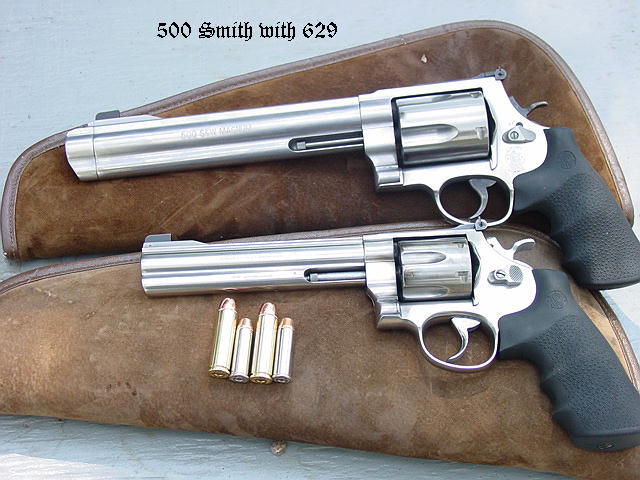
In early 2002, Smith & Wesson product manager Herb Belin proposed developing a new revolver platform that would become the company's massive X Frame. Smith & Wesson worked with Cor Bon on the ammunition side of the project, with Peter Pi and Cor Bon developing the cartridge while Smith & Wesson developed the revolver around it. The resulting Model 500 and .500 S&W Magnum were publicly introduced at the 2003 SHOT Show.
The performance goal was ambitious.
American Rifleman reports that 2,000 fps was a target during development, and a 300 grain projectile could reach that neighborhood from the original 8 3/8 inch barrel. The cartridge uses a 1.625 inch case and was engineered around pressures and performance that demanded an entirely new revolver frame rather than simply enlarging one of Smith & Wesson's existing designs.
In other words, this wasn't an attempt to squeeze a little more performance out of an existing handgun.
Smith & Wesson essentially built a bigger revolver because the cartridge demanded one.
And once ammunition manufacturers had that enormous case to work with, they had plenty of room to explore.
300 Grains Is Where Things Start Getting Interesting
One of the best ways to understand the .500 S&W is to start around 300 grains.
That's already a heavy handgun projectile by ordinary standards, but it allows the .500 S&W to combine substantial bullet mass with extremely high velocity.
Compiled factory ballistics from Ballistics101, for example, list a Hornady 300 grain FTX load at approximately 2,075 fps, producing about 2,868 ft lb of muzzle energy.
Think about that combination for a moment.
This isn't a tiny rifle bullet reaching 2,000 fps.
It's a 300 grain, half inch diameter handgun bullet doing it.
That's the basic formula that made the .500 S&W so extraordinary when it arrived. Instead of relying solely on an enormous projectile moving slowly, the cartridge had enough case capacity to drive very heavy bullets at velocities more commonly associated with rifles.
It also explains why the cartridge doesn't need a 700 grain bullet to produce spectacular energy figures.
Velocity matters enormously.
Then You Get to 350 and 400 Grains
Move upward in bullet weight and the balance begins to change.
Ballistics101 lists a Hornady 350 grain XTP load at approximately 1,900 fps and 2,805 ft lb. A Buffalo Bore 400 grain example is listed around 1,675 fps and 2,491 ft lb.
The pattern is already becoming obvious.
Bullet weight is increasing.
Velocity is falling.
Yet muzzle energy remains enormous.
This middle portion of the .500 S&W spectrum is particularly interesting because manufacturers can combine substantial projectile mass with enough velocity to produce very serious performance without going all the way to the cartridge's heaviest possible bullets.
Bullet construction becomes increasingly important here too.
An expanding jacketed bullet and a nonexpanding hard cast bullet of similar weight aren't designed to behave the same way. One may be engineered around expansion and energy transfer, while another may prioritize maintaining its shape and penetrating deeply.
So even when two boxes both say "400 grain," you still don't know enough to understand the ammunition.
You need to know what that 400 grain bullet actually is.
500 Grains Sounds Enormous Because It Is
Once you reach a 500 grain projectile, the .500 S&W begins entering territory that seems almost absurd for a handgun.
Ballistics101 lists a Cor Bon 500 grain hard cast load at approximately 1,500 fps, producing around 2,499 ft lb of muzzle energy.
For perspective, 500 grains equals about 1.14 ounces.
That's the projectile alone.
And yet even here, the .500 S&W still hasn't reached the end of its bullet weight range.
This is also where focusing exclusively on muzzle energy becomes less useful. A heavy hard cast projectile may not be intended to produce the largest energy number on a chart. Its construction and mass can instead be chosen for penetration.
That's an important distinction because shooters sometimes look at ammunition as though there were one universal performance hierarchy.
More velocity must be better.
More energy must be better.
More bullet weight must be better.
Ammunition doesn't really work that way.
The correct question is what the projectile was designed to accomplish.
And Then There's the 700 Grain Bullet
This is where the .500 S&W becomes difficult to explain without sounding like you're exaggerating.
Underwood offers a 700 grain wide flat nose hard cast .500 S&W Magnum load rated at 1,200 fps and 2,239 ft lb of muzzle energy.
Seven hundred grains works out to approximately 1.6 ounces.
For one bullet.
The projectile weighs more than twice as much as a 300 grain .500 S&W bullet and more than three times the weight of a standard 230 grain .45 ACP projectile.
But look at that energy number again.
2,239 ft lb.
That's actually less muzzle energy than several substantially lighter .500 S&W loads.
And that gives us one of the most useful lessons this cartridge can teach.
A 700 Grain Bullet Isn't Automatically More Powerful
It sounds wrong at first.
How can a 300 grain bullet produce more muzzle energy than one weighing 700 grains?
Velocity.
Kinetic energy increases with the square of velocity, which means adding speed can have an enormous effect on muzzle energy. Adding bullet mass increases energy too, but if a much heavier bullet has to travel considerably slower, the faster projectile can still come out ahead.
That's exactly what we see in these .500 S&W examples.
The compiled Hornady 300 grain FTX figure of approximately 2,075 fps produces around 2,868 ft lb.
Underwood's 700 grain hard cast travels at 1,200 fps and produces a listed 2,239 ft lb.
The 700 grain projectile weighs more than twice as much, yet the much faster 300 grain example produces the larger muzzle energy figure.
That doesn't make the 300 grain load universally "better."
It means they're doing different things.
Underwood describes its 700 grain projectile as a hard cast wide flat nose design and emphasizes penetration. It's a completely different approach from a lighter expanding projectile.
The grain number tells you how heavy the bullet is. It doesn't tell you what the bullet was designed to do.
That's especially important with .500 S&W ammunition because the difference between loads can be enormous.
What Happens to Recoil as Bullet Weight Goes Up?
You don't get to launch a 700 grain projectile from a handgun for free.
Recoil is one of the defining characteristics of the .500 S&W, but even here it's important not to lump every load together.
American Rifleman found that the large X Frame revolver, its substantial weight and its compensating system could make lighter .500 S&W loads more manageable than the cartridge's reputation might suggest. Their experience with heavier ammunition was very different, with recoil becoming considerably more demanding as load intensity increased.
The 700 grain ammunition takes this to another level.
Underwood specifically warns about the extreme recoil generated by its 700 grain load. In .500 S&W revolvers with barrels four inches or shorter, the company recommends loading only one or two rounds because recoil can cause the bullets in the remaining cartridges to move forward in their cases.
That's not a minor footnote.
It's a reminder that there is a practical side to ammunition selection.
The heaviest load that physically fits into the chamber isn't automatically the load you'll enjoy shooting, shoot most accurately or have any reason to choose.
For many shooters, the more useful .500 S&W load may be somewhere considerably below the extreme end of the scale.
Why Would Anyone Want a 700 Grain Bullet?
This is probably the question most people have after seeing one.
If lighter bullets can produce more muzzle energy, why make a 700 grain projectile at all?
Because muzzle energy isn't the only thing bullets do.
The Underwood load uses a hard cast, nonexpanding wide flat nose projectile. The goal is not to create dramatic expansion. The heavy bullet and its construction are intended to emphasize penetration and straight line performance.
That's a very different philosophy from a lightweight expanding bullet moving at tremendous velocity.
The 700 grain load is an extreme example, but it makes the distinction easy to understand.
Ammunition manufacturers aren't simply putting increasingly heavy bullets into .500 S&W cases to see who can print the biggest number on the box.
Different projectile weights and designs allow the cartridge to emphasize different performance characteristics.
And sometimes the bullet design matters more than another 50 or 100 grains of weight.
Why Do People Shoot the 500 S&W at All?
The obvious answer is probably the simplest one.
Because it's extraordinary.
There is an undeniable recreational appeal to firing one of the largest and most powerful production revolver cartridges ever created. The muzzle blast, recoil and sheer scale of the ammunition make the .500 S&W an experience unlike shooting an ordinary handgun.
But reducing the cartridge to a range novelty doesn't tell the whole story.
From its early development, .500 S&W ammunition included loads aimed at serious hunting applications. American Rifleman discussed original ammunition ranging from lighter expanding bullets to 400 grain hunting loads and heavy hard cast ammunition intended for deep penetration.
That versatility is possible precisely because the cartridge has so much capacity.
It doesn't have to do one thing.
A manufacturer can use a relatively lighter projectile and exploit velocity, move into the middle of the weight spectrum for a balance of mass and speed, or go extremely heavy and design the projectile around penetration.
That's much more interesting than simply calling it "powerful."
The Gun Matters Almost as Much as the Ammo
Another mistake would be assuming that every .500 S&W load will behave the same from every firearm.
The cartridge is most closely associated with Smith & Wesson's enormous X Frame revolvers, but it has also been chambered in other platforms, including single shot rifles such as the Thompson/Center Pro Hunter. Outdoor Life tested a Pro Hunter chambered in .500 S&W and demonstrated how moving the cartridge into a rifle changes the overall package and shooting experience.
Even among revolvers, barrel length, firearm weight, grip design and muzzle brake or compensator configuration can dramatically affect the shooter's experience.
That matters when you're looking at ammunition.
A load that seems manageable from a long, heavy revolver may feel completely different from a shorter configuration.
Published velocity can change with barrel length too.
The numbers on the box are useful references.
Your firearm still gets a vote.
Is Heavier 500 S&W Ammo Better for Hunting?
Not automatically.
It can be tempting to look at a cartridge this large and assume that hunting ammunition selection is simply a matter of buying the heaviest bullet available.
But bullet construction, intended game, expected distance and firearm all matter.
A heavy hard cast bullet emphasizing penetration solves a different problem than an expanding jacketed projectile. Likewise, a faster, lighter bullet may offer a flatter trajectory than an extremely heavy load.
The fact that a 700 grain projectile exists doesn't suddenly make a 300, 350 or 400 grain bullet inadequate.
The enormous range of available bullet weights exists precisely because there isn't one ideal .500 S&W projectile for every purpose.
For hunters considering the cartridge, ammunition manufacturer recommendations and applicable hunting regulations should be part of the decision rather than choosing solely by grain weight.
What About Ordinary Range Shooting?
Here's where the extremes become much less important.
You absolutely don't need a 700 grain projectile simply because your revolver says .500 S&W Magnum on the barrel.
For recreational shooting, manageable recoil, availability, accuracy and cost can matter more than squeezing every possible ounce of performance out of the cartridge.
Lighter loads can still produce serious recoil and tremendous muzzle energy while generally being more approachable than the heaviest specialty ammunition.
And with a cartridge this powerful, shooter fatigue matters.
If an extremely heavy load causes you to flinch after a few rounds, the fact that it launches a gigantic projectile isn't helping you shoot better.
There's something inherently entertaining about saying you've fired a 700 grain handgun bullet.
That doesn't mean you'd want to shoot a box of them every Saturday.
So What Bullet Weight Should You Choose?
There isn't one grain weight we can point to and call the best .500 S&W load.
Instead, think about the ammunition in broad categories.
Lighter .500 S&W bullets can take advantage of the cartridge's enormous case capacity to produce exceptionally high velocity. These loads can generate tremendous muzzle energy while offering a different trajectory and recoil profile than the heaviest ammunition.
Midweight bullets around the 350 to 400 grain area offer substantial projectile mass while retaining impressive velocity. This range includes ammunition designed for several different purposes, so bullet construction remains critical.
Heavy bullets around 440 to 500 grains shift even farther toward mass and can be paired with projectile designs intended for substantial penetration.
And then there are extreme loads such as the 700 grain Underwood, where bullet mass becomes the defining characteristic and recoil reaches a level that deserves serious consideration.
The most important thing is not to assume that moving farther down that list automatically means you're buying "better" ammunition.
You're buying different ammunition.
The 500 S&W Makes Bullet Weight Impossible to Ignore
Most ammunition discussions treat bullet weight as one specification among many.
The .500 S&W Magnum makes it impossible to ignore.
This is a cartridge where a 300 grain projectile can travel around 2,000 fps, where 500 grain bullets don't seem particularly shocking, and where you can buy a 700 grain projectile weighing approximately 1.6 ounces.
Yet the biggest bullet isn't automatically the fastest.
It isn't automatically the highest energy load.
And it certainly isn't automatically the best choice.
That's what makes the .500 S&W more interesting than its reputation as an enormous handgun cartridge suggests.
The cartridge gives ammunition manufacturers an unusually large performance envelope. They can trade bullet weight for velocity, choose expansion or penetration, and build ammunition with dramatically different personalities while keeping the same cartridge stamped on the case.
Smith & Wesson and Cor Bon started with an ambitious idea more than two decades ago: build a production revolver and cartridge capable of extraordinary handgun performance.
They certainly accomplished that.
But somewhere between the original 300 grain concept and today's 700 grain monsters, the .500 S&W also became one of the clearest demonstrations of why the heaviest bullet isn't always the most powerful, and the biggest number on the box isn't always the one that matters most.
Information provided by AmmoBrowser is for general informational and educational purposes only. Ammunition specifications, ballistics, performance, pricing, and availability can vary by manufacturer, load, firearm, barrel length, and other conditions. While we strive to provide accurate and current information, AmmoBrowser makes no guarantee regarding its completeness or accuracy. Always follow firearm and ammunition manufacturer instructions, verify that ammunition is compatible with your firearm, and follow all applicable laws and safe firearm handling practices.