
'%3e%3cpath%20d='M25.8906%2030.68L16.0006%2025L6.14062%2030.68V4.55C6.14063%203.75435%206.4567%202.99129%207.0193%202.42868C7.58191%201.86607%208.34498%201.55%209.14063%201.55H22.8906C23.6863%201.55%2024.4493%201.86607%2025.0119%202.42868C25.5746%202.99129%2025.8906%203.75435%2025.8906%204.55V30.68ZM9.14063%203.55C8.87541%203.55%208.62105%203.65536%208.43352%203.84289C8.24598%204.03043%208.14063%204.28478%208.14063%204.55V27.23L16.0006%2022.72L23.8806%2027.23V4.55C23.8806%204.28478%2023.7753%204.03043%2023.5877%203.84289C23.4002%203.65536%2023.1458%203.55%2022.8806%203.55H9.14063Z'%20fill='white'/%3e%3cpath%20d='M9.14063%202.55H22.8906C23.4211%202.55%2023.9298%202.76071%2024.3048%203.13579C24.6799%203.51086%2024.8906%204.01957%2024.8906%204.55V8.62H7.14062V4.55C7.14063%204.01957%207.35134%203.51086%207.72641%203.13579C8.10148%202.76071%208.61019%202.55%209.14063%202.55Z'%20fill='%238A3301'/%3e%3cpath%20d='M25.8906%209.62H6.14062V4.55C6.14063%203.75435%206.4567%202.99129%207.0193%202.42868C7.58191%201.86607%208.34498%201.55%209.14063%201.55H22.8906C23.6863%201.55%2024.4493%201.86607%2025.0119%202.42868C25.5746%202.99129%2025.8906%203.75435%2025.8906%204.55V9.62ZM8.14063%207.62H23.8906V4.55C23.8906%204.28478%2023.7853%204.03043%2023.5977%203.84289C23.4102%203.65536%2023.1558%203.55%2022.8906%203.55H9.14063C8.87541%203.55%208.62105%203.65536%208.43352%203.84289C8.24598%204.03043%208.14063%204.28478%208.14063%204.55V7.62Z'%20fill='white'/%3e%3cpath%20d='M16%2020.25C15.7348%2020.25%2015.4804%2020.1446%2015.2929%2019.9571C15.1054%2019.7696%2015%2019.5152%2015%2019.25V14.07C15%2013.8048%2015.1054%2013.5504%2015.2929%2013.3629C15.4804%2013.1754%2015.7348%2013.07%2016%2013.07C16.2652%2013.07%2016.5196%2013.1754%2016.7071%2013.3629C16.8946%2013.5504%2017%2013.8048%2017%2014.07V19.25C17%2019.5152%2016.8946%2019.7696%2016.7071%2019.9571C16.5196%2020.1446%2016.2652%2020.25%2016%2020.25Z'%20fill='white'/%3e%3cpath%20d='M18.5999%2017.66H13.4199C13.1547%2017.66%2012.9004%2017.5546%2012.7128%2017.3671C12.5253%2017.1796%2012.4199%2016.9252%2012.4199%2016.66C12.4199%2016.3948%2012.5253%2016.1404%2012.7128%2015.9529C12.9004%2015.7654%2013.1547%2015.66%2013.4199%2015.66H18.5999C18.8651%2015.66%2019.1195%2015.7654%2019.307%2015.9529C19.4946%2016.1404%2019.5999%2016.3948%2019.5999%2016.66C19.5999%2016.9252%2019.4946%2017.1796%2019.307%2017.3671C19.1195%2017.5546%2018.8651%2017.66%2018.5999%2017.66Z'%20fill='white'/%3e%3c/g%3e%3cdefs%3e%3cclipPath%20id='clip0_29353_35'%3e%3crect%20width='32'%20height='32'%20fill='white'/%3e%3c/clipPath%3e%3c/defs%3e%3c/svg%3e) Wishlist
Wishlist
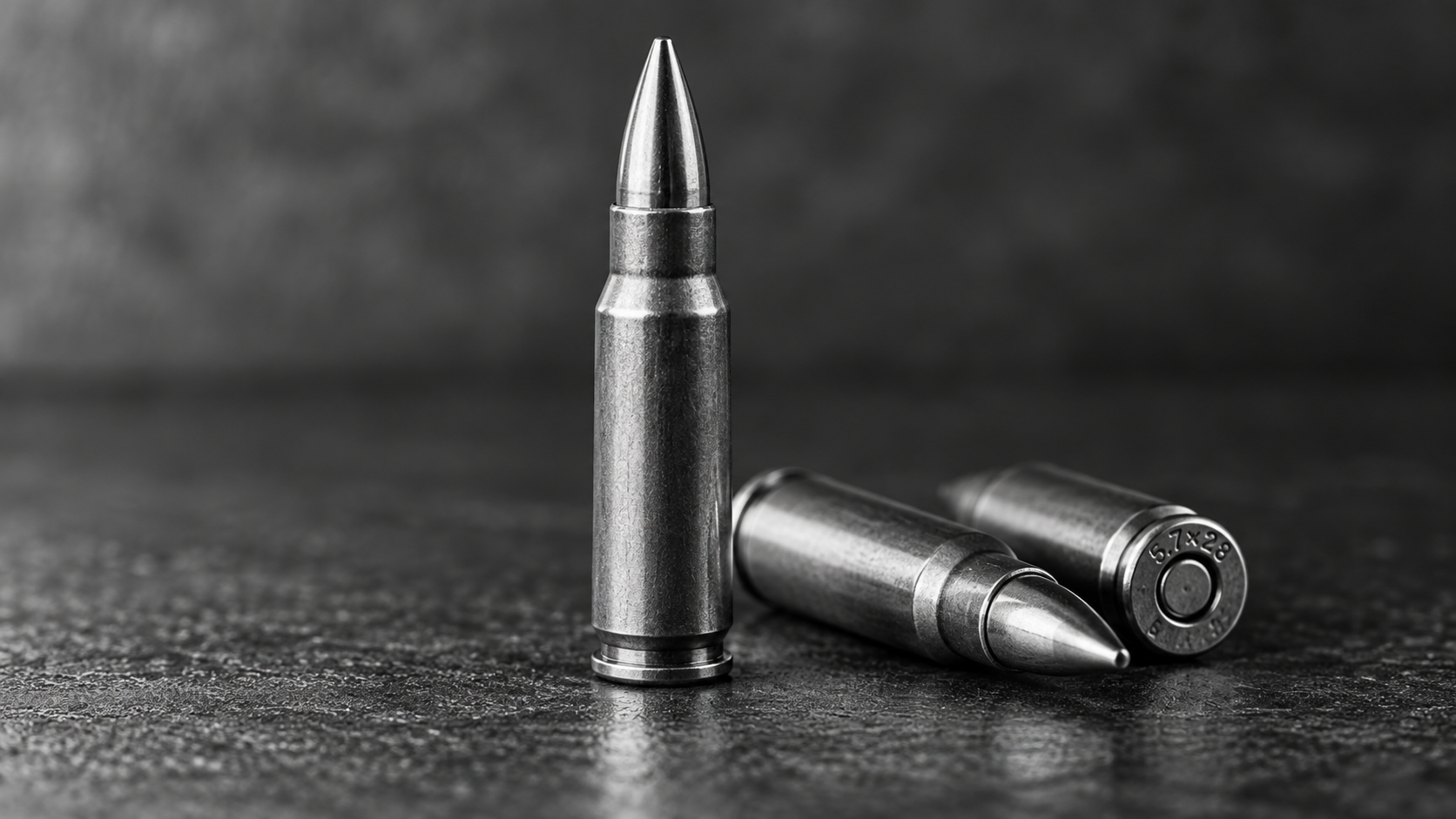
The 5.7x28 doesn't look like the ammunition sitting next to it on most handgun-ammo shelves. It's long, skinny and bottlenecked, with a tiny .224-inch projectile that looks more like something borrowed from a miniature rifle cartridge than a conventional pistol round. Fire one and the differences become even more obvious: recoil is mild, velocity can be remarkably high for a handgun, and many 5.7 pistols hold 20 rounds without resorting to unusually large magazines.
Those characteristics have helped turn what was once an obscure military-oriented cartridge into one of the more interesting ammunition stories of the last several years. More manufacturers now chamber firearms for it, ammunition selection has expanded, and shooters who might once have encountered 5.7x28 only through FN's P90 or Five-seveN now have considerably more opportunities to shoot it. Guns & Ammo notes that ammunition once largely associated with FN and Fiocchi has expanded to include loads from Hornady, Speer, Federal and others.
But popularity has also given 5.7x28 a reputation that can get ahead of reality. Depending on who you ask, it's either an incredibly fast, soft-shooting alternative to conventional handgun cartridges or an expensive little round that gives up too much projectile mass for all that velocity.
The truth is considerably more interesting.
Quick Answer: What's the Big Deal With 5.7x28?
5.7x28 combines very light bullets, relatively high velocity, low recoil and excellent magazine capacity in a cartridge that works in both handguns and longer-barreled firearms. Those are real advantages.
But it isn't a miniature rifle cartridge that magically makes 9mm obsolete.
Commercial 5.7x28 ammunition spans a surprisingly broad range. Current examples include light 27-grain loads capable of very high velocities, common 40-grain FMJ and expanding loads, and even much heavier subsonic ammunition. The cartridge's small diameter and lightweight projectiles help keep recoil low, but they also mean you're working with substantially less projectile mass than conventional service handgun cartridges.
So is the reputation deserved?
Mostly, but for different reasons than the hype sometimes suggests.
The best argument for 5.7x28 isn't simply that it's "more powerful." It's that the cartridge offers an unusual combination of speed, shootability, capacity and flat trajectory that conventional handgun ammunition doesn't quite replicate in the same way.
5.7x28 Wasn't Originally Designed to Impress Civilian Shooters
Understanding why 5.7x28 is so unusual gets easier once you understand where it came from.
FN developed the cartridge around requirements that emerged in the late 1980s and early 1990s for a new personal defense weapon cartridge. The goal wasn't simply to make another pistol round. The concept called for greater range and accuracy than traditional 9mm ammunition while working in compact weapons and meeting military performance requirements. FN designers developed a new cartridge rather than modifying an existing case.
That history explains much of what you see today.
The cartridge uses a bottleneck case and a small .224-inch projectile. Early military-oriented ammunition used extremely light bullets, and the cartridge was paired with FN's P90 personal-defense weapon and Five-seveN pistol.
Civilian ammunition is a different story. Some specialized military ammunition is restricted and shouldn't be confused with the loads ordinary shooters can buy. Commercial 5.7x28 has developed into its own ecosystem of FMJ practice ammunition, polymer-tipped loads, expanding ammunition, frangible loads and even subsonic offerings.
That's an important distinction because much of the mythology surrounding 5.7x28 comes from its original military role. Buying a box of ordinary commercial 5.7 ammunition doesn't give you the same ammunition developed around specialized military requirements.
What civilian shooters do get is still pretty unusual.
The Bullet Weights Tell the Story
If you're accustomed to 9mm ammunition with 115-, 124- and 147-grain bullets, 5.7x28 numbers look almost comically small.
Common commercial ammunition tends to cluster around the 27- to 40-grain range, although heavier options exist. Current listings illustrate just how varied the cartridge has become: 27-grain hollow-point loads, 30-grain JHPs, 35-grain frangible ammunition, multiple 40-grain FMJ and expanding loads, and heavier specialty ammunition can all be found.
The most familiar weight for many shooters is probably 40 grains.
That's where you'll find everything from inexpensive FMJ-style range ammunition to polymer-tipped and purpose-built defensive loads. Guns & Ammo notes current examples including 40-grain Hornady V-MAX and Critical Defense ammunition, Speer Gold Dot and 40-grain American Eagle FMJ.
Move down toward 27 grains, and velocity becomes one of the big attractions. AmmunitionToGo currently lists an FN 27-grain load at published velocities above 2,000 fps, although reported velocities vary by load and test conditions.
Move in the other direction and things get stranger. Guns & Ammo reported Fiocchi offering a 62-grain subsonic load alongside its conventional 40-grain ammunition.
That's a huge spread for a cartridge people sometimes describe as though every 5.7 round does essentially the same thing.
It doesn't.
Bullet weight and bullet construction matter enormously with 5.7x28.
Is 5.7x28 Really That Fast?
Yes but this is where we need to separate marketing from reality.
5.7x28 is capable of impressive velocity for a handgun cartridge, especially with lightweight projectiles. But quoting one enormous velocity number without telling you the bullet weight or barrel used doesn't tell you very much.
Firearms News tested several loads from a Ruger-57 pistol. A 40-grain FN SS197SR averaged 1,784 fps, while a 50-grain American Eagle FMJ averaged 1,689 fps. Much lighter specialty 27- and 28-grain loads approached 2,475 fps in the same test.
That's a tremendous difference created simply by changing ammunition.
It also illustrates why saying "5.7x28 travels at 2,400 fps" is misleading. Some loads can. Plenty don't.
Barrel length matters as well. The cartridge was developed around both pistols and personal-defense weapons, and longer barrels can allow different performance than a handgun. That's one reason you'll encounter velocity figures online that seem to contradict one another.
When you're comparing 5.7 ammunition, always ask:
Which bullet? Which load? Which barrel?
Without those answers, the velocity number is mostly trivia.
Speed Isn't the Same Thing as Power
This is probably the biggest misconception surrounding the cartridge.
A projectile moving very quickly sounds powerful, but kinetic energy depends on both velocity and mass. A 5.7 projectile is extremely light compared with a typical 9mm bullet.
That's why 5.7x28 can produce spectacular-looking velocity figures without automatically producing more muzzle energy than larger handgun cartridges.
Current commercial examples make the point nicely. AmmunitionToGo lists a 40-grain 5.7 load at 1,700 fps and about 257 ft-lbs of muzzle energy, while other 27- and 40-grain loads on the same page vary substantially depending on the particular ammunition.
So when somebody asks:
"Is 5.7 more powerful than 9mm?"
the best answer isn't simply yes or no.
5.7x28 generally gives you a lighter, faster projectile. Conventional 9mm generally gives you a much heavier projectile. Those are fundamentally different ways of producing useful performance.
And that's exactly why comparing them based only on muzzle velocity produces bad conclusions.
5.7x28 vs. 9mm: The Difference You Actually Feel
Put the ballistic charts aside for a moment and shoot both.
One of the 5.7's most obvious advantages is recoil.
Reduced recoil was part of the original design concept, and modern 5.7 pistols are frequently praised for being easy to shoot quickly. In Firearms News' comparison, standard 5.7x28 ammunition produced noticeably softer recoil than conventional 115-, 124- and 147-grain 9mm loads.
That matters more than a ballistic chart might suggest.
Less recoil can make it easier to keep the sights controlled and recover quickly between shots. For recoil-sensitive shooters, it can also make practice considerably more pleasant.
Then there's capacity.
Because the cartridge is relatively narrow, manufacturers can fit a surprising number into a handgun magazine. Twenty-round capacities are common in full-size 5.7 pistols, giving the cartridge another practical advantage over many conventional handgun designs.
Those two characteristics together low recoil and high capacity are arguably more important to 5.7's modern popularity than its headline velocity.
9mm still has enormous advantages of its own. Ammunition is generally more ubiquitous, the range of available loads is enormous, and shooters have decades of modern defensive-ammunition development to choose from.
That's why I wouldn't describe 5.7 as the cartridge that "beats" 9mm.
It's better described as a genuinely different alternative.
What Is 5.7x28 Actually Good For?
This is where the cartridge's identity becomes clearer.
For range shooting, it's simply fun. Recoil is mild, trajectory is relatively flat, and the cartridge offers a shooting experience that's noticeably different from traditional handgun ammunition.
For shooters who prioritize low recoil, 5.7 has a legitimate advantage. You don't need to be recoil-sensitive to appreciate a handgun that's easy to control during longer shooting sessions.
For personal protection, the question gets more complicated because ammunition selection matters tremendously. Modern manufacturers now offer commercial loads designed specifically around defensive use rather than merely adapting FMJ ammunition.
Guns & Ammo reported ballistic-gel testing of several modern 5.7 loads and found multiple defensive loads penetrating at least 12 inches in synthetic ballistic gelatin, while also emphasizing that the cartridge has limitations and shouldn't be treated as magical.
That's the right way to look at it.
The modern 5.7 isn't automatically unsuitable because the bullet is small, nor should someone assume that its velocity makes it superior to proven conventional defensive cartridges.
Load selection matters.
For small-varmint applications where legal and appropriate, the combination of a small projectile and high velocity can also make conceptual sense, although firearm, ammunition, distance and local hunting regulations all matter.
For larger game or situations where deep penetration and heavy projectile mass are priorities, however, there are much more appropriate cartridges.
What Caliber Is 5.7x28 Equivalent To?
There really isn't a perfect equivalent.
The projectile diameter is approximately .224 inch, which immediately makes people think of .223 Remington/5.56 NATO. But sharing a similar projectile diameter doesn't make 5.7x28 remotely equivalent to a full-power 5.56 rifle cartridge.
On the other side, 5.7 is frequently compared with 9mm because both are available in defensive-sized handguns. But their projectile weights, dimensions, velocities and ballistic behavior are dramatically different.
Historically, American Rifleman noted that the cartridge's case capacity and external ballistics had some similarities to the old .22 Hornet, although the 5.7's design was optimized for reliable operation in compact semi-automatic firearms.
Even that isn't an exact modern equivalency.
The easiest way to understand 5.7 is to stop trying to turn it into another caliber.
It's a lightweight, high-velocity cartridge occupying an unusual space between traditional handgun ammunition and small rifle cartridges.
That's what makes it interesting.
Not All 5.7 Ammo Is Created Equal
This deserves more attention than it usually gets.
Someone buying 9mm can already encounter major differences between inexpensive FMJ and premium defensive hollow points. With 5.7, those differences can be even more dramatic because bullet weights and construction vary so much.
A 40-grain FMJ load makes sense as straightforward range ammunition.
A 40-grain expanding or polymer-tipped load may be designed around a completely different purpose.
A 27-grain load sacrifices projectile mass in pursuit of considerably greater velocity.
A 35-grain frangible load is yet another category.
And a 62-grain subsonic load essentially flips the traditional 5.7 formula on its head by trading the cartridge's famous velocity for specialized subsonic performance.
That's why shopping for 5.7 based purely on price per round can be a mistake.
Two boxes marked 5.7x28mm can contain ammunition designed to behave very differently.
The Downside Nobody Should Ignore: Cost
Here's where 9mm gets revenge.
5.7x28 has become considerably more mainstream, but it still doesn't have anything close to the production scale and ubiquity of 9mm. That affects both selection and price.
The situation is better than it used to be. Guns & Ammo notes that the cartridge was once comparatively rare and expensive, while today's market includes ammunition from multiple major manufacturers and a much wider range of purposes.
But 5.7 remains a cartridge where comparing prices matters.
For someone shooting a couple of boxes occasionally, the difference may not be especially important. For a high-volume range shooter, ammunition cost can quickly become one of the biggest arguments against switching from something like 9mm.
And that's important because one of 5.7's greatest strengths is shootability. A soft-recoiling handgun that's enjoyable to shoot isn't as appealing if ammunition cost discourages you from practicing with it.
So Why Is 5.7x28 Becoming So Popular Now?
The cartridge itself isn't new.
What's new is the ecosystem around it.
For years, 5.7x28 was closely associated with FN. That made it interesting but niche. As more firearms and ammunition entered the civilian market, the equation changed. Guns & Ammo described the recent period as a surge in 5.7 interest, with more manufacturers producing ammunition and more platforms available to shoot it.
That creates a feedback loop.
More firearms make ammunition manufacturers more interested.
More ammunition makes consumers less hesitant to buy firearms.
More shooters create more demand.
And eventually a cartridge that once seemed exotic starts appearing on ordinary ammunition shelves.
That's essentially what has happened to 5.7x28.
It also arrived at the right moment. Shooters increasingly have access to optics-ready handguns, suppressor-oriented products and unconventional pistol/carbine platforms. A fast, lightweight cartridge with low recoil and high capacity fits comfortably into that market.
Is the 5.7x28 Reputation Deserved?
Yes but not because it's some ballistic cheat code.
5.7x28 isn't secretly a rifle cartridge hiding inside a handgun. It doesn't make projectile weight irrelevant. It doesn't automatically outperform 9mm just because the chronograph displays a larger number.
Its reputation is deserved because the combination is unusual.
You get extremely light projectiles.
You can get impressive handgun velocity.
Recoil is mild.
Magazine capacity can be excellent.
Trajectory is relatively flat for a handgun cartridge.
Modern ammunition selection is substantially better than it once was.
And there are now enough firearms chambered for it that buying into 5.7 no longer feels like committing to an orphan cartridge.
The tradeoffs are just as real. Ammunition generally costs more than mainstream handgun cartridges. Load selection matters tremendously. The tiny projectiles don't suddenly acquire the mass of conventional service-caliber bullets simply because they're moving quickly.
That's why 5.7 makes the most sense for someone who specifically values low recoil, speed, capacity and the cartridge's distinctive shooting characteristics.
If your only question is whether it is universally "better than 9mm," you're asking the wrong question.
Final Takeaway
5.7x28 earned its reputation by doing something genuinely different.
It takes a tiny projectile, pushes it unusually fast, packages it in a slender bottleneck cartridge and produces a shooting experience that combines high capacity with remarkably manageable recoil.
That isn't hype.
The hype begins when those advantages get translated into claims that 5.7 somehow makes conventional handgun cartridges obsolete.
It doesn't.
For some shooters, 9mm remains the more practical choice because ammunition is abundant, affordable and available in an enormous range of proven loads. For others, the 5.7's softer recoil, capacity and speed are exactly what make it appealing.
And perhaps that's the best explanation for why a cartridge designed decades ago is suddenly getting so much attention.
5.7x28 didn't become popular because everyone finally discovered it was better. It became popular because enough shooters finally had the firearms and ammunition choices to appreciate what makes it different.
Disclaimer
AmmoBrowser Disclaimer: Information provided by AmmoBrowser is for general informational and educational purposes only. Ammunition specifications, ballistics, performance, pricing, and availability can vary by manufacturer, load, firearm, barrel length, and other conditions. While we strive to provide accurate and current information, AmmoBrowser makes no guarantee regarding its completeness or accuracy. Always follow firearm and ammunition manufacturer instructions, verify that ammunition is compatible with your firearm, and follow all applicable laws and safe firearm-handling practices.