
 Wishlist

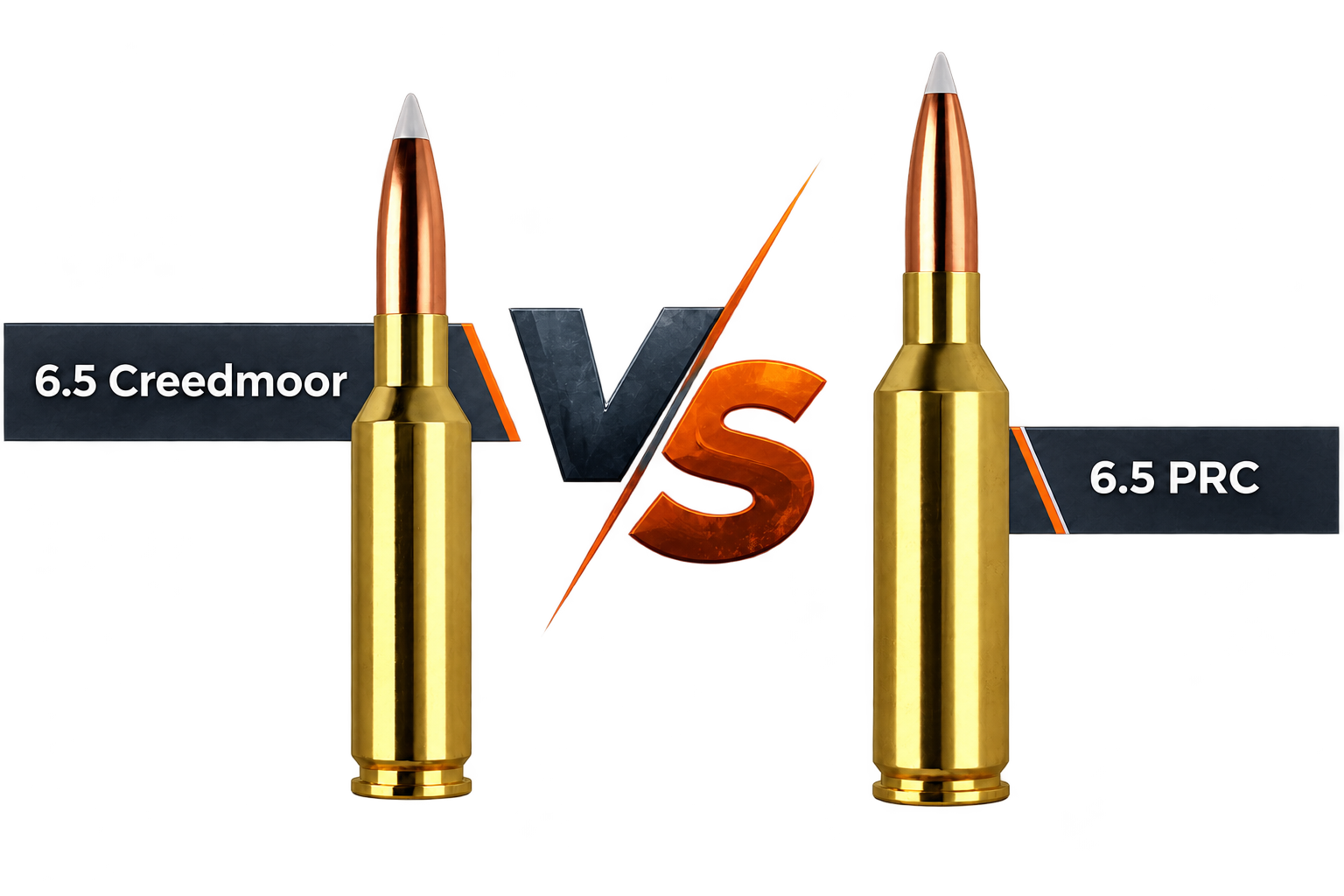
The 6.5 Creedmoor has become one of the most recognizable rifle cartridges of the modern era, earning a reputation for excellent accuracy, manageable recoil, and impressive long-range performance. It has found a home with competitive shooters, recreational target shooters, and hunters who appreciate a cartridge that can perform well without punishing the person behind the rifle. But for all its popularity, the Creedmoor has also attracted criticism from shooters who believe its relatively modest velocity limits its effectiveness, particularly when hunting larger animals or shooting across wide-open country.
That's where the 6.5 PRC enters the conversation. Developed by Hornady as a faster, more powerful alternative, the PRC fires the same diameter bullets as the Creedmoor but uses a larger cartridge case to push them at higher velocities. On paper, the difference is obvious. The PRC produces a flatter trajectory, carries more energy downrange, and generally drifts less in the wind when comparable bullets are used. Those advantages sound compelling, especially for hunters who regularly encounter longer shooting distances.
But more velocity doesn't automatically make a cartridge the better choice. The Creedmoor's lower recoil, ammunition availability, and efficiency are precisely what made it so successful. To understand which cartridge makes more sense, it's worth looking beyond the muzzle velocity figures and examining what the extra performance actually changes in the field.
Two Cartridges Built Around the Same Bullet
The 6.5 Creedmoor was introduced by Hornady in 2007, originally with long-range target shooting in mind. Its design emphasizes efficient powder use, excellent accuracy potential, and the ability to accommodate long, aerodynamic bullets in short-action rifles. It didn't take long for hunters to recognize those same characteristics as useful in the field. The Creedmoor offered enough performance for deer-sized game at reasonable distances while remaining comfortable enough for extended practice sessions.
Hornady introduced the 6.5 PRC in 2018 with a different objective. PRC stands for Precision Rifle Cartridge, and the design was intended to deliver magnum-like performance in a relatively compact package. By increasing case capacity, Hornady created a cartridge capable of driving heavy-for-caliber 6.5mm bullets significantly faster than the Creedmoor. Both cartridges use .264-inch-diameter bullets, but they are entirely different cartridges and are not interchangeable.
A typical 143-grain hunting bullet might leave a 6.5 Creedmoor barrel at approximately 2,700 feet per second, while a comparable 6.5 PRC load can approach 2,960 feet per second. That's a difference of roughly 260 fps, although actual velocities depend on the specific factory load, barrel length, and rifle. The advantage may not sound enormous at first, but it affects nearly every aspect of the bullet's flight.
The PRC's larger case also means more powder, more muzzle blast, and more recoil. Those are the trade-offs that need to be considered alongside the additional performance.
6.5 PRC vs 6.5 Creedmoor Ballistics
The clearest way to understand the difference is to compare similar bullets. Hornady's 143-grain ELD-X is a particularly useful example because it is available in factory hunting ammunition for both cartridges. The bullet has a high ballistic coefficient and is designed to retain velocity efficiently, making it a good choice for examining how the cartridges perform as distances increase.
Using representative factory muzzle velocities, the 6.5 Creedmoor launches this bullet at approximately 2,700 fps, while the 6.5 PRC launches it at approximately 2,960 fps. Both produce substantial muzzle energy, but the PRC starts with a meaningful advantage and maintains that advantage as the bullets travel downrange.
6.5 Creedmoor — 143-Grain ELD-X:
Muzzle: Approximately 2,700 fps | 2,315 ft-lbs
6.5 PRC — 143-Grain ELD-X:
Muzzle: Approximately 2,960 fps | 2,780 ft-lbs
These are representative muzzle figures, not a complete trajectory comparison. Exact downrange velocity, energy, bullet drop, and wind drift depend on the manufacturer's published load data, atmospheric conditions, barrel length, and sight-in distance.
At closer hunting distances, both cartridges have more than enough velocity to perform effectively with an appropriate bullet on deer-sized game. As distance increases, however, the PRC's higher starting velocity becomes more useful. The bullet reaches the target sooner, spends less time exposed to crosswinds, and generally follows a flatter trajectory.
This doesn't mean the Creedmoor suddenly becomes ineffective at longer distances. Its aerodynamic bullets are exceptionally good at retaining velocity, which is one of the reasons the cartridge became popular with long-range shooters. The distinction is that the PRC provides more ballistic margin, particularly when distances stretch and conditions become less forgiving.
How Much Flatter Does the 6.5 PRC Shoot?
One of the most frequently advertised advantages of the 6.5 PRC is its flatter trajectory. That advantage is real, but its practical importance depends heavily on distance.
Inside 200 yards, the difference between the two cartridges is relatively small. A hunter using either rifle with a properly established zero is unlikely to notice a dramatic difference in point of impact at ordinary woodland hunting distances. Both cartridges are capable of placing a suitable hunting bullet accurately into the vital area of a deer.
At 300 yards, the PRC begins to show a more noticeable advantage. At 500 yards, the difference becomes more significant, with the faster bullet requiring less elevation correction. Farther out, the PRC's advantage continues to grow.
A flatter trajectory can reduce the consequences of a small range-estimation error, but it doesn't eliminate the need for accurate ranging or careful shooting. At extended distances, even a fast cartridge requires substantial elevation correction. Wind calls, shooting position, and knowledge of the rifle's actual trajectory remain critical.
The PRC also generally produces less wind drift when firing the same bullet at a higher velocity. Because the faster bullet spends less time traveling to the target, the wind has less opportunity to move it sideways. That can be useful in open-country hunting, where steady crosswinds are common and judging wind speed is often more difficult than measuring distance.
Still, the difference between the cartridges shouldn't be confused with the difference between an experienced shooter and an inexperienced one. A practiced marksman with a Creedmoor can easily outperform someone using a PRC who hasn't learned the rifle, its ammunition, or the conditions.
Recoil: The Price of Additional Velocity
Recoil is one of the most important differences between these cartridges, and it's often overlooked when comparing ballistic charts. The Creedmoor became popular partly because it offers useful long-range performance without the recoil associated with larger magnum cartridges. That makes it comfortable for high-volume target shooting and helps shooters maintain their sight picture through the shot.
The 6.5 PRC produces more recoil because it burns more powder and sends the bullet down the barrel at a higher velocity. In comparable rifles, the difference is noticeable, although the PRC is still generally manageable for experienced shooters.
Backfire's published recoil estimates provide an illustrative comparison, placing the 6.5 Creedmoor at approximately 11.9 foot-pounds of free recoil energy and the 6.5 PRC at approximately 16.3 foot-pounds. That represents roughly 37% more calculated recoil energy. Those figures depend on the assumptions used for rifle weight and ammunition, so they shouldn't be interpreted as the exact difference between every Creedmoor and PRC rifle.
The distinction becomes especially important in lightweight hunting rifles. A heavier rifle can absorb recoil more comfortably, while a lightweight mountain rifle may make the PRC feel considerably sharper. Stock design, recoil pads, suppressors, and muzzle brakes can also change how recoil feels to the shooter.
For someone who fires a handful of shots each hunting season, the difference might not seem particularly important. For someone who regularly shoots 50 or 100 rounds during a range session, it can become a deciding factor. Lower recoil makes it easier to practice comfortably, observe impacts, and avoid developing a flinch.
And practice matters. The ballistic advantage of the PRC is only useful when the shooter can place the bullet where it needs to go.
6.5 PRC vs 6.5 Creedmoor for Hunting
Hunting is where the debate between these two cartridges becomes particularly interesting. The Creedmoor has earned a reputation as an effective deer cartridge, but its popularity has also encouraged some exaggerated claims about what it can accomplish. It is neither an underpowered target cartridge that has no place in the hunting woods nor a magical long-range hunting solution.
For whitetail deer, mule deer, and similar game, the 6.5 Creedmoor is a capable choice when paired with an appropriate hunting bullet and used within sensible distances. Its relatively mild recoil makes accurate shot placement easier, and modern controlled-expansion and high-ballistic-coefficient hunting bullets have helped demonstrate what the cartridge can accomplish.
The 6.5 PRC offers additional performance that can be valuable when hunting in more open terrain. Its higher velocity generally means more retained energy at a given distance, less bullet drop, and somewhat less wind drift. Those characteristics are appealing to western hunters who may encounter longer shots across canyons, open hillsides, or alpine terrain.
The PRC can also offer more margin when hunting larger animals, but that shouldn't be mistaken for a guarantee of better terminal performance. Bullet construction, impact velocity, shot placement, and the animal's size matter far more than simply choosing the cartridge with the higher muzzle-energy figure.
A poorly placed shot from a 6.5 PRC is still a poorly placed shot. Likewise, a properly constructed hunting bullet from a Creedmoor can be highly effective when used within its intended performance limits.
Experienced hunting writers have expressed different opinions about the Creedmoor's suitability for larger game. Some argue that its modest velocity makes faster cartridges preferable, while others point to successful field experience with well-chosen bullets. Both perspectives highlight an important reality: cartridge selection should reflect the animal, terrain, expected distance, and shooter's ability rather than the cartridge's popularity.
For most ordinary deer hunting, the Creedmoor's performance is entirely reasonable. For hunters who regularly operate in open country and want greater velocity and downrange energy from a 6.5mm bullet, the PRC has a legitimate advantage.
Does the 6.5 PRC Have an Accuracy Advantage?
It's tempting to assume that a faster cartridge must also be more accurate, but velocity and accuracy are not the same thing.
Both the 6.5 Creedmoor and 6.5 PRC are capable of excellent precision. Their modern case designs and compatibility with long, aerodynamic bullets make them well suited to accurate rifles. A high-quality rifle chambered in either cartridge can deliver impressive groups with ammunition it prefers.
The PRC's flatter trajectory can make certain shooting situations more forgiving, particularly when the target distance isn't known perfectly. But that doesn't mean the cartridge inherently produces tighter groups. Mechanical accuracy depends on the rifle, barrel, chamber, ammunition consistency, and numerous other factors.
The Creedmoor also benefits from a wide selection of match ammunition and a long history of use in precision shooting. Shooters can choose from numerous bullet weights and factory loads, making it easier to find ammunition that performs well in a particular rifle.
For recreational target shooting and frequent range use, the Creedmoor is often the more practical choice. It provides excellent accuracy potential with less recoil and generally lower ammunition costs. The PRC becomes more appealing when the goal is to maximize ballistic performance from a 6.5mm projectile rather than simply achieve the smallest possible group.
Barrel Life and Ammunition Cost
More velocity usually comes with greater powder consumption and increased heat and erosion in the barrel. Because the 6.5 PRC burns more powder through the same nominal bore diameter, it generally has a shorter expected barrel life than the 6.5 Creedmoor.
That doesn't mean a PRC barrel will wear out after a few hunting seasons. A hunting rifle that fires relatively few rounds each year may provide many years of service before throat erosion becomes a practical concern. For a dedicated long-range target rifle that sees frequent, extended shooting sessions, however, barrel life becomes a more meaningful consideration.
The Creedmoor's efficiency is a major advantage for shooters who practice regularly. Its comparatively moderate powder charge and lower operating demands generally make it easier on barrels, and its widespread popularity has created a large market for factory ammunition.
The PRC typically costs more to shoot. Factory ammunition is often more expensive, and the selection may be narrower depending on the retailer and local market. Availability can vary, so checking current listings is more useful than assuming a particular cartridge will always be cheaper or easier to find.
For someone who shoots several hundred rounds a year, even a modest difference in ammunition price can add up. That expense should be part of the decision, particularly if buying the PRC would mean practicing less often.
Which Cartridge Makes More Sense?
The 6.5 Creedmoor and 6.5 PRC are more alike than their supporters sometimes admit. Both use aerodynamic .264-inch bullets, both are capable of excellent accuracy, and both can serve hunters and long-range shooters well. Their real difference is how they balance ballistic performance against recoil, efficiency, and shooting cost.
The 6.5 Creedmoor makes a strong case for itself as an all-around cartridge. It offers manageable recoil, a wide selection of ammunition, excellent accuracy potential, and sufficient hunting performance for many common situations. For someone who enjoys frequent range sessions, hunts deer at ordinary distances, or simply wants a versatile rifle without magnum-level recoil, it's difficult to overlook.
The 6.5 PRC appeals to shooters who want more performance from the same bullet diameter. Its additional velocity provides a flatter trajectory, reduced wind drift, and greater retained energy. Those advantages become increasingly relevant at longer distances, especially in open-country hunting. The trade-offs are additional recoil, greater ammunition expense, and typically shorter barrel life.
Neither cartridge makes the other obsolete. The PRC doesn't turn the Creedmoor into an inadequate hunting round, and the Creedmoor's efficiency doesn't erase the PRC's ballistic advantages.
Ultimately, the extra power is worth having when it solves a problem you actually encounter. If your shooting involves regular long-range hunting opportunities and you can comfortably handle the recoil, the 6.5 PRC offers meaningful benefits. If most of your shooting takes place at the range or within conventional hunting distances, the Creedmoor may deliver nearly everything you need with fewer compromises.
The best choice isn't necessarily the cartridge that shoots faster. It's the one you'll shoot well, practice with regularly, and use confidently when the opportunity matters.
Compare 6.5 PRC and 6.5 Creedmoor Ammunition
Whether you're looking for high-ballistic-coefficient hunting loads or accurate ammunition for your next range session, comparing available options is an important part of getting the most from either cartridge. You can browse ammunition listings and compare prices from online retailers at AmmoBrowser before deciding which load to try.
Ballistic figures are representative and may vary by ammunition, barrel length, environmental conditions, and testing methods. Always verify the exact ammunition specifications and use only cartridges approved for your firearm. Hunting regulations and ethical shooting distances vary by location and circumstances.