
'%3e%3cpath%20d='M25.8906%2030.68L16.0006%2025L6.14062%2030.68V4.55C6.14063%203.75435%206.4567%202.99129%207.0193%202.42868C7.58191%201.86607%208.34498%201.55%209.14063%201.55H22.8906C23.6863%201.55%2024.4493%201.86607%2025.0119%202.42868C25.5746%202.99129%2025.8906%203.75435%2025.8906%204.55V30.68ZM9.14063%203.55C8.87541%203.55%208.62105%203.65536%208.43352%203.84289C8.24598%204.03043%208.14063%204.28478%208.14063%204.55V27.23L16.0006%2022.72L23.8806%2027.23V4.55C23.8806%204.28478%2023.7753%204.03043%2023.5877%203.84289C23.4002%203.65536%2023.1458%203.55%2022.8806%203.55H9.14063Z'%20fill='white'/%3e%3cpath%20d='M9.14063%202.55H22.8906C23.4211%202.55%2023.9298%202.76071%2024.3048%203.13579C24.6799%203.51086%2024.8906%204.01957%2024.8906%204.55V8.62H7.14062V4.55C7.14063%204.01957%207.35134%203.51086%207.72641%203.13579C8.10148%202.76071%208.61019%202.55%209.14063%202.55Z'%20fill='%238A3301'/%3e%3cpath%20d='M25.8906%209.62H6.14062V4.55C6.14063%203.75435%206.4567%202.99129%207.0193%202.42868C7.58191%201.86607%208.34498%201.55%209.14063%201.55H22.8906C23.6863%201.55%2024.4493%201.86607%2025.0119%202.42868C25.5746%202.99129%2025.8906%203.75435%2025.8906%204.55V9.62ZM8.14063%207.62H23.8906V4.55C23.8906%204.28478%2023.7853%204.03043%2023.5977%203.84289C23.4102%203.65536%2023.1558%203.55%2022.8906%203.55H9.14063C8.87541%203.55%208.62105%203.65536%208.43352%203.84289C8.24598%204.03043%208.14063%204.28478%208.14063%204.55V7.62Z'%20fill='white'/%3e%3cpath%20d='M16%2020.25C15.7348%2020.25%2015.4804%2020.1446%2015.2929%2019.9571C15.1054%2019.7696%2015%2019.5152%2015%2019.25V14.07C15%2013.8048%2015.1054%2013.5504%2015.2929%2013.3629C15.4804%2013.1754%2015.7348%2013.07%2016%2013.07C16.2652%2013.07%2016.5196%2013.1754%2016.7071%2013.3629C16.8946%2013.5504%2017%2013.8048%2017%2014.07V19.25C17%2019.5152%2016.8946%2019.7696%2016.7071%2019.9571C16.5196%2020.1446%2016.2652%2020.25%2016%2020.25Z'%20fill='white'/%3e%3cpath%20d='M18.5999%2017.66H13.4199C13.1547%2017.66%2012.9004%2017.5546%2012.7128%2017.3671C12.5253%2017.1796%2012.4199%2016.9252%2012.4199%2016.66C12.4199%2016.3948%2012.5253%2016.1404%2012.7128%2015.9529C12.9004%2015.7654%2013.1547%2015.66%2013.4199%2015.66H18.5999C18.8651%2015.66%2019.1195%2015.7654%2019.307%2015.9529C19.4946%2016.1404%2019.5999%2016.3948%2019.5999%2016.66C19.5999%2016.9252%2019.4946%2017.1796%2019.307%2017.3671C19.1195%2017.5546%2018.8651%2017.66%2018.5999%2017.66Z'%20fill='white'/%3e%3c/g%3e%3cdefs%3e%3cclipPath%20id='clip0_29353_35'%3e%3crect%20width='32'%20height='32'%20fill='white'/%3e%3c/clipPath%3e%3c/defs%3e%3c/svg%3e) Wishlist
Wishlist
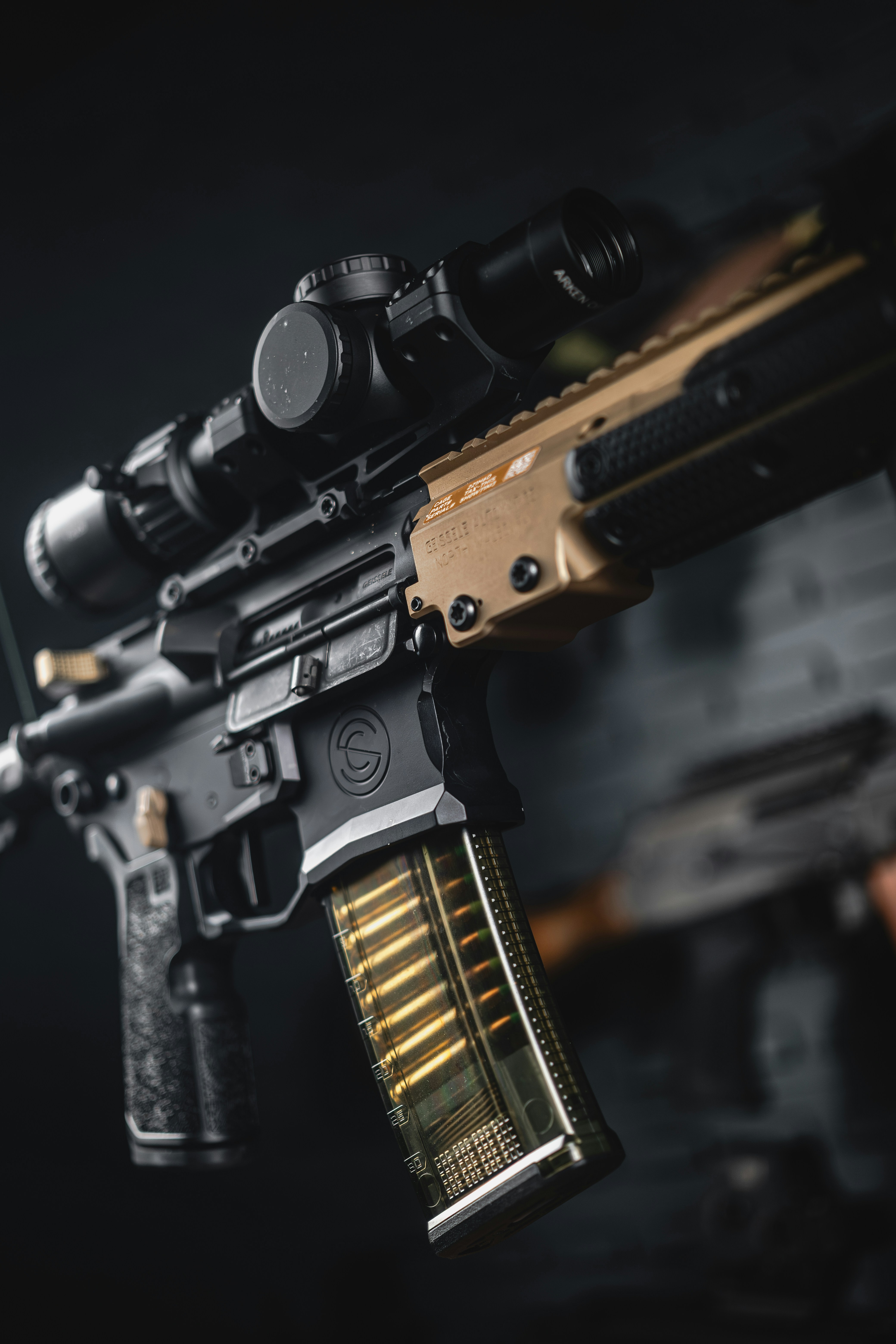
For decades, the 5.56 NATO has been the undisputed king of the AR-15 platform. It's affordable, lightweight, widely available, and has served military personnel, law enforcement officers, competitive shooters, and civilian firearm owners around the world. Whether you're training at the range, defending your home, or enjoying a weekend of recreational shooting, the 5.56 has earned its reputation as one of the most practical rifle cartridges ever developed.
Then came the 6mm ARC.
Introduced by Hornady in 2020, the 6mm Advanced Rifle Cartridge promised something many AR-15 owners had wanted for years: significantly better long-range performance without moving to a larger AR-10 platform. It offered flatter trajectories, less wind drift, improved retained energy, and excellent accuracy all while fitting inside a standard AR-15 magazine.
Naturally, shooters began asking the same question.
Is the 6mm ARC actually worth upgrading to, or is the 5.56 NATO still the better choice?
The answer depends entirely on what you expect your rifle to do.
If your shooting consists primarily of home defense, recreational target practice, and range sessions inside 300 yards, the 5.56 NATO remains extremely difficult to beat.
If your goal is stretching the effective range of your AR-15, improving long-range precision, or increasing downrange energy without stepping up to a heavier rifle platform, the 6mm ARC offers advantages that simply can't be ignored.
This guide compares the two cartridges in detail, examining everything from velocity and muzzle energy to wind drift, recoil, effective range, ammunition availability, and overall value. By the end, you'll have a clear understanding of which cartridge better fits your shooting style—and whether upgrading your AR-15 makes sense.
At a Glance
Choose 5.56 NATO if you want affordable ammunition, light recoil, excellent magazine capacity, and outstanding performance inside 300 yards.
Choose 6mm ARC if you want superior long-range accuracy, less wind drift, greater retained energy, and improved performance beyond 400 yards.
Most shooters don't need to replace their 5.56 rifle—but many serious long-range shooters find the 6mm ARC to be a worthwhile upgrade.
Thinking about upgrading your AR-15?
Why Are So Many AR-15 Owners Considering the 6mm ARC?
When the AR-15 became America's most popular rifle, the 5.56 NATO naturally became its most popular cartridge.
It's easy to understand why.
The 5.56 offers low recoil, inexpensive ammunition, lightweight magazines, and enough accuracy for virtually any practical use inside normal shooting distances. For decades, it has served as the benchmark by which nearly every modern AR-15 cartridge has been judged.
But every cartridge has limitations.
As shooting distances increase, the lightweight bullets commonly used in the 5.56 begin losing velocity relatively quickly. Wind drift becomes more noticeable, retained energy decreases, and accurate shot placement becomes increasingly difficult.
For recreational shooters firing at 100 yards, those limitations rarely matter.
For shooters engaging steel at 700 yards or competing in precision rifle matches, they become much more apparent.
That's exactly the problem the 6mm ARC was designed to solve.
Rather than replacing the 5.56 NATO, Hornady developed a cartridge that could extend the capabilities of the AR-15 platform while requiring only a barrel, bolt, and magazine change.
The result is a rifle that maintains the familiar handling characteristics of the AR-15 while dramatically improving its long-range performance.
A Brief History
Although these cartridges now compete for many of the same shooters, they were developed decades apart for completely different purposes.
5.56 NATO
The 5.56 NATO traces its origins back to the late 1950s and early 1960s, when military planners sought a lightweight, high-velocity cartridge capable of replacing larger battle rifle cartridges.
Its adoption alongside the M16 rifle fundamentally changed military small arms.
Civilian shooters quickly embraced the cartridge because of its low recoil, flat trajectory, affordable ammunition, and outstanding versatility.
Today, it remains one of the most popular rifle cartridges in the world.
6mm ARC
The 6mm ARC was introduced by Hornady in 2020 after years of development alongside military personnel seeking greater long-range performance from the AR-15 platform.
Rather than increasing caliber alone, Hornady optimized nearly every aspect of the cartridge.
Using the proven 6.5 Grendel case as its foundation, engineers necked the cartridge down to accept high-ballistic-coefficient 6mm bullets capable of retaining velocity and resisting wind drift far better than traditional 5.56 projectiles.
The result was a cartridge specifically designed to excel where the 5.56 begins reaching its practical limitations.
Cartridge Specifications
Although both cartridges fit inside the AR-15 platform, they're very different from a technical standpoint.
5.56 NATO
- Bullet Diameter: .224 inch
- Overall Length: 2.26 inches
- Common Bullet Weights: 55, 62, 69, 77 grains
- Typical Uses: Training, home defense, recreational shooting, duty use
6mm ARC
- Bullet Diameter: .243 inch
- Overall Length: 2.26 inches
- Common Bullet Weights: 58, 87, 90, 103, 105, 108 grains
- Typical Uses: Long-range shooting, precision competition, predator control, outdoor shooting, medium game hunting where legal
Notice something interesting.
Despite firing significantly larger bullets, both cartridges maintain the same overall cartridge length.
That's because the 6mm ARC was specifically engineered to function reliably inside standard AR-15 magazines.
Why Does the 6mm ARC Shoot Flatter?
One of the biggest misconceptions about rifle cartridges is that velocity alone determines long-range performance.
In reality, bullet design plays an equally important role.
The 5.56 NATO generally launches lighter bullets at higher initial velocities.
The 6mm ARC often starts slightly slower.
Yet despite that, the 6mm ARC frequently outperforms the 5.56 at extended distances.
Why?
Because of ballistic coefficient.
The long, streamlined 6mm bullets used by the ARC retain velocity much more efficiently than the lighter .224-caliber bullets commonly fired by the 5.56.
Instead of slowing rapidly after leaving the muzzle, they continue carrying energy farther downrange while resisting crosswinds more effectively.
That's why many shooters notice the biggest difference between these cartridges beyond 400 yards rather than at the muzzle.
Ballistics Comparison
Although individual loads vary by manufacturer, the performance differences between these cartridges are remarkably consistent.
55 Grain 5.56 NATO
- Approximately 3,240 fps
- Extremely light recoil
- Excellent for training and general-purpose shooting
62 Grain M855
- Approximately 3,020 fps
- Military-standard loading
- Good balance of penetration and trajectory
77 Grain Match
- Approximately 2,750 fps
- Excellent long-range accuracy
- Popular among competitive shooters
87 Grain 6mm ARC
- Approximately 2,800 fps
- Flat trajectory
- Excellent predator load
103 Grain 6mm ARC
- Approximately 2,800 fps
- Outstanding retained energy
- Excellent all-around load
108 Grain Match
- Approximately 2,750 fps
- Exceptional ballistic coefficient
- Designed for precision shooting
Although the 5.56 NATO often begins with higher muzzle velocity when using lighter bullets, the 6mm ARC quickly begins to close the gap as distances increase. Its heavier, more aerodynamic projectiles retain velocity more efficiently, resist wind drift far better, and deliver noticeably greater energy farther downrange.
That's one of the primary reasons precision shooters have embraced the cartridge. Instead of focusing solely on muzzle velocity, the 6mm ARC emphasizes efficient flight characteristics that become increasingly important at extended ranges.
Wind Drift: Where the 6mm ARC Really Shines
If there is one category that best demonstrates why the 6mm ARC was developed, it's wind drift.
Crosswinds become one of the greatest challenges in long-range shooting. Even relatively mild winds can push lightweight bullets several feet off target at extended distances.
Because the 6mm ARC fires long, high-ballistic-coefficient bullets, it resists wind noticeably better than standard 5.56 NATO ammunition.
This advantage becomes increasingly obvious beyond 400 yards.
At 800 yards, many 6mm ARC match loads experience substantially less wind drift than comparable 5.56 NATO loads, making corrections easier and improving hit probability on distant steel targets.
This is one of the primary reasons competitive shooters and precision rifle enthusiasts have embraced the cartridge. Reduced wind drift doesn't eliminate the need to read the wind, but it provides a larger margin for error when conditions aren't perfect.
For shooters who spend most of their time inside 200 yards, the difference may never be noticed.
For shooters stretching an AR-15 to 800 yards and beyond, it can be one of the most important advantages the cartridge offers.
Effective Range
The most significant difference between the 6mm ARC and the 5.56 NATO isn't what happens at the muzzle.
It's what happens hundreds of yards downrange.
Inside 200 or even 300 yards, both cartridges perform exceptionally well. At these distances, the average shooter is unlikely to notice a dramatic difference in trajectory or practical accuracy.
That's one reason the 5.56 NATO has remained America's most popular AR-15 cartridge for decades.
As the distance increases, however, the two cartridges begin to separate.
The lightweight bullets commonly used in 5.56 NATO ammunition lose velocity relatively quickly. Wind has a greater influence on bullet flight, retained energy begins to drop, and making consistent hits becomes increasingly difficult.
The 6mm ARC was specifically engineered to overcome those limitations.
Its longer, heavier, high-ballistic-coefficient bullets maintain velocity more efficiently, allowing them to stay flatter, drift less in crosswinds, and carry substantially more energy to the target.
For shooters stretching their rifles to 500, 700, or even 1,000 yards, those differences become impossible to ignore.
While a skilled marksman can certainly shoot a 5.56 accurately at extended distances, the 6mm ARC simply makes the task easier.
Recoil Comparison
One concern many AR-15 owners have before switching to the 6mm ARC is recoil.
Fortunately, the increase is much smaller than many people expect.
The 5.56 NATO remains one of the lightest-recoiling centerfire rifle cartridges available. Its mild recoil allows rapid follow-up shots, fast target transitions, and comfortable shooting during long training sessions.
The 6mm ARC does produce slightly more recoil.
After all, it's launching heavier bullets with significantly greater downrange energy.
However, because it's still chambered in the AR-15 platform, recoil remains remarkably manageable.
Most shooters describe it as a noticeable but modest increase over the 5.56 rather than a dramatic jump.
Unlike moving to an AR-10 chambered in .308 Winchester or 6.5 Creedmoor, the 6mm ARC maintains much of the AR-15's familiar handling characteristics while delivering substantially greater long-range performance.
For many shooters, that's one of its biggest advantages.
Accuracy
Both cartridges are capable of exceptional accuracy.
The biggest difference isn't mechanical precision.
It's consistency at distance.
A quality AR-15 chambered in 5.56 NATO can easily produce sub-MOA groups with match ammunition.
Likewise, quality 6mm ARC rifles routinely deliver outstanding precision using factory match loads.
The difference begins appearing once wind, bullet drop, and retained velocity start affecting the shot.
Because the 6mm ARC's bullets resist wind drift more effectively and retain velocity longer, shooters often find it easier to maintain tight groups at extended distances.
That doesn't mean the cartridge is inherently "more accurate."
Instead, it gives shooters a greater margin for error as distances increase.
Inside 100 or 200 yards, either cartridge is capable of excellent precision.
At 600 yards and beyond, the advantages of the 6mm ARC become increasingly apparent.
Home Defense
For home defense, the conversation changes considerably.
Very few defensive shootings occur beyond typical room distances.
Inside a home, the long-range advantages of the 6mm ARC simply aren't relevant.
The 5.56 NATO has become one of the most popular home-defense rifle cartridges because of its light recoil, excellent magazine capacity, widespread ammunition availability, and extensive selection of high-quality defensive loads.
It also allows faster follow-up shots for many shooters.
Could the 6mm ARC serve in the same role?
Absolutely.
However, its strengths lie elsewhere.
Most shooters choosing the 6mm ARC aren't doing so because they're looking for a better home-defense cartridge.
They're looking for greater capability once distances extend well beyond what the average defensive encounter demands.
For that reason, the 5.56 NATO remains the more practical choice for most dedicated home-defense rifles.
Practical Uses
Although these cartridges share the same rifle platform, they're often chosen for very different reasons.
Choose 5.56 NATO If You Want...
- Affordable ammunition for frequent practice.
- Low recoil for new shooters.
- Excellent home-defense performance.
- High-volume recreational shooting.
- A proven general-purpose AR-15 cartridge.
For the vast majority of AR-15 owners, the 5.56 NATO continues to offer the best balance of affordability, reliability, and versatility.
Choose 6mm ARC If You Want...
- Better long-range performance.
- Less wind drift.
- Greater retained energy.
- Improved precision beyond 400 yards.
- A cartridge designed specifically to maximize the AR-15 platform at extended distances.
If your primary interest is stretching your AR-15 as far as possible without moving to an AR-10, the 6mm ARC offers a compelling upgrade.
Magazine Capacity
One advantage often overlooked is magazine capacity.
Standard 5.56 AR-15 magazines typically hold 30 rounds, making them ideal for training, competition, and defensive use.
Because of its larger case design, the 6mm ARC generally requires dedicated magazines.
Capacity is also reduced.
Most magazines designed for the cartridge hold approximately 24 to 26 rounds, depending on the manufacturer.
For precision shooting, this reduction is rarely important.
For shooters who value maximum capacity, the 5.56 maintains an advantage.
Ammunition Availability and Cost
This is one category where the 5.56 NATO remains the clear winner.
Walk into nearly any sporting goods store, gun shop, or outdoor retailer in the United States, and you'll likely find multiple shelves dedicated to 5.56 NATO ammunition.
Practice ammunition is abundant.
Defensive loads are plentiful.
Bulk cases are easy to purchase.
The 6mm ARC has improved dramatically since its introduction, but it still doesn't enjoy the same widespread availability.
Most major online retailers regularly carry multiple factory loads, yet local inventory can vary depending on your area.
Price is another consideration.
Practice-grade 5.56 NATO ammunition remains one of the most affordable centerfire rifle options available.
The 6mm ARC typically costs noticeably more per round, especially when purchasing premium hunting or match ammunition.
For shooters firing thousands of rounds every year, ammunition cost alone may influence the decision.
Barrel Life
One topic that's often overlooked when comparing rifle cartridges is barrel life.
Because the 5.56 NATO operates at moderate pressures while using relatively small powder charges, quality barrels often deliver excellent service life before accuracy begins to decline.
The 6mm ARC also offers respectable barrel life, though it generally won't match the longevity of a comparable 5.56 barrel.
The cartridge's larger powder charge and heavier bullets naturally create more barrel wear over time.
For the average recreational shooter, however, this difference is unlikely to become a practical concern.
Most owners will enjoy many years of accurate shooting before barrel replacement ever becomes necessary.
Is It Worth Upgrading Your AR-15?
This is ultimately the question that brings most people to this comparison.
The answer depends entirely on how you use your rifle.
If your AR-15 spends most of its time at the local range, serves as a home-defense firearm, or rarely sees targets beyond 300 yards, the 5.56 NATO remains one of the smartest choices available.
It's affordable, dependable, easy to shoot, and supported by an enormous selection of factory ammunition.
For many shooters, there simply isn't a compelling reason to change.
If, however, you've found yourself wanting better performance beyond 400 or 500 yards, struggling with wind drift during precision shooting, or looking for a cartridge that pushes the AR-15 platform to its practical limits, the 6mm ARC becomes a very attractive option.
Rather than replacing the 5.56 NATO, it complements it.
Many experienced shooters ultimately own both.
One rifle serves as an economical, general-purpose workhorse.
The other becomes a dedicated long-range precision platform.
That combination allows each cartridge to do exactly what it was designed to do.
Frequently Asked Questions
Is the 6mm ARC more accurate than the 5.56 NATO?
Not necessarily.
Both cartridges are capable of exceptional accuracy. The advantage of the 6mm ARC comes from its superior long-range ballistics, reduced wind drift, and greater retained energy at extended distances.
Does the 6mm ARC have more recoil?
Yes, but only slightly.
Most shooters describe the increase as noticeable without being difficult to manage.
Is the 6mm ARC worth the extra cost?
For long-range precision shooters, many believe the answer is yes.
For casual shooters who primarily shoot inside 300 yards, the benefits may not justify the additional ammunition cost.
Can I convert my existing AR-15 to 6mm ARC?
Yes.
Most conversions require a new barrel, a compatible bolt, and dedicated magazines while allowing you to keep your existing lower receiver.
Which cartridge is better for beginners?
The 5.56 NATO.
Its lower recoil, lower ammunition cost, and greater availability make it one of the best rifle cartridges for new AR-15 owners.
Final Verdict
The 5.56 NATO and 6mm ARC represent two different approaches to getting the most out of the AR-15 platform.
The 5.56 remains one of the most versatile rifle cartridges ever developed. It's affordable, widely available, easy to shoot, and exceptionally effective for training, home defense, recreational shooting, and general-purpose use. For most AR-15 owners, it continues to be the cartridge that offers the best balance of performance and value.
The 6mm ARC, on the other hand, was designed to answer a very specific question:
"How can we make the AR-15 perform better at long range?"
It answers that question remarkably well.
With superior ballistic coefficients, reduced wind drift, greater retained energy, and outstanding accuracy beyond 400 yards, the 6mm ARC unlocks capabilities that standard 5.56 NATO simply wasn't designed to provide.
So, is it worth upgrading?
If you're happy with your rifle's performance inside normal shooting distances, probably not.
If you're ready to push your AR-15 farther, shoot more accurately in windy conditions, and get the absolute most from the platform without moving to an AR-10, the 6mm ARC is one of the best upgrades available today.
Neither cartridge replaces the other.
Instead, each excels in the role it was designed to fill.
Ready to compare prices? Browse current listings for both 5.56 NATO and 6mm ARC ammunition to find the best load for your rifle, your budget, and your next day at the range.