
'%3e%3cpath%20d='M25.8906%2030.68L16.0006%2025L6.14062%2030.68V4.55C6.14063%203.75435%206.4567%202.99129%207.0193%202.42868C7.58191%201.86607%208.34498%201.55%209.14063%201.55H22.8906C23.6863%201.55%2024.4493%201.86607%2025.0119%202.42868C25.5746%202.99129%2025.8906%203.75435%2025.8906%204.55V30.68ZM9.14063%203.55C8.87541%203.55%208.62105%203.65536%208.43352%203.84289C8.24598%204.03043%208.14063%204.28478%208.14063%204.55V27.23L16.0006%2022.72L23.8806%2027.23V4.55C23.8806%204.28478%2023.7753%204.03043%2023.5877%203.84289C23.4002%203.65536%2023.1458%203.55%2022.8806%203.55H9.14063Z'%20fill='white'/%3e%3cpath%20d='M9.14063%202.55H22.8906C23.4211%202.55%2023.9298%202.76071%2024.3048%203.13579C24.6799%203.51086%2024.8906%204.01957%2024.8906%204.55V8.62H7.14062V4.55C7.14063%204.01957%207.35134%203.51086%207.72641%203.13579C8.10148%202.76071%208.61019%202.55%209.14063%202.55Z'%20fill='%238A3301'/%3e%3cpath%20d='M25.8906%209.62H6.14062V4.55C6.14063%203.75435%206.4567%202.99129%207.0193%202.42868C7.58191%201.86607%208.34498%201.55%209.14063%201.55H22.8906C23.6863%201.55%2024.4493%201.86607%2025.0119%202.42868C25.5746%202.99129%2025.8906%203.75435%2025.8906%204.55V9.62ZM8.14063%207.62H23.8906V4.55C23.8906%204.28478%2023.7853%204.03043%2023.5977%203.84289C23.4102%203.65536%2023.1558%203.55%2022.8906%203.55H9.14063C8.87541%203.55%208.62105%203.65536%208.43352%203.84289C8.24598%204.03043%208.14063%204.28478%208.14063%204.55V7.62Z'%20fill='white'/%3e%3cpath%20d='M16%2020.25C15.7348%2020.25%2015.4804%2020.1446%2015.2929%2019.9571C15.1054%2019.7696%2015%2019.5152%2015%2019.25V14.07C15%2013.8048%2015.1054%2013.5504%2015.2929%2013.3629C15.4804%2013.1754%2015.7348%2013.07%2016%2013.07C16.2652%2013.07%2016.5196%2013.1754%2016.7071%2013.3629C16.8946%2013.5504%2017%2013.8048%2017%2014.07V19.25C17%2019.5152%2016.8946%2019.7696%2016.7071%2019.9571C16.5196%2020.1446%2016.2652%2020.25%2016%2020.25Z'%20fill='white'/%3e%3cpath%20d='M18.5999%2017.66H13.4199C13.1547%2017.66%2012.9004%2017.5546%2012.7128%2017.3671C12.5253%2017.1796%2012.4199%2016.9252%2012.4199%2016.66C12.4199%2016.3948%2012.5253%2016.1404%2012.7128%2015.9529C12.9004%2015.7654%2013.1547%2015.66%2013.4199%2015.66H18.5999C18.8651%2015.66%2019.1195%2015.7654%2019.307%2015.9529C19.4946%2016.1404%2019.5999%2016.3948%2019.5999%2016.66C19.5999%2016.9252%2019.4946%2017.1796%2019.307%2017.3671C19.1195%2017.5546%2018.8651%2017.66%2018.5999%2017.66Z'%20fill='white'/%3e%3c/g%3e%3cdefs%3e%3cclipPath%20id='clip0_29353_35'%3e%3crect%20width='32'%20height='32'%20fill='white'/%3e%3c/clipPath%3e%3c/defs%3e%3c/svg%3e) Wishlist
Wishlist
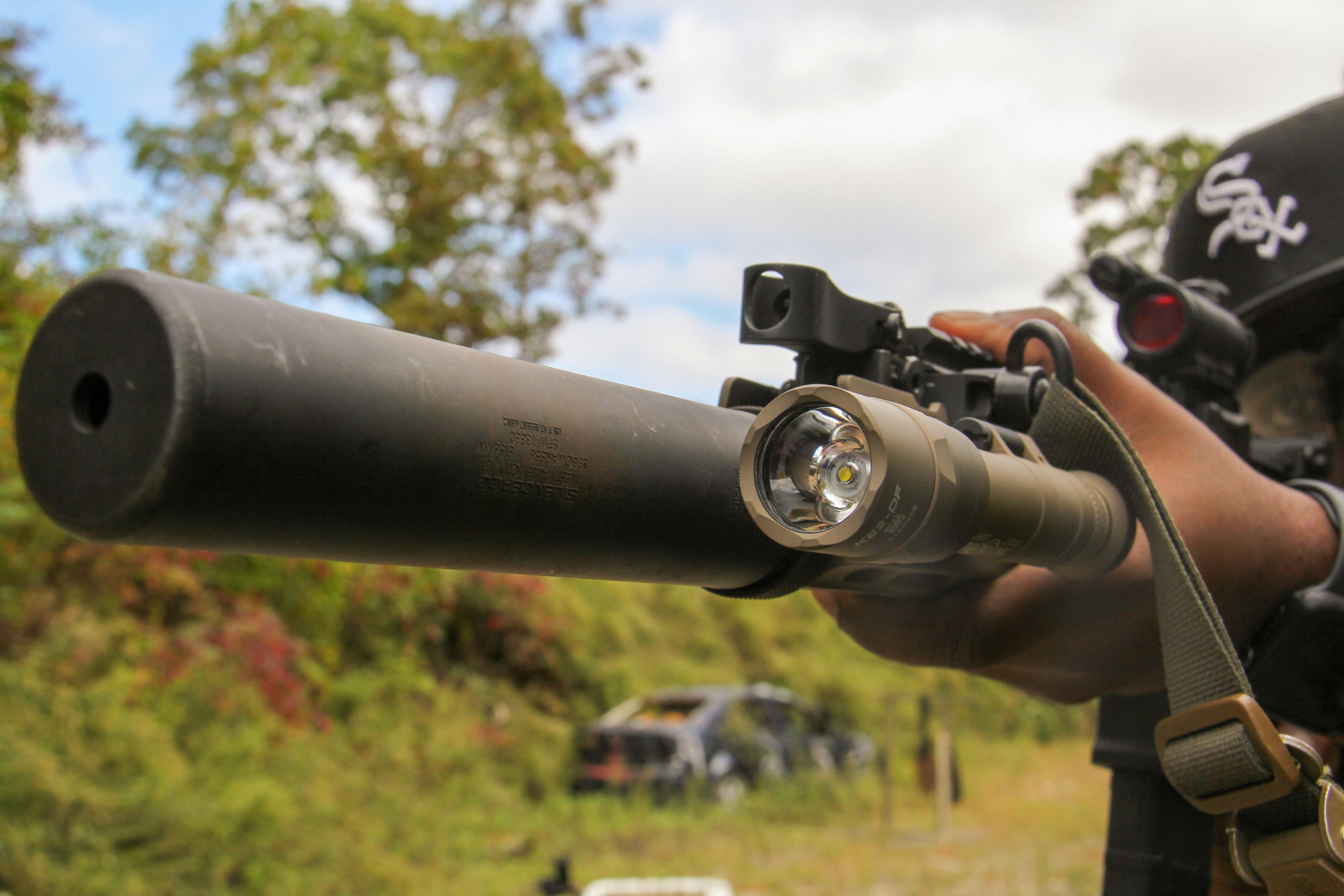
The 8.6 Blackout is one of those cartridges where bullet weight changes far more than a number printed on the ammunition box. Depending on the load, an 8.6 BLK projectile can weigh roughly twice as much as another and travel at dramatically different velocities. Lightweight loads can operate at supersonic speeds approaching conventional rifle cartridge performance, while extremely heavy bullets can travel just below the speed of sound for suppressed use.
That enormous performance range is one of the defining characteristics of 8.6 Blackout. Current ammunition includes everything from lightweight supersonic bullets in the 160-grain range to extremely heavy subsonic projectiles approaching 350 grains. Shooting Times describes the general split as 160- to 210-grain bullets for supersonic ammunition and roughly 280- to 350-grain bullets for subsonic ammunition.
This means asking "What is the best grain for 8.6 Blackout?" doesn't have a simple answer. A 210-grain supersonic load and a 342-grain subsonic load may fit into the same chamber, but they're designed around very different ballistic goals. One emphasizes velocity and a flatter trajectory. The other sacrifices velocity to keep a massive .338-inch projectile below the speed of sound.
There is another characteristic that makes this discussion especially important with 8.6 Blackout: twist rate. The cartridge is closely associated with extremely fast rifling, commonly around a 1:3-inch twist, which produces extraordinary rotational speeds. That has implications for projectile construction, particularly with lightweight supersonic ammunition, and it's one reason we can't discuss 8.6 Blackout bullet weights exactly the same way we would discuss .308 Winchester or even .300 Blackout.
In this guide, we'll break down the major 8.6 Blackout bullet weights, explain the difference between supersonic and subsonic ammunition, and look at how projectile weight affects velocity, muzzle energy, trajectory, recoil, suppressed performance, and practical shooting distance.
Most importantly, we'll answer the question someone shopping for ammunition actually wants answered:
Which 8.6 Blackout bullet weight should you choose?
At a Glance
- 160–210 grain: The lighter, supersonic side of 8.6 Blackout, emphasizing velocity, energy, and a flatter trajectory.
- 285–300 grain: Heavy 8.6 Blackout loads commonly found in the subsonic category, emphasizing projectile mass and suppressed performance.
- 342–350 grain: Extremely heavy subsonic ammunition that pushes the cartridge toward maximum projectile weight while remaining near or below the speed of sound.
Why Bullet Weight Matters So Much in 8.6 Blackout
Bullet weight matters enormously in 8.6 Blackout because the cartridge was designed to operate in two very different velocity regimes. Lightweight bullets can be driven at supersonic rifle velocities, while heavy bullets can be kept around the speed of sound to take advantage of the cartridge's suppressor-oriented design.
That makes 8.6 Blackout fundamentally different from cartridges where moving between bullet weights merely changes velocity by a modest amount. Consider something like .308 Winchester. A shooter choosing between 150-, 165-, and 180-grain .308 ammunition is generally comparing three supersonic loads occupying different positions within the same broad ballistic envelope. With 8.6 Blackout, moving from a lightweight supersonic projectile to a 300-plus-grain subsonic projectile can completely change the rifle's trajectory, energy, sound characteristics, and useful shooting distance.
Current factory ammunition demonstrates just how large that difference can be. Ammo.com's manufacturer based data includes a 210-grain Barnes TSX load at a published 1,970 fps, while several 285-, 300-, and 342-grain offerings operate around 1,000 fps. That isn't a minor velocity change caused by adding a few grains of bullet weight. It's essentially two different ballistic personalities contained within one cartridge.
This is why we shouldn't approach the question by asking whether a heavier 8.6 Blackout bullet is simply "better." The more useful question is what you're trying to accomplish. If velocity and a flatter trajectory are the priorities, lighter supersonic ammunition has an obvious advantage. If subsonic suppressed performance is the objective, a much heavier projectile becomes attractive precisely because maximum velocity is no longer the goal.
What Does Grain Mean in 8.6 Blackout Ammunition?
A grain is a unit of mass used to describe bullet weight, not the amount of powder contained inside the cartridge. There are 7,000 grains in one pound, and ammunition manufacturers commonly identify loads by projectile weight using this measurement.
When you see 210 gr printed on an 8.6 Blackout ammunition box, that normally means the projectile weighs 210 grains. Likewise, a 300-grain load uses a projectile weighing 300 grains.
That distinction becomes especially useful with 8.6 BLK because the grain number immediately gives you some information about what kind of ammunition you're probably looking at. A 160- or 185-grain load will generally be associated with the supersonic end of the cartridge. A 300- or 342-grain load will generally fall into the heavy subsonic category.
But grain weight alone doesn't tell you everything.
A bullet's construction matters tremendously, particularly with 8.6 Blackout's unusually fast rifling twist. Two bullets of similar weight can be built differently and behave very differently both in flight and after impact. You should therefore treat grain weight as one of the first pieces of information used to evaluate a load, not as a complete description of its performance.
Understanding Supersonic vs. Subsonic 8.6 Blackout
The most important division in 8.6 Blackout ammunition isn't really 210 grain vs. 285 grain or 300 grain vs. 342 grain. It's supersonic vs. subsonic.
Supersonic ammunition propels the bullet faster than the local speed of sound. The exact speed of sound varies with atmospheric conditions, so there isn't one velocity threshold that applies everywhere, but roughly 1,100 fps is a useful general reference.
Subsonic ammunition is intentionally loaded so the projectile remains below that threshold under its intended conditions.
Why would anyone deliberately make a rifle bullet slower?
Suppressors.
A suppressor can significantly reduce the muzzle blast produced when high-pressure propellant gases exit the barrel, but it cannot eliminate the ballistic crack created by a projectile traveling faster than sound. Keeping the projectile subsonic eliminates that component of the sound signature.
The obvious problem is energy.
If you're intentionally limiting velocity, you need another way to increase projectile energy and momentum. One solution is bullet mass, and 8.6 Blackout has a tremendous amount available.
This is why the heavy end of the cartridge becomes so interesting.
Shooting Times cites subsonic bullets roughly between 286 and 350 grains traveling around 1,050 fps, while its supersonic category spans roughly 160 to 210 grains. That allows 8.6 BLK to put far more projectile mass into a subsonic load than smaller cartridges can.
The result is a cartridge that can behave very differently simply by changing ammunition.
160–185 Grain 8.6 Blackout
The 160- to 185-grain range represents the lightweight, high-velocity extreme of 8.6 Blackout. These loads are firmly supersonic and attempt to extract as much velocity as practical from the cartridge.
This is where 8.6 BLK starts behaving more like a conventional rifle cartridge.
American Hunter discusses published load data for a 160-grain Barnes TTSX approaching 2,400 fps from a 16-inch barrel, while Shooting Times reported testing a 185-grain Hornady CX supersonic load. These aren't representative of what heavy subsonic 8.6 BLK does; they're examples of just how far toward the high-velocity side the cartridge can be pushed with substantially lighter projectiles.
The ballistic advantage is straightforward. Higher muzzle velocity means less flight time, a flatter trajectory, and considerably more practical flexibility as distance increases. A lightweight supersonic projectile won't exhibit anything approaching the enormous bullet drop associated with a 300-plus-grain projectile traveling around 1,000 fps.
But there's an important complication.
The extremely fast twist rates associated with 8.6 Blackout create enormous rotational speeds when combined with high supersonic velocity. Projectile construction therefore becomes especially important. Shooting Times notes that its discussed 1:3-inch twist can be too aggressive for some conventional non-bonded projectiles at supersonic speeds, which is why suitable solid-copper or otherwise appropriately constructed bullets matter.
This isn't a cartridge where you should select a projectile based solely on diameter and weight.
Typical Characteristics of 160–185 Grain 8.6 Blackout
- Supersonic: Yes
- Velocity: Highest end of the 8.6 BLK spectrum
- Trajectory: Flattest of the major 8.6 Blackout weight categories
- Projectile mass: Light by 8.6 BLK standards
- Major advantage: Velocity and extended practical trajectory
- Major consideration: Projectile construction becomes critical with extremely fast twist rates
What This Means
If you're interested in maximizing the supersonic side of 8.6 Blackout, the lightweight end deserves attention. But this isn't necessarily the ammunition category that defines the cartridge for most shooters. The truly unusual side of 8.6 Blackout appears as projectile weight increases.
210 Grain 8.6 Blackout
The 210-grain category is particularly interesting because it can deliver substantial supersonic performance without moving all the way down to the lightest projectiles available for the cartridge.
A useful real world reference is Gorilla's 210-grain Barnes TSX load. Ammo.com's current manufacturer-ballistics compilation lists it at 1,970 fps and approximately 1,810 ft-lbs of muzzle energy.
American Hunter chronographed the same bullet weight from a 16-inch rifle and recorded 2,116 fps in its test, demonstrating exactly why factory advertised velocity and actual firearm velocity shouldn't be treated as identical numbers.
That is serious velocity for a .338-inch, 210-grain projectile coming from a cartridge designed around relatively compact firearms.
And compared with the heavy subsonic side of 8.6 Blackout, the trajectory difference is enormous.
This makes 210 grain an important reference point for understanding the cartridge. It demonstrates that 8.6 BLK isn't simply a giant subsonic round. With appropriate ammunition, it can produce conventional supersonic rifle performance while still firing a substantially heavier projectile than cartridges like .300 Blackout.
The tradeoff is sound. A projectile traveling nearly 2,000 fps is unquestionably supersonic, so even when a suppressor reduces muzzle blast, the bullet itself still produces a supersonic crack.
Typical Characteristics of 210 Grain 8.6 Blackout
- Supersonic: Yes in representative high-velocity factory loads
- Representative velocity: Around 1,970 fps for a commonly cited factory load
- Representative muzzle energy: Around 1,810 ft-lbs for that same load
- Trajectory: Much flatter than heavy subsonic ammunition
- Major advantage: Strong combination of projectile mass and supersonic velocity
- Major disadvantage: Cannot provide the same sound characteristics as true subsonic ammunition
What This Means
For someone who wants 8.6 Blackout primarily for supersonic performance, 210 grain is one of the most important categories to investigate. It gives the cartridge a very different personality from the heavy 285- to 350-grain ammunition that dominates discussions about suppressed 8.6 BLK.
285–286 Grain 8.6 Blackout
Once we move into the 285- to 286-grain range, we're entering the heavy side of the cartridge where subsonic factory ammunition becomes increasingly prominent.
This is where the philosophy behind 8.6 Blackout begins changing.
The goal is no longer to push a .338-inch projectile as fast as possible. Instead, manufacturers can use an exceptionally heavy bullet while holding velocity around or below the speed of sound.
Current factory offerings illustrate the category well. Ammo.com's manufacturer data includes multiple 285-grain 8.6 Blackout loads, including offerings built around very different projectile designs. That's another reminder that two loads sharing the same grain weight shouldn't automatically be expected to perform identically.
Compared with a 210-grain supersonic load, the velocity loss is substantial. But that's intentional.
A heavy 285-grain projectile provides far more mass while remaining compatible with the subsonic operating envelope that makes suppressed 8.6 Blackout so interesting.
Trajectory becomes the major compromise.
Once velocity falls toward approximately 1,000 fps, gravity has much more time to act on the projectile. Bullet drop increases rapidly as distance grows, and knowing the exact trajectory of your specific ammunition becomes much more important.
Typical Characteristics of 285–286 Grain 8.6 Blackout
- Commonly available as: Subsonic ammunition
- Velocity: Around the subsonic range in representative loads
- Projectile mass: Very heavy
- Trajectory: Considerably more arched than supersonic ammunition
- Major advantage: Heavy projectile while maintaining subsonic operation
- Major disadvantage: Significant velocity and trajectory tradeoff
What This Means
The 285/286-grain category begins showing what makes 8.6 Blackout different from a conventional .338-caliber rifle cartridge. Instead of using a heavy bullet and trying to maximize speed, the cartridge can combine substantial projectile mass with deliberately restrained velocity.
300 Grain 8.6 Blackout
At 300 grains, 8.6 Blackout is firmly into the heavy-projectile territory most closely associated with its subsonic personality. Current factory ammunition includes 300-grain offerings, including Sierra MatchKing-based loads cataloged in available manufacturer ballistic data.
A 300-grain projectile is extraordinarily heavy compared with the bullets most AR-platform shooters are accustomed to. For perspective, it's nearly four times the weight of a 77-grain 5.56 projectile and roughly twice the weight of a common 150-grain .308 bullet.
But again, mass isn't the entire story.
These loads operate at dramatically lower velocity than lightweight supersonic 8.6 BLK ammunition. That means muzzle energy, trajectory, time of flight, and downrange behavior need to be evaluated according to the actual load rather than simply assuming a 300-grain projectile must be "more powerful" because it's heavier.
For suppressed shooting, however, that heavy projectile is exactly the point. It allows the cartridge to carry substantial mass while staying within a subsonic velocity envelope.
Typical Characteristics of 300 Grain 8.6 Blackout
- Commonly: Subsonic
- Projectile weight: Extremely heavy
- Velocity: Roughly around the subsonic range in representative factory ammunition
- Trajectory: Highly arched compared with supersonic 8.6 BLK
- Major advantage: Very heavy projectile suited to the cartridge's subsonic role
- Major disadvantage: Substantial bullet drop as distance increases
What This Means
If you're buying 8.6 Blackout specifically because you're interested in heavy subsonic ammunition, 300 grain sits right in the heart of the category.
342–350 Grain 8.6 Blackout
At approximately 342 to 350 grains, we've reached the extreme heavy end of commonly discussed 8.6 Blackout ammunition.
This is where the cartridge's subsonic concept is taken about as far as practical factory ammunition currently demonstrates.
Ammo.com's manufacturer data includes a 342-grain Gorilla subsonic hunting load at approximately 1,000 fps. Shooting Times discusses the broader heavy subsonic category extending to roughly 350 grains at around 1,050 fps.
The physics here are fascinating.
A 342-grain projectile weighs more than 60 percent more than a 210-grain projectile, yet the representative subsonic load travels at roughly half the velocity of the supersonic 210-grain example.
That creates completely different external ballistics.
The supersonic projectile reaches the target much faster and follows a considerably flatter trajectory. The heavy subsonic projectile sacrifices those advantages to remain below the sound barrier while carrying enormous projectile mass.
This is why comparing these loads purely by bullet weight makes very little sense.
They're designed to accomplish different things.
Typical Characteristics of 342–350 Grain 8.6 Blackout
- Subsonic: Typically
- Representative velocity: Around 1,000–1,050 fps
- Projectile mass: Extremely heavy
- Trajectory: Very arched compared with supersonic loads
- Major advantage: Maximum projectile mass within the heavy subsonic concept
- Major disadvantage: Low velocity and rapidly increasing trajectory correction with distance
What This Means
If your goal is to explore the extreme heavy-subsonic side of 8.6 Blackout, the 342- to 350-grain class represents exactly what makes the cartridge so unusual.
210 vs. 285 vs. 300 vs. 342 Grain: The Big Picture
Looking at these bullet weights together reveals why asking for the "best 8.6 Blackout grain" without providing any context doesn't work.
The 210-grain category represents a compelling supersonic option. It combines a heavy .338-inch projectile with enough velocity to provide dramatically flatter external ballistics than the cartridge's subsonic loads.
The 285/286-grain category moves firmly toward heavy subsonic ammunition, sacrificing velocity in exchange for substantially greater projectile mass while remaining around or below the sound barrier.
The 300-grain category continues that concept and sits squarely in the heavy subsonic territory many shooters associate with 8.6 BLK.
The 342- to 350-grain category pushes the idea even further, placing enormous projectile mass behind a velocity intentionally held near the speed of sound.
And lighter 160- to 185-grain ammunition exists at the opposite extreme, demonstrating just how broad the cartridge's performance envelope can be.
This means the first question when choosing 8.6 Blackout ammunition shouldn't be:
"What grain is best?"
It should be:
"Do I want supersonic or subsonic ammunition?"
Once you answer that, choosing an appropriate bullet weight becomes much easier.
What Happens as 8.6 Blackout Bullet Weight Increases?
In broad terms, increasing 8.6 Blackout bullet weight tends to move factory ammunition away from high-velocity supersonic performance and toward heavy subsonic performance, although individual loads must always be evaluated separately.
The general progression looks like this:
160–185 grain: Lightweight, high velocity supersonic
210 grain: Heavy supersonic
285–286 grain: Heavy subsonic territory
300 grain: Very heavy subsonic
342–350 grain: Extreme heavy subsonic
As projectile weight increases and velocity falls, trajectory becomes increasingly arched. Time of flight increases, range estimation becomes more important, and the ballistic experience changes substantially.
But there's another variable we haven't fully explored yet.
Spin.
The 8.6 Blackout's extremely fast twist rate means these bullets aren't simply moving forward. They're rotating at extraordinary speeds, and the relationship between bullet weight, velocity, construction, and rotational speed is one of the most unusual aspects of the entire cartridge.
That's where this article needs to go next.
8.6 Blackout Bullet Weights: Ballistics, Twist Rate, Trajectory, and Suppressed Performance
The enormous difference between lightweight supersonic and heavy subsonic 8.6 Blackout ammunition becomes much easier to understand once we look beyond muzzle velocity. Bullet weight affects trajectory, energy, recoil, time of flight, and practical shooting distance, but 8.6 Blackout adds another variable that makes it particularly unusual: extremely fast rifling twist.
A 210-grain projectile traveling around 2,000 fps and a 300-plus-grain projectile traveling around 1,000 fps aren't simply different versions of the same load. The supersonic projectile reaches the target much faster and follows a considerably flatter trajectory, while the heavy subsonic projectile sacrifices those advantages to remain below the speed of sound. Add the rotational speeds produced by a 1:3-inch twist barrel, and 8.6 Blackout becomes one of the more unusual modern rifle cartridges to analyze.
Understanding those differences is essential before deciding which bullet weight actually makes sense.
Why Does 8.6 Blackout Use Such a Fast Twist Rate?
One of the defining characteristics of 8.6 Blackout is its unusually fast rifling twist, with 1:3-inch twist barrels closely associated with the cartridge. That means the rifling completes one full rotation in only three inches of barrel travel.
For comparison, many conventional rifle cartridges use dramatically slower twist rates. A fast twist is normally selected to provide sufficient rotational stability for long, heavy projectiles, but 8.6 Blackout pushes the concept much farther than most mainstream rifle cartridges.
The heavy bullets used in subsonic 8.6 Blackout can be extremely long. Because velocity is intentionally limited, the cartridge relies heavily on projectile mass, and stabilizing those long projectiles requires substantial rotational speed. The fast twist allows 8.6 Blackout to stabilize very heavy bullets even when their forward velocity is only around 1,000 fps.
But the implications extend beyond simply keeping the projectile point-forward. The combination of a very fast twist and supersonic velocity can produce extraordinary rotational speeds, which is why projectile construction and manufacturer compatibility become especially important. Shooting Times specifically discusses the cartridge's fast twist and cautions that some conventional jacketed projectiles may not be appropriate for the rotational forces generated by these barrels.
What This Means
With 8.6 Blackout, you shouldn't assume that any .338-inch projectile of the appropriate weight is automatically suitable. Use ammunition and projectiles specifically approved for the barrel, twist rate, and velocity involved.
How Fast Does an 8.6 Blackout Bullet Spin?
Rotational speed depends on two primary variables: muzzle velocity and barrel twist rate. The faster the projectile travels and the faster the rifling twist, the greater the rotational speed.
A useful approximation is:
RPM = Velocity (fps) × 720 ÷ Twist Rate (inches)
Using a 1:3 twist barrel makes the numbers remarkable.
A projectile traveling at approximately 1,000 fps would theoretically rotate at roughly:
240,000 RPM
Increase muzzle velocity to 2,000 fps, and rotational speed becomes approximately:
480,000 RPM
At 2,400 fps, the calculation approaches:
576,000 RPM
Those are approximate values based on muzzle velocity and nominal twist rate, but they demonstrate why projectile construction becomes such an important part of the 8.6 Blackout conversation.
The difference between a 300-grain subsonic bullet and a lightweight supersonic projectile isn't merely that one travels faster. The faster bullet can also be rotating at dramatically higher speed.
Does the Fast Twist Increase 8.6 Blackout Energy?
This is an area where discussions about 8.6 Blackout can become misleading.
The projectile absolutely contains rotational kinetic energy in addition to the translational kinetic energy represented by conventional muzzle-energy calculations. However, you shouldn't simply treat rotational energy as additional conventional muzzle energy or assume that an extremely fast twist automatically creates a specific increase in terminal effectiveness.
Standard ammunition energy figures—such as 1,800 ft-lbs—refer primarily to the projectile's translational kinetic energy, calculated from its mass and forward velocity.
Rotation is a separate physical phenomenon.
The fast twist is unquestionably one of the defining engineering characteristics of 8.6 Blackout, and projectile rotation can influence stability and projectile behavior. But terminal performance still depends heavily on bullet construction, impact velocity, expansion or fragmentation characteristics, and the medium being struck.
So when evaluating ammunition, don't assume:
Faster spin = automatically more effective ammunition.
That's too simplistic.
What we can say confidently is that the extremely fast twist places unusual demands on projectile construction and allows the cartridge to stabilize long, heavy projectiles at relatively low forward velocities.
Why Bullet Construction Matters With 8.6 Blackout
Bullet construction is particularly important with 8.6 Blackout because the cartridge combines extremely fast twist rates with an enormous velocity range. A projectile that works perfectly at subsonic velocity may not necessarily be appropriate when driven much faster through a 1:3 twist barrel.
This is one reason solid-copper and purpose-designed projectiles appear frequently in 8.6 Blackout ammunition. The projectile needs to tolerate the rotational forces generated by the barrel while also performing correctly at its intended impact velocity.
This becomes even more important when comparing subsonic ammunition.
Traditional rifle bullets are often engineered to expand within particular impact-velocity ranges. A bullet designed around conventional supersonic rifle velocity may behave very differently when it strikes a target at roughly 900 or 1,000 fps.
Consequently, a 300-grain projectile designed specifically to expand at subsonic velocity can be fundamentally different from another 300-grain projectile intended primarily for target shooting.
This reinforces a point from earlier:
Grain weight alone doesn't determine terminal performance.
A bullet's construction may be just as important as its weight.
8.6 Blackout Supersonic vs. Subsonic Ballistics
The easiest way to understand the ballistic difference between supersonic and subsonic 8.6 Blackout is to compare representative factory loads rather than treating every bullet of a given weight as identical.
Current published factory data includes a 210-grain Barnes TSX load around 1,970 fps, while heavy 285-, 300-, and 342-grain subsonic loads generally sit around the 1,000-fps neighborhood.
Exact numbers depend on manufacturer, barrel length, environmental conditions, and the individual firearm.
That roughly two-to-one difference in velocity has enormous consequences.
The supersonic projectile has a much shorter flight time. Gravity therefore has less time to pull the bullet downward before it reaches the target. The result is a substantially flatter trajectory and a much easier ballistic problem as distance increases.
The heavy subsonic projectile takes considerably longer to cover the same distance. Consequently, bullet drop becomes increasingly dramatic, and small errors in range estimation become much more important.
Neither behavior is inherently superior.
They're optimized around different objectives.
8.6 Blackout at 50 Yards
At 50 yards, both supersonic and subsonic 8.6 Blackout ammunition remain relatively straightforward to use when the rifle is properly zeroed for the particular load.
A 210-grain supersonic projectile reaches the target very quickly and hasn't had enough flight time for gravity to create substantial drop. Heavy subsonic ammunition is moving dramatically slower, but 50 yards is still close enough that the trajectory can be easily managed with an appropriate zero.
This is an important distance for heavy subsonic ammunition because it allows the shooter to take advantage of the cartridge's suppressor-oriented characteristics without yet dealing with the extreme trajectory penalties that become increasingly apparent farther downrange.
The critical issue is zero. A rifle zeroed with 210-grain supersonic ammunition shouldn't be assumed to produce the same point of impact when loaded with 300- or 342-grain subs.
What This Means
At 50 yards, both supersonic and subsonic 8.6 Blackout are easy to manage ballistically, provided you know where your particular load impacts.
8.6 Blackout at 100 Yards
At 100 yards, the separation between the two ammunition categories becomes much more obvious.
Supersonic 8.6 Blackout still behaves much like a conventional rifle cartridge. A projectile starting near 2,000 fps retains substantial velocity, and its trajectory remains relatively manageable.
A 300-plus-grain subsonic bullet starts around half as fast.
That means it spends much longer in flight before reaching 100 yards, giving gravity considerably more time to act on it. The exact drop depends on muzzle velocity, ballistic coefficient, sight height, atmospheric conditions, and zero distance, so there isn't one responsible universal "8.6 Blackout drops X inches at 100 yards" figure.
This is especially important with 8.6 BLK because the cartridge's ammunition is so diverse.
A trajectory figure calculated for a 210-grain supersonic load tells you almost nothing about the trajectory of a 342-grain subsonic load.
What This Means
At 100 yards, supersonic ammunition has the clear trajectory advantage, while heavy subsonic ammunition remains very usable when the shooter understands the specific load's trajectory.
8.6 Blackout at 200 Yards
At 200 yards, velocity becomes one of the dominant factors in the comparison.
A 210-grain supersonic load remains within a distance where its trajectory can be managed relatively easily with an appropriate zero and optic. Bullet drop is becoming more significant, but the projectile's higher velocity keeps flight time comparatively short.
Heavy subsonic ammunition is now presenting a much more difficult ballistic problem.
A projectile moving around 1,000 fps takes considerably longer to travel 200 yards, producing substantially more drop. Range estimation becomes increasingly important because even relatively small errors in target distance can result in meaningful vertical displacement.
Again, this doesn't mean a 300- or 342-grain bullet cannot travel 200 yards.
It absolutely can.
But maximum travel distance and practical effective range aren't the same thing.
If the objective is simply to hit targets at 200 yards with the easiest trajectory possible, supersonic ammunition has a major advantage.
What This Means
At 200 yards, I'd strongly favor supersonic 8.6 Blackout when external ballistics are the priority. Heavy subs are increasingly specialized at this distance.
8.6 Blackout at 300 Yards
At 300 yards, the difference becomes dramatic.
A quality supersonic 8.6 Blackout load is still capable of reaching the target with substantial retained velocity, although the cartridge shouldn't be mistaken for a purpose-built high-velocity long-range round. The shooter needs to understand bullet drop and make appropriate corrections.
Heavy subsonic ammunition presents a very different challenge.
At roughly 1,000 fps at the muzzle, flight time is long, trajectory is highly arched, and accurate range estimation becomes critical. A relatively small error in estimated distance can translate into a substantial vertical miss.
This is one reason claims about the "effective range" of subsonic rifle cartridges need context. A projectile may remain physically capable of traveling well beyond 300 yards, but that doesn't mean it offers the same practical usability as a supersonic rifle load at that distance.
What This Means
For 300-yard shooting, supersonic 8.6 Blackout is overwhelmingly the more practical choice of the two categories.
If 300 yards and beyond represents most of your shooting, however, the larger question becomes whether 8.6 Blackout is the optimal cartridge for your particular needs.
Which 8.6 Blackout Bullet Weight Shoots Flattest?
The lightweight supersonic end of the 8.6 Blackout spectrum generally produces the flattest trajectory, because those projectiles achieve the highest muzzle velocities.
A 160- or 185-grain supersonic projectile can be driven considerably faster than a 210-grain load, while the 210-grain category itself remains dramatically faster than 285- to 350-grain subsonic ammunition.
In broad terms, the trajectory hierarchy looks like this:
- 160–185 grain supersonic: Flattest
- 210 grain supersonic: Very good by 8.6 BLK standards
- 285/286 grain subsonic: Significant drop
- 300 grain subsonic: Significant drop
- 342–350 grain subsonic: Extremely arched trajectory compared with supers
But remember that ballistic coefficient, actual muzzle velocity, zero distance, and projectile design matter. You cannot accurately calculate trajectory from bullet weight alone.
Which 8.6 Blackout Bullet Weight Has the Most Muzzle Energy?
The answer depends on the actual loads being compared, because velocity has an enormous influence on kinetic energy.
This produces a counterintuitive result.
A 342-grain projectile is substantially heavier than a 210-grain projectile, but if the 342-grain bullet is traveling at approximately 1,000 fps while the 210-grain bullet is approaching 2,000 fps, the lighter supersonic load can produce substantially more muzzle energy.
Using representative published factory figures illustrates the point.
A 210-grain Barnes TSX at approximately 1,970 fps is listed around 1,810 ft-lbs of muzzle energy.
A 342-grain subsonic projectile at approximately 1,000 fps works out to roughly 760 ft-lbs of conventional translational kinetic energy.
That's a huge difference despite the subsonic projectile weighing considerably more.
Why?
Because kinetic energy increases with the square of velocity.
Doubling velocity has a much greater effect on kinetic energy than simply doubling bullet mass.
This is why the statement "heavier bullets hit harder" is too simplistic to be useful when comparing supersonic and subsonic 8.6 Blackout.
Does 8.6 Blackout Have Heavy Recoil?
8.6 Blackout recoil varies considerably with load and firearm configuration, and bullet weight alone doesn't tell the whole story.
A lightweight supersonic projectile is moving much faster, while a heavy subsonic projectile has substantially more mass but dramatically less velocity. Powder charge, firearm weight, suppressor use, stock design, and the operating system all influence what the shooter ultimately feels.
This is another situation where comparing actual factory loads is more useful than assuming a 342-grain projectile must automatically recoil much harder than a 210-grain projectile.
Both are still launching very substantial .338-inch bullets, so 8.6 Blackout isn't intended to replicate the extremely mild recoil of something like 5.56 NATO.
At the same time, its performance shouldn't be confused with traditional high-velocity .338 magnum cartridges either. The cartridges operate in completely different pressure, velocity, and ballistic environments.
Why 8.6 Blackout Works So Well From Short Barrels
One of 8.6 Blackout's major design advantages is its ability to produce useful performance from relatively short barrels.
The cartridge doesn't depend on an extremely long barrel to achieve its intended purpose, which makes it attractive for compact rifle configurations and suppressed setups where overall firearm length can become an important consideration.
This is particularly useful with suppressors.
Adding a suppressor increases overall length. Starting with a shorter barrel can therefore produce a much more manageable overall package than attaching the same suppressor to a conventional 20- or 24-inch rifle.
Short barrels also align naturally with the cartridge's heavy subsonic role. A 300-plus-grain projectile isn't trying to reach 2,500 or 3,000 fps. Its velocity is intentionally constrained near the speed of sound.
Supersonic ammunition is more sensitive to barrel length because velocity is one of its major advantages. A longer barrel may increase velocity depending on the specific load, while a shorter barrel may reduce it.
This is why published velocities should always be evaluated alongside the manufacturer's test-barrel length.
8.6 Blackout Suppressed vs. Unsuppressed
You can shoot 8.6 Blackout with or without a suppressor, but heavy subsonic ammunition makes substantially more sense when a suppressor is part of the system.
Without a suppressor, a subsonic projectile still eliminates the ballistic crack because it remains below the speed of sound. However, the firearm still produces significant muzzle blast.
Attach a suppressor and you address both major sound components: the suppressor reduces the muzzle blast while subsonic ammunition avoids the supersonic crack.
Supersonic ammunition also benefits from a suppressor because muzzle blast is reduced, but the projectile still creates its ballistic crack as it travels through the atmosphere.
This means a suppressor doesn't magically turn supersonic ammunition into subsonic ammunition.
210-grain supersonic ammunition remains supersonic.
300-grain ammunition loaded for subsonic operation remains the subsonic choice.
The suppressor changes the firearm's sound signature. It doesn't fundamentally rewrite the ammunition's external ballistics.
Is 8.6 Blackout Better Suppressed?
If the goal is to take advantage of heavy subsonic ammunition, a suppressor is a major part of what makes 8.6 Blackout compelling.
Without one, you're accepting the lower velocity, dramatically greater bullet drop, and reduced conventional muzzle energy of subsonic ammunition without receiving the full sound-reduction benefit of the suppressed system.
That doesn't mean 8.6 BLK requires a suppressor.
Its supersonic ammunition can deliver impressive performance from compact firearms without one.
It's better to think of the cartridge as having two distinct personalities.
The first is a compact .338-caliber supersonic cartridge.
The second is a very heavy .338-caliber subsonic cartridge optimized around suppressed use.
Which personality matters more depends on why you bought the rifle.
210 Grain vs. 300 Grain 8.6 Blackout
The 210 vs. 300 grain comparison demonstrates the supersonic/subsonic divide particularly well.
A representative 210-grain supersonic load can approach approximately 2,000 fps, giving it a much flatter trajectory and substantially greater conventional muzzle energy.
A representative 300-grain subsonic load operates around 1,000 fps.
The 300-grain projectile is about 43 percent heavier, yet it travels at roughly half the velocity.
That means the 210-grain load offers:
- Much greater velocity
- Flatter trajectory
- Shorter time of flight
- More conventional muzzle energy in representative comparisons
- Easier use as distance increases
- A supersonic ballistic crack
The 300-grain subsonic load offers:
- Far greater projectile mass
- Subsonic operation
- No supersonic ballistic crack
- Excellent compatibility with the cartridge's suppressed role
- Much greater bullet drop
- Longer time of flight
Neither wins universally.
210 grain wins the external-ballistics contest.
300 grain wins when heavy subsonic operation is the objective.
210 Grain vs. 342 Grain 8.6 Blackout
Moving from 210 to 342 grains makes the contrast even more extreme.
The 342-grain projectile weighs roughly 63 percent more than the 210-grain bullet. But a representative 342-grain subsonic factory load travels at only about 1,000 fps compared with approximately 1,970 fps for the representative 210-grain supersonic load.
If your only criteria were velocity, trajectory, and conventional muzzle energy, the 210-grain load would be the easy winner.
But those aren't the only criteria.
The 342-grain load exists precisely because shooters may want to put an extraordinarily heavy .338-inch projectile downrange while remaining below the speed of sound.
That is a very specialized capability.
And it highlights the reason this entire grain-weight comparison can't be reduced to:
"Which bullet is more powerful?"
The more useful question is:
"Which load is designed for what I want my rifle to accomplish?"
285 vs. 300 vs. 342 Grain Subsonic 8.6 Blackout
Choosing between 285, 300, and 342-grain subsonic ammunition is more nuanced than choosing between supers and subs because all three categories can occupy broadly similar velocity territory.
Once velocity is deliberately constrained near the speed of sound, projectile construction becomes particularly important.
A 285-grain expanding bullet designed specifically for low-velocity performance may be more appropriate for a particular application than a heavier projectile with a different construction.
Likewise, a 300-grain match projectile may be optimized around accuracy rather than the same terminal behavior as an expanding subsonic design.
The 342-grain category maximizes projectile mass, but that doesn't automatically make it the best ammunition.
This is where grain weight stops being enough information.
For heavy subsonic 8.6 Blackout, I'd evaluate ammunition in this order:
- Is it specifically designed for subsonic operation?
- Is the projectile construction appropriate for the intended use?
- Is it approved for the barrel's twist rate?
- Does it function reliably in your firearm?
- Does it produce acceptable accuracy?
- Then consider whether 285, 300, 342, or another weight best fits your priorities.
That's a much more useful approach than simply buying the heaviest box available.
How Much Ballistic Performance Do You Give Up Going Subsonic?
Quite a lot. if we're defining ballistic performance strictly as velocity, conventional kinetic energy, trajectory, and flight time.
Moving from a representative 210-grain supersonic load around 1,970 fps to a 300-plus-grain subsonic load around 1,000 fps cuts velocity approximately in half.
That has cascading effects.
Trajectory becomes much more arched. Time of flight increases substantially. Conventional kinetic energy decreases dramatically despite the heavier projectile. Range estimation becomes increasingly important. Shooting at 200 or 300 yards becomes a much more complicated ballistic problem.
But describing that entirely as "giving up performance" isn't quite fair.
You're exchanging one kind of performance for another.
You give up velocity and trajectory to obtain heavy-projectile subsonic operation.
That's the trade.
And understanding that trade is the key to choosing the right 8.6 Blackout ammunition.
The Ballistic Divide: Which Side Should You Be On?
If your priorities are velocity, flatter trajectory, higher conventional muzzle energy, and easier shooting as distance increases, you belong on the supersonic side of 8.6 Blackout.
That generally means investigating loads in roughly the 160- to 210-grain range.
If your priorities are heavy projectiles, subsonic operation, and maximizing the benefits of a suppressed firearm, the heavy end of the cartridge makes much more sense.
That generally means 285 grains and above, with 300- and 342-grain loads representing some of the most recognizable examples.
The interesting part is that neither choice requires a different cartridge.
That's what makes 8.6 Blackout so unusual.
A change in ammunition can transform the same basic rifle from a compact supersonic .338-caliber system into a platform launching extraordinarily heavy projectiles below the speed of sound.
And now that we've established exactly what happens ballistically, we can answer the question this entire article is ultimately built around:
Which 8.6 Blackout bullet weight should you actually buy?
Which 8.6 Blackout Bullet Weight Should You Choose?
After comparing the major 8.6 Blackout bullet-weight categories, the decision becomes much easier once you stop asking which load is “best” and start asking what you want the rifle to do.
If you want supersonic performance, flatter trajectory, and more conventional rifle-like ballistics, lighter loads in roughly the 160- to 210-grain range make the most sense. If your goal is subsonic suppressed shooting, heavy loads around 285, 300, 342, or even 350 grains are where 8.6 Blackout becomes truly distinctive.
The key is understanding that these bullet weights are not just different versions of the same ammunition. They are built around fundamentally different performance goals.
Best 8.6 Blackout Grain for Supersonic Shooting
For shooters who want supersonic 8.6 Blackout, I would start by looking at the 185- to 210-grain range.
The lighter 160- to 185-grain loads can deliver impressive velocity and the flattest trajectory available from the cartridge, but 210 grain is particularly compelling because it maintains substantial projectile mass while still operating at supersonic speed.
A representative 210-grain load around 1,970 fps produces roughly 1,800 ft-lbs of conventional muzzle energy, which gives it a completely different ballistic profile from the heavy subsonic side of the cartridge. It reaches the target faster, requires less elevation correction, and is easier to use as distance increases.
For a shooter who wants 8.6 Blackout to behave more like a compact .338-caliber rifle cartridge rather than a specialized subsonic round, 210 grain is probably the first weight I’d investigate.
Quick Recommendation
Best overall supersonic starting point: 210 grain
Best for maximum velocity: 160–185 grain
Best 8.6 Blackout Grain for Subsonic Suppressed Shooting
For subsonic suppressed use, the decision shifts toward the 285- to 342-grain range.
This is where 8.6 Blackout becomes dramatically different from conventional rifle cartridges. Instead of trying to maximize velocity, the ammunition is loaded to remain around or below the speed of sound while carrying a very heavy .338-inch projectile.
The 285- and 300-grain categories provide an excellent balance of projectile mass and subsonic operation. The 342- to 350-grain category pushes the concept even farther and maximizes bullet mass while remaining in roughly the same low-velocity operating window.
Which one should you choose?
I would not automatically choose the heaviest bullet.
At subsonic velocities, projectile construction becomes especially important. A 285-grain bullet designed to expand reliably at low impact velocity may be a more useful choice for a specific application than a 342-grain projectile optimized primarily around another purpose.
That means the better buying order is:
- Confirm the load is genuinely intended for subsonic use.
- Confirm the projectile is appropriate for the intended application.
- Confirm it is suitable for your barrel’s fast twist rate.
- Confirm reliable cycling and accuracy in your firearm.
- Then decide which bullet weight you prefer.
Quick Recommendation
Best general subsonic category: 285–300 grain
Maximum projectile mass: 342–350 grain
Is 300 Grain the Best All-Around Subsonic Weight?
If I had to select one heavy subsonic category as a starting point, 300 grain is probably the most intuitive middle ground.
It sits between the lighter 285-grain options and the extreme 342- to 350-grain loads. It still provides substantial projectile mass while remaining firmly within the heavy-subsonic side of the cartridge.
That does not make 300 grain automatically superior. A specific 285-grain load may produce better accuracy, better low-velocity projectile behavior, or better reliability in your rifle. Likewise, a 342-grain load may better fit a shooter who specifically wants maximum projectile mass.
But as a simple category-level recommendation, 300 grain is a useful place to begin when evaluating heavy subsonic 8.6 Blackout.
Is 342 Grain Better Than 300 Grain?
Not necessarily.
A 342-grain projectile is heavier, but that does not automatically make it better. If both loads are operating around the same subsonic velocity, the heavier projectile carries more mass, but other factors such as ballistic coefficient, bullet construction, expansion characteristics, accuracy, and feeding reliability can matter more.
The 342-grain class is interesting because it demonstrates just how much projectile mass 8.6 Blackout can carry while remaining subsonic. It represents the extreme end of what makes the cartridge unusual.
But extreme does not always mean optimal.
For many shooters, a well-designed 285- or 300-grain load may offer the better overall balance.
Best 8.6 Blackout Grain for Range Shooting
For ordinary range shooting, I would separate the decision into supersonic practice and subsonic practice.
If you're shooting unsuppressed or primarily interested in conventional trajectory and easier hits at distance, a supersonic 185- to 210-grain load will generally be the more practical choice.
If you're practicing specifically with a suppressed setup and want your training ammunition to match the ballistic behavior of your subsonic loads, then a 285- to 300-grain subsonic load may make more sense.
The biggest consideration here is price.
8.6 Blackout is still a relatively specialized cartridge, and factory ammunition can be expensive. For high-volume range sessions, the specific factory load that gives you the best combination of reliability, accuracy, and cost may matter more than a small difference in bullet weight.
Best 8.6 Blackout Grain for an Unsuppressed Rifle
If you do not use a suppressor, I would generally lean toward the supersonic side of 8.6 Blackout.
That usually means 160- to 210-grain ammunition.
The reason is straightforward: without a suppressor, you are not realizing the full sound related benefit of heavy subsonic ammunition, yet you are still accepting its much lower velocity and more arched trajectory.
Subsonic ammunition can still be fired unsuppressed, assuming it functions correctly in your firearm, but it becomes a much more specialized choice.
For ordinary unsuppressed use, the flatter trajectory and higher conventional muzzle energy of supersonic ammunition make it the more practical option.
Best 8.6 Blackout Grain for a Short Barrel
The cartridge’s strong short-barrel performance is one of its biggest selling points, but the right bullet weight still depends on whether you want supersonic or subsonic operation.
For a compact supersonic setup, 185- to 210-grain ammunition is attractive because it preserves much of the cartridge’s high-velocity capability even from relatively short barrels.
For a compact suppressed setup, the 285- to 342-grain subsonic category makes much more sense because the rifle is being optimized around low velocity and heavy projectiles rather than maximum speed.
This is why barrel length alone should not dictate the bullet weight.
The mission of the firearm should.
Best 8.6 Blackout Grain for General-Purpose Use
If someone asked me to choose one category for general-purpose 8.6 Blackout, I would probably say 210 grain supersonic.
It does not provide the sound characteristics of a heavy subsonic load, but it gives the cartridge a much broader external-ballistics envelope. It is easier to use at distance, delivers strong conventional muzzle energy, and still takes advantage of the large .338-inch projectile diameter.
However, that recommendation changes completely if the rifle is being built around a suppressor.
For a suppressor-focused rifle, I would start in the 285- to 300-grain subsonic range.
That distinction is exactly why there is no universal best grain weight.
210 Grain vs. 285 Grain: Which Should You Choose?
The 210-grain load is the better choice for supersonic performance.
It offers higher velocity, flatter trajectory, shorter flight time, and stronger conventional muzzle energy.
The 285-grain load is the better choice for heavy subsonic use.
It sacrifices those ballistic advantages in exchange for a much heavier projectile operating near or below the speed of sound.
If your rifle is primarily unsuppressed or used at longer distances, I would favor 210 grain.
If your rifle is primarily suppressed and intended for relatively close-range use, 285 grain becomes far more attractive.
210 Grain vs. 300 Grain: Which Should You Choose?
This is probably the cleanest comparison in the entire article because the two loads represent opposite sides of the cartridge.
Choose 210 grain if you want:
- Supersonic velocity
- Flatter trajectory
- More conventional rifle ballistics
- Easier shooting at extended distances
Choose 300 grain if you want:
- Heavy subsonic performance
- Suppressor-focused use
- No supersonic ballistic crack
- Much greater projectile mass at low velocity
Neither is universally better because they are trying to do different things.
300 Grain vs. 342 Grain: Which Should You Choose?
Between 300 and 342 grain, the decision becomes more about specific projectile design than raw weight.
Both commonly occupy the heavy subsonic category. Both operate at relatively similar velocity ranges compared with supersonic ammunition. Both produce highly arched trajectories relative to lighter loads.
The 342-grain projectile gives you more mass.
The 300-grain category may offer a broader middle ground.
But I would choose the actual factory load based on bullet construction, accuracy, reliability, and manufacturer specifications before treating the extra 42 grains as automatically advantageous.
Common Mistakes When Choosing 8.6 Blackout Ammo
The most common mistake is assuming heavier means more powerful. A 342-grain subsonic projectile is dramatically heavier than a 210-grain bullet, but the lighter supersonic load may produce far more conventional muzzle energy because of its much greater velocity.
Another mistake is assuming all .338-inch bullets are suitable for 8.6 Blackout. The cartridge’s extremely fast twist rate creates enormous rotational speeds, particularly with supersonic ammunition. Projectile compatibility should always be confirmed with the ammunition or barrel manufacturer.
Shooters also sometimes assume that any heavy bullet will automatically remain subsonic. That is not guaranteed. Actual velocity depends on the specific load, barrel length, environmental conditions, and firearm.
Finally, switching between supersonic and subsonic ammunition without confirming zero is a major mistake. The point-of-impact difference can be substantial because the trajectories are so different.
Should You Zero for Supersonic or Subsonic 8.6 Blackout?
Zero the rifle around the ammunition you use most often.
If your rifle is primarily used with 210-grain supersonic ammunition, establish and confirm your zero with that specific load.
If your rifle is primarily a suppressed platform using 300-grain subsonic ammunition, zero it with that ammunition instead.
If you frequently switch between supers and subs, document the point-of-impact change and know your hold or optic adjustment for both.
This matters more with 8.6 Blackout than with many other cartridges because the velocity difference can be enormous.
A zero established with a projectile traveling nearly 2,000 fps should never be assumed to apply perfectly to one traveling around 1,000 fps.
Frequently Asked Questions:
What Is the Best Grain for 8.6 Blackout?
There is no universal best weight. For supersonic performance, roughly 185 to 210 grains is a strong starting point. For heavy subsonic suppressed use, approximately 285 to 300 grains is an excellent place to begin.
Is 210 Grain 8.6 Blackout Supersonic?
Many 210-grain factory loads are supersonic. A commonly cited 210-grain Barnes TSX load is published around 1,970 fps, although actual velocity depends on the firearm and barrel length.
Is 300 Grain 8.6 Blackout Subsonic?
Many 300-grain factory loads are designed for subsonic operation. Always verify the manufacturer's specifications for the specific ammunition.
Is 342 Grain 8.6 Blackout Subsonic?
Yes, commonly available 342-grain factory ammunition is generally designed around subsonic velocity.
What Grain 8.6 Blackout Is Best for a Suppressor?
For a suppressor-focused setup, 285- to 300-grain subsonic ammunition is a very logical starting point, with heavier 342- to 350-grain loads available for shooters who specifically want maximum projectile mass.
Which 8.6 Blackout Weight Shoots Flattest?
The lightest supersonic ammunition generally shoots the flattest. Loads in the 160- to 185-grain range can achieve the highest velocities, while 210-grain supersonic ammunition still offers dramatically flatter trajectories than heavy subs.
Does 342 Grain Have More Energy Than 210 Grain?
Not necessarily. A 210-grain supersonic load can produce substantially greater conventional kinetic energy than a 342-grain subsonic load because velocity has such a large influence on kinetic energy.
Is 8.6 Blackout Only for Suppressed Rifles?
No. The cartridge can also be used with supersonic ammunition in unsuppressed rifles. Heavy subsonic ammunition simply highlights one of the cartridge's most distinctive capabilities.
Does Bullet Weight Affect 8.6 Blackout Recoil?
Yes, but bullet weight is only one factor. Velocity, powder charge, firearm weight, suppressor use, and rifle configuration all influence felt recoil.
Final Verdict: Which 8.6 Blackout Bullet Weight Is Best?
The 8.6 Blackout bullet-weight spectrum tells the entire story of the cartridge.
At the light end, roughly 160 to 185 grains, the cartridge emphasizes velocity. These loads provide the flattest trajectory and push 8.6 BLK toward conventional rifle-cartridge performance.
At 210 grains, you get one of the most interesting combinations in the lineup: a genuinely heavy .338-inch projectile moving at supersonic speed, with substantially better trajectory and conventional muzzle energy than the heavy subsonic loads.
At 285 to 300 grains, the cartridge enters the heavy subsonic territory that has become central to its identity. Velocity drops dramatically, trajectory becomes more arched, and suppressor compatibility becomes far more important.
At 342 to 350 grains, the concept reaches its extreme. These loads combine extraordinary projectile mass with intentionally low velocity, creating a ballistic system that looks almost nothing like the lightweight supersonic side of the same cartridge.
So which should you buy?
For supersonic general-purpose use, I would start with 210 grain.
For maximum supersonic velocity, look toward 160–185 grain.
For suppressed subsonic use, I would start in the 285–300 grain range.
For maximum heavy-subsonic projectile mass, investigate 342–350 grain ammunition.
And regardless of which weight you choose, remember that 8.6 Blackout is one cartridge where projectile construction and twist-rate compatibility matter enormously. Don't select ammunition based on grain weight alone.
The best load is the one designed for your intended velocity range, compatible with your firearm, reliable in your rifle, and accurate enough for the way you actually shoot.
Ready to compare current 8.6 Blackout ammunition prices?
Compare supersonic and subsonic 8.6 Blackout ammo from multiple online retailers to find the bullet weight and factory load that best fits your rifle.