
'%3e%3cpath%20d='M25.8906%2030.68L16.0006%2025L6.14062%2030.68V4.55C6.14063%203.75435%206.4567%202.99129%207.0193%202.42868C7.58191%201.86607%208.34498%201.55%209.14063%201.55H22.8906C23.6863%201.55%2024.4493%201.86607%2025.0119%202.42868C25.5746%202.99129%2025.8906%203.75435%2025.8906%204.55V30.68ZM9.14063%203.55C8.87541%203.55%208.62105%203.65536%208.43352%203.84289C8.24598%204.03043%208.14063%204.28478%208.14063%204.55V27.23L16.0006%2022.72L23.8806%2027.23V4.55C23.8806%204.28478%2023.7753%204.03043%2023.5877%203.84289C23.4002%203.65536%2023.1458%203.55%2022.8806%203.55H9.14063Z'%20fill='white'/%3e%3cpath%20d='M9.14063%202.55H22.8906C23.4211%202.55%2023.9298%202.76071%2024.3048%203.13579C24.6799%203.51086%2024.8906%204.01957%2024.8906%204.55V8.62H7.14062V4.55C7.14063%204.01957%207.35134%203.51086%207.72641%203.13579C8.10148%202.76071%208.61019%202.55%209.14063%202.55Z'%20fill='%238A3301'/%3e%3cpath%20d='M25.8906%209.62H6.14062V4.55C6.14063%203.75435%206.4567%202.99129%207.0193%202.42868C7.58191%201.86607%208.34498%201.55%209.14063%201.55H22.8906C23.6863%201.55%2024.4493%201.86607%2025.0119%202.42868C25.5746%202.99129%2025.8906%203.75435%2025.8906%204.55V9.62ZM8.14063%207.62H23.8906V4.55C23.8906%204.28478%2023.7853%204.03043%2023.5977%203.84289C23.4102%203.65536%2023.1558%203.55%2022.8906%203.55H9.14063C8.87541%203.55%208.62105%203.65536%208.43352%203.84289C8.24598%204.03043%208.14063%204.28478%208.14063%204.55V7.62Z'%20fill='white'/%3e%3cpath%20d='M16%2020.25C15.7348%2020.25%2015.4804%2020.1446%2015.2929%2019.9571C15.1054%2019.7696%2015%2019.5152%2015%2019.25V14.07C15%2013.8048%2015.1054%2013.5504%2015.2929%2013.3629C15.4804%2013.1754%2015.7348%2013.07%2016%2013.07C16.2652%2013.07%2016.5196%2013.1754%2016.7071%2013.3629C16.8946%2013.5504%2017%2013.8048%2017%2014.07V19.25C17%2019.5152%2016.8946%2019.7696%2016.7071%2019.9571C16.5196%2020.1446%2016.2652%2020.25%2016%2020.25Z'%20fill='white'/%3e%3cpath%20d='M18.5999%2017.66H13.4199C13.1547%2017.66%2012.9004%2017.5546%2012.7128%2017.3671C12.5253%2017.1796%2012.4199%2016.9252%2012.4199%2016.66C12.4199%2016.3948%2012.5253%2016.1404%2012.7128%2015.9529C12.9004%2015.7654%2013.1547%2015.66%2013.4199%2015.66H18.5999C18.8651%2015.66%2019.1195%2015.7654%2019.307%2015.9529C19.4946%2016.1404%2019.5999%2016.3948%2019.5999%2016.66C19.5999%2016.9252%2019.4946%2017.1796%2019.307%2017.3671C19.1195%2017.5546%2018.8651%2017.66%2018.5999%2017.66Z'%20fill='white'/%3e%3c/g%3e%3cdefs%3e%3cclipPath%20id='clip0_29353_35'%3e%3crect%20width='32'%20height='32'%20fill='white'/%3e%3c/clipPath%3e%3c/defs%3e%3c/svg%3e) Wishlist
Wishlist
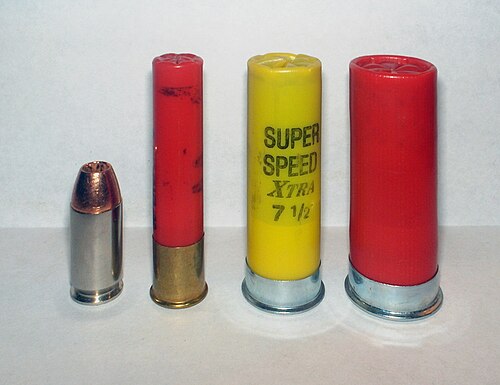
Walk into a store looking for 9mm ammunition and the process is fairly straightforward. You find the caliber, decide what type of ammunition you need, compare a few loads and you're probably on your way.
Then you walk over to the shotgun shells.
Suddenly you're looking at 12 gauge, 20 gauge, .410 bore, 2 3/4 inch, 3 inch, No. 4, No. 7 1/2, 00 buck, 1 ounce, 1 1/8 ounce, 1,200 fps, 1,300 fps and boxes covered with pictures of everything from clay targets to ducks and deer.
It can feel like the ammunition industry decided a shotgun shell needed its own language.
The good news is that it really isn't as complicated as it first appears. Most of the information printed on a box is answering a handful of basic questions: Will this shell fit my shotgun? What does it contain? How much does it contain? And how fast is the payload supposed to leave the barrel?
Once you understand those pieces, a wall of shotgun ammunition starts making a lot more sense.
Quick Answer: How Do You Read a Box of Shotgun Shells?
Before worrying about every number printed on the packaging, look for a few key pieces of information.
The gauge tells you which shotgun the ammunition is designed for. The shell length tells you the chamber length required. The shot size or projectile type tells you what's being fired. The payload weight tells you how much shot is inside when you're dealing with a shot load. And the velocity gives you the manufacturer's advertised speed for that load under its specified test conditions.
So a box might tell you that you're looking at a 12 gauge, 2 3/4 inch shell loaded with 1 1/8 ounces of No. 7 1/2 shot at a listed velocity of 1,200 fps.
At first glance, that looks like a collection of unrelated numbers.
It isn't.
Every number is describing a different characteristic of the same shell.
And the first number is arguably the strangest of all.
Why Is It Called 12 Gauge?
If you come from rifles and handguns, shotgun gauge is weird.
A .308 caliber rifle uses a bullet approximately .308 inch in diameter. A .45 caliber handgun uses a projectile approximately .45 inch in diameter. You might reasonably assume a 12 gauge shotgun follows some similar measurement system.
It doesn't.
Traditional shotgun gauge comes from an old system based on the number of round lead balls of bore diameter that could be made from one pound of lead.
For a 12 gauge bore, twelve lead balls of bore diameter would collectively weigh approximately one pound.
For a 20 gauge, it would take twenty.
That's also why the gauge numbers seem backward.
A 12 gauge has a larger bore than a 20 gauge.
The smaller number represents the larger bore because fewer bore diameter lead balls are required to make up a pound.
Once you understand where the measurement came from, the numbers make sense.
Well, mostly.
Because then there's the .410.
Why Isn't .410 Called a Gauge?
The .410 is technically a bore measurement rather than a gauge designation.
Instead of using the old lead ball formula, .410 refers directly to a bore diameter of approximately .410 inch.
That's why calling it "410 gauge" isn't technically correct, even though you'll hear people say it all the time. The proper terminology is .410 bore.
This also illustrates something important about shotgun ammunition generally: you cannot determine compatibility simply because two shells look similar.
A 12 gauge shell belongs in an appropriate 12 gauge shotgun. A 20 gauge shell belongs in a 20 gauge. A .410 shell belongs in a firearm chambered for .410 ammunition.
That sounds obvious, but shotgun shells can create a particularly dangerous situation because a smaller gauge shell may physically enter the barrel or chamber area of a larger gauge shotgun. Never mix ammunition gauges, and always verify the markings on the firearm and ammunition before loading.
The gauge is only the first compatibility check.
The next number matters just as much.
What Does 2 3/4 Inch or 3 Inch Mean?
This is probably the second thing that confuses new shotgun owners.
You might see boxes labeled:
- 2 3/4 inch
- 3 inch
- 3 1/2 inch
These numbers refer to shell length, but there is an important detail that's easy to miss.
The advertised length refers to the approximate length of the shell after it has been fired and opened, not necessarily the length of the loaded shell sitting in your hand.
A loaded shotshell has a crimp at the front that folds part of the hull inward. When fired, that crimp opens. The shell therefore becomes longer.
That distinction matters because the chamber needs room for the shell to open properly.
So if you put a ruler next to an unfired shell marked 2 3/4 inches and wonder why your measurement doesn't seem to match exactly, the box isn't necessarily wrong.
You're measuring it in a different state.
Can You Shoot 2 3/4 Inch Shells in a 3 Inch Shotgun?
Generally, a shotgun chambered for the longer shell can also use shorter shells of the correct gauge, provided the firearm manufacturer permits it.
For example, many shotguns with a 3 inch chamber can use both 2 3/4 inch and 3 inch ammunition of the proper gauge.
The reverse is where you can get into trouble.
A 3 inch shell should not be fired in a shotgun chambered only for 2 3/4 inch ammunition.
Even though an unfired 3 inch shell may appear to fit, the chamber may not provide sufficient room for the longer hull to open correctly when fired.
The safest rule is simple:
- Read the chamber marking on your shotgun and follow the firearm manufacturer's ammunition requirements.
- Never assume a shell is compatible just because you can physically put it into the chamber.
- And don't assume the longer shell is automatically the better one.
Is a 3 Inch Shotgun Shell More Powerful Than a 2 3/4 Inch Shell?
This is where shotgun ammunition starts becoming more interesting.
A longer shell gives ammunition manufacturers additional room to work with, and it can allow a heavier payload or a different combination of components. But 3 inch does not simply mean "the faster version" of 2 3/4 inch.
A longer shell may carry more shot rather than dramatically increasing velocity.
That's an important distinction.
Imagine two shells using the same shot size. One contains a larger payload. That means more pellets can be sent toward the target, but moving a heavier payload also changes recoil and the overall characteristics of the load.
This is why comparing shotgun shells based only on shell length doesn't tell you enough.
A 3 inch shell isn't automatically the right choice because it's bigger.
You need to know what's inside it.
What's Actually Inside a Shotgun Shell?
A modern shotgun shell looks simple from the outside, but several components have to work together.
At the bottom is the primer, which initiates the firing process. Inside the hull is the propellant, commonly called powder. Above that is a wad, and above or within the wad is the payload, which may consist of numerous pellets or, in the case of a slug load, a single projectile.
The wad performs several important jobs. Depending on its design, it helps separate the powder gases from the shot and can help protect and contain the pellets as they travel through the barrel.
The outer body is the hull, which is what most people think of when they picture the familiar plastic body of a shotgun shell.
Federal breaks the modern shotshell into components including the hull, shot, wad, powder, primer and base wad.
This construction is fundamentally different from the ammunition most rifle and handgun shooters are accustomed to.
A rifle cartridge generally launches one bullet.
A shotgun shell might launch hundreds of tiny pellets, a smaller number of much larger pellets, or one large slug.
And that's where the terminology gets even more confusing.
Birdshot, Buckshot and Slugs: The Three Big Categories
Most shotgun ammunition can be understood much more easily if you first divide it into three broad categories.
Birdshot contains numerous relatively small pellets.
Buckshot contains a smaller number of much larger pellets.
Slugs replace the group of pellets with a single large projectile.
Those differences dramatically change what the shell is intended to do.
Birdshot allows a shotgun to send many small pellets into a spreading pattern. Different shot sizes are used depending on the application.
Buckshot takes the same basic concept and uses much larger pellets. Because the pellets are larger, substantially fewer of them fit into a shell of comparable payload weight.
A slug abandons the multiple pellet concept almost entirely and sends one large projectile downrange.
This is the point where understanding the box becomes much easier.
If you're looking at birdshot or buckshot, the shot size becomes important.
And unfortunately, shot size has another numbering system that initially seems backward.
Why Does a Bigger Shot Number Mean a Smaller Pellet?
This is one of those conventions that feels designed to confuse beginners.
With common birdshot sizes, larger numbers generally indicate smaller pellets.
For example, No. 8 shot is smaller than No. 6 shot.
No. 6 is smaller than No. 4.
So when the numerical designation goes down, pellet diameter generally goes up within the conventional numbered shot system.
That means a shell containing No. 8 shot can fit considerably more pellets into a given payload weight than a shell containing much larger No. 4 shot.
But those smaller individual pellets also have less mass.
This creates one of the central tradeoffs in shotgun ammunition.
Smaller pellets give you more pellets. Larger pellets give each individual pellet more mass.
That tradeoff is one reason there isn't one universally best shot size.
The appropriate choice depends on what you're doing.
Fiocchi's explanation of shot sizing makes the same basic point: shot size affects pellet count, energy and how a load performs for different applications.
But then you reach buckshot and discover yet another numbering convention.
What Does 00 Buck Mean?
Buckshot uses larger pellets than ordinary birdshot, and its naming system is different.
Common examples include No. 4 buck, No. 1 buck, 0 buck, 00 buck and 000 buck.
And here the direction eventually changes.
Once you get into the "aught" sizes, more zeros indicate a larger pellet. So 000 buck uses larger pellets than 00 buck.
00 buck, commonly pronounced "double aught buck," is probably the designation most people recognize.
But the name alone still doesn't tell you everything about the shell.
Two 00 buck loads can contain different pellet counts, use different shell lengths, advertise different velocities and incorporate different wad designs.
This is another reason shotgun ammunition is more complicated than simply saying:
"I need 12 gauge 00 buck."
That's a starting point, not a complete description of the ammunition.
What Does 1 Ounce or 1 1/8 Ounce Mean?
Now we're getting to one of the numbers that actually makes intuitive sense.
On a shot load, the weight printed in ounces generally describes the weight of the shot payload.
A 1 ounce load contains approximately one ounce of shot.
A 1 1/8 ounce load contains more shot.
That doesn't necessarily mean every pellet is larger. If both loads use the same shot size, the heavier payload generally means there are more pellets.
And this is where several numbers on the box finally begin connecting.
Suppose two 12 gauge shells both contain No. 7 1/2 shot.
One contains 1 ounce.
The other contains 1 1/8 ounces.
The second load has a heavier payload, so all else being similar, it can contain more pellets.
But that additional payload also has to be accelerated.
Which brings us to another number printed prominently on many shotgun ammunition boxes.
What Does FPS Mean on Shotgun Shells?
FPS means feet per second, and it represents the manufacturer's advertised velocity for the load under its specified test conditions.
You might see something like:
- 1,200 fps
- 1,250 fps
- 1,300 fps
or considerably different figures depending on the ammunition.
It's tempting to simply pick the largest number.
That's not necessarily a good strategy.
Velocity is only one characteristic of a shotshell. Payload weight, pellet size, projectile design and the intended purpose of the load matter too.
A heavier payload moving at a particular velocity can also produce a different recoil experience than a lighter load.
And just as with rifle ammunition, the velocity printed on the box isn't a promise that every shotgun will produce that exact number. Barrel length, ammunition lot, environmental conditions and other variables can affect actual measured velocity.
'
Treat advertised velocity as a useful comparison specification, not a universal constant.
So What Are All Those Numbers Really Telling You?
At this point, that intimidating box of shotgun shells should look a little less mysterious.
Take a hypothetical box labeled:
- 12 Gauge
- 2 3/4 Inch
- 1 1/8 oz
- No. 7 1/2 Shot
- 1,200 fps
Instead of seeing five unrelated numbers, you can translate it:
- 12 gauge tells you the gauge.
- 2 3/4 inch tells you the shell length and therefore helps determine chamber compatibility.
- 1 1/8 ounces tells you the shot payload weight.
- No. 7 1/2 tells you the pellet size.
- 1,200 fps tells you the advertised velocity.
That's it.
The box isn't speaking another language anymore.
It's describing the shell.
Why Two 12 Gauge Shells Can Be Completely Different
This may be the most important thing to understand about shotgun ammunition.
"12 gauge" doesn't describe one type of ammunition.
It describes the gauge.
You could have a 12 gauge shell filled with hundreds of small birdshot pellets. Another 12 gauge shell might contain a handful of large buckshot pellets. Another might contain a single slug.
Even within one of those categories, the differences continue.
Two birdshot loads can use different pellet sizes, payload weights and velocities.
Two buckshot loads can use different pellet sizes and pellet counts.
Two slug loads can use entirely different projectile designs.
That's why asking "What's the best 12 gauge shell?" without any other context is almost impossible to answer.
Best for what?
Clay targets?
Upland birds?
Waterfowl?
Deer where legal?
Home defense?
Recreational shooting?
The gauge tells you what family of ammunition you're looking at.
The rest of the box tells you what that particular shell was designed to do.
The Most Important Rule Before Buying Shotgun Shells
Before comparing shot size, velocity, payload or price, verify two things:
The correct gauge or bore and the correct shell length for your firearm.
Everything else comes afterward.
Check the markings on the shotgun itself and consult the firearm manufacturer's manual if you're uncertain. Never assume compatibility based on appearance, and never substitute a different gauge because a shell seems like it might fit.
Once compatibility is established, then you can start asking the more interesting questions.
Do you want lots of small pellets or fewer large ones?
Does a heavier payload make sense?
Would a shorter shell accomplish the same job?
Would birdshot, buckshot or a slug be appropriate for the intended application?
Those are the decisions that turn shotgun ammunition from a wall of confusing boxes into something you can actually compare.
And now that we've decoded the outside of the box, the next step is understanding what those different payloads actually do.
Birdshot, buckshot and slugs may all come in shotgun shells, but they behave so differently that choosing between them is arguably more important than any other number printed on the packaging.
Birdshot: More Pellets, Smaller Pellets, and a Lot of Choices
Birdshot is probably the best example of why understanding shotgun shells can initially feel overwhelming.
Instead of firing one projectile, birdshot loads contain many small pellets. Depending on the gauge, payload weight and shot size, a single shell can contain a surprisingly large number of them. Those pellets spread into a pattern after leaving the barrel, although not nearly as dramatically or predictably as movies sometimes suggest.
The purpose is straightforward. Rather than requiring one projectile to strike a relatively small or moving target, birdshot places multiple pellets into an expanding pattern. That makes it useful for clay target sports and many forms of bird and small game hunting.
But "birdshot" isn't one specific load.
A box containing No. 8 shot is very different from one containing No. 4 shot. Remember the backwards numbering system we discussed earlier: the larger number generally means a smaller pellet.
Smaller pellets allow more pellets to fit within the same payload weight. Larger pellets mean fewer individual pellets, but each pellet carries more mass.
That creates a balancing act between pellet count, pellet size, pattern density and the amount of energy carried by each pellet.
For something like clay target shooting, smaller shot sizes are common because shooters benefit from having many pellets in the pattern. Hunting applications can call for different pellet sizes depending on the game, distance and regulations.
This is why there is no single "best birdshot."
The right shell depends on what you're asking it to do.
Buckshot Changes the Equation
Move from birdshot to buckshot and the basic concept stays the same, but the scale changes dramatically.
Buckshot still fires multiple pellets. Those pellets are simply much larger.
Because they're larger, far fewer fit into a shell.
A familiar example is 00 buck, pronounced double aught buck. Individual 00 buck pellets are roughly .33 inch in diameter. Compare that with the tiny pellets used in many birdshot loads and you can immediately understand why the pellet count drops so dramatically.
Instead of dealing with hundreds of tiny pellets, a buckshot shell may contain only a relatively small number of large ones.
That fundamentally changes the purpose of the ammunition.
Buckshot has historically been associated with larger game at appropriate distances and, depending on the load and circumstances, defensive applications. Different buckshot sizes give ammunition manufacturers different ways to balance pellet diameter, pellet count, velocity and pattern characteristics.
But one of the most important things to understand about buckshot is that the gauge and pellet size still don't tell you exactly how a particular load will perform from your shotgun.
Patterning matters.
A Shotgun Doesn't Create a Giant Wall of Pellets
This is one of the most persistent misconceptions about shotguns.
At close range, the pellets don't instantly spread across an enormous area the moment they leave the muzzle.
They begin relatively close together and spread progressively as distance increases. How quickly and evenly that happens depends on several variables, including the ammunition, choke, barrel and distance.
That means two loads containing the same nominal shot size can produce noticeably different patterns from the same shotgun.
It also means the same ammunition can behave differently when fired through different shotguns or choke configurations.
That's why hunters and target shooters often pattern their shotgun with the ammunition they intend to use. Rather than assuming a load will distribute pellets a certain way, they fire at an appropriate patterning target and observe what their particular shotgun and ammunition combination actually produces.
This is especially important because the useful range of a shotshell isn't determined simply by how far the pellets can physically travel.
Pattern quality matters too.
As distance increases, pellets spread farther apart. Eventually the pattern may become too sparse or inconsistent for the intended application even though individual pellets continue traveling.
That is one of the major differences between understanding shotgun ammunition and understanding a single projectile rifle cartridge.
Then There Are Slugs
A slug takes the shotgun concept in a completely different direction.
Instead of launching dozens or hundreds of pellets, a slug load fires one large projectile.
That makes a slug behave much more like conventional single projectile ammunition, although the projectile itself and the firearm launching it are still very different from a typical rifle cartridge.
Slugs are commonly associated with hunting applications where permitted, particularly in places or situations where shotguns are used for deer. They are also available in different designs intended for different barrel and sighting configurations.
Two broad terms you'll encounter are rifled slugs and sabot slugs.
A rifled slug is commonly associated with smoothbore shotgun barrels. The name can be confusing because the grooves on the slug don't turn a smoothbore shotgun into a conventional rifled firearm.
Sabot slugs are different. They typically use a smaller diameter projectile surrounded by a sabot and are generally associated with rifled shotgun barrels designed for that type of ammunition.
That distinction matters.
A person walking into a store and simply asking for "12 gauge slugs" hasn't necessarily provided enough information to choose the most appropriate ammunition for their shotgun.
As always, check the firearm manufacturer's recommendations and make sure the ammunition is appropriate for the barrel and firearm configuration you're using.
Birdshot vs. Buckshot vs. Slugs
This is where everything we've covered starts coming together.
All three can be shotgun ammunition.
All three can potentially be sold in the same gauge.
But they accomplish very different things.
Birdshot gives you a large number of relatively small pellets. That makes it common for clay target shooting and various bird or small game hunting applications.
Buckshot uses fewer but substantially larger pellets. That shifts the balance toward greater individual pellet mass and different applications.
A slug abandons the multiple pellet pattern and uses one large projectile.
None is universally better than the others.
The mistake is asking which is "best" without first deciding what you're trying to accomplish.
A shell designed for breaking clay targets isn't intended to perform the same job as a buckshot load. A buckshot load isn't trying to behave like a slug. And a slug doesn't give you the multiple pellet pattern that defines traditional shotshell performance.
The firearm may say 12 gauge on the barrel in every case.
The ammunition inside can be completely different.
Does Gauge Determine How Powerful a Shotgun Is?
Not by itself.
Gauge is one of the first things people use to compare shotguns, and it certainly matters. A 12 gauge has a larger bore than a 20 gauge and generally offers room for heavier payloads.
But saying "12 gauge is more powerful than 20 gauge" oversimplifies what actually happens.
Individual loads matter.
Payload weight matters.
Velocity matters.
Projectile type matters.
A light target load and a heavy hunting load can both be 12 gauge ammunition while producing very different recoil and ballistic characteristics.
Likewise, modern 20 gauge ammunition can provide impressive performance without trying to duplicate every characteristic of a 12 gauge.
That's one reason the 20 gauge remains so popular. It can offer a smaller, lighter platform and potentially less recoil depending on the firearm and load, while still being useful for a broad range of shooting and hunting applications.
If you're specifically trying to understand that ammunition, our 20 Gauge Shells Explained guide goes much deeper into 20 gauge shot sizes, shell lengths, slugs and ammunition choices.
And Where Does the .410 Fit?
The .410 occupies an interesting place because, as we discussed earlier, it isn't technically a gauge at all.
It has a much smaller bore than a 12 or 20 gauge and generally carries a smaller shot payload.
That doesn't make it a miniature version of a 12 gauge in every meaningful sense.
A smaller payload means fewer pellets when comparing similar shot sizes. Fewer pellets can make pattern density more demanding, particularly for moving targets.
This is one reason the old idea that a .410 is automatically the ideal shotgun for every beginner deserves some scrutiny. The firearm may be smaller and recoil can be mild with many loads, but putting fewer pellets into the air doesn't necessarily make hitting a moving target easier.
The .410 has legitimate uses and a devoted following. It simply needs to be understood on its own terms.
And based on how much .410 ammunition varies today, it deserves a guide of its own rather than being squeezed into a few paragraphs here.
What About 12 Gauge?
If one shotgun gauge dominates ammunition shelves, it's usually 12 gauge.
Its popularity gives shooters an enormous range of ammunition choices. Light target loads, hunting ammunition, buckshot, slugs and specialized loads are widely available.
That flexibility is one of the biggest strengths of the 12 gauge.
It's also one reason shopping for 12 gauge ammunition can be so confusing.
Someone who says "I need 12 gauge shells" has only answered the first question.
What chamber length?
What projectile type?'
What shot size?
What payload?
What velocity?
What intended use?
This is why the broad shotgun shells category makes more sense once you understand how the system works. Gauge determines compatibility, but it doesn't completely describe the ammunition.
What Does Choke Have to Do With Shotgun Shells?
You may notice we've talked about patterns without spending much time on choke.
That's intentional because choke is a characteristic of the shotgun rather than the shell, but it has an important relationship with ammunition performance.
A choke changes the constriction near the muzzle and can influence how a shot pattern develops. Different choke configurations can produce tighter or more open patterns depending on the shotgun and ammunition combination.
But choke labels shouldn't be treated as a guarantee that every load will produce an identical pattern.
A particular shell may pattern beautifully through one combination and less consistently through another.
That's another reason actual pattern testing matters.
It also reinforces a theme running through this entire article:
Shotgun ammunition is a system.
The shell, shot size, payload, velocity, barrel, choke and distance all interact.
You can't always isolate one number and predict everything else.
Steel, Lead, Bismuth, and Other Shot Materials
There's another specification you may encounter when comparing shotgun shells: what the pellets are made from.
Lead has historically been widely used because its density gives relatively small pellets useful mass.
But hunting regulations have changed the ammunition landscape significantly. Nonlead shot is required in certain hunting situations and jurisdictions, particularly for waterfowl in the United States. Shooters may encounter steel, bismuth, tungsten based materials and other alternatives depending on the application and manufacturer.
The material matters because different metals have different densities.
A steel pellet and a lead pellet of the same physical diameter do not weigh the same. That affects how ammunition is designed and why simply comparing shot size across different pellet materials can be misleading.
This is another area where the information on the box matters.
Don't assume that a shot size you prefer in one material will behave identically when you switch to another.
And always check the applicable hunting regulations where you will actually be shooting.
Why More Velocity Isn't Automatically Better
If ammunition manufacturers print velocity prominently on the box, the biggest number must be the best, right?
Not necessarily.
Higher velocity can be useful, but it comes with tradeoffs.
Accelerating a payload harder generally affects recoil. And when we're talking about shot loads, the relationship between velocity, pellet size, payload weight, pattern performance and the intended application matters more than simply winning a feet per second contest.
A 1 ounce load moving faster and a 1 1/8 ounce load moving somewhat slower are not automatically interchangeable just because one has the larger velocity number.
This is especially relevant for target shooters who may fire a large number of shells during a session. A load that provides adequate target performance with manageable recoil can be much more pleasant over the course of dozens or hundreds of shots.
Hunters may prioritize differently.
Once again, the intended use determines which specification deserves the most attention.
What About "Low Brass" and "High Brass"?
This is another piece of shotgun terminology that has survived longer than its usefulness as a performance measurement.
You'll sometimes hear shooters refer to low brass and high brass shells based on the height of the metal head at the base of the shell.
Historically, that visual distinction could provide some indication of the type of load.
With modern shotshell construction, however, brass height is not a reliable way to determine how powerful a shell is.
Read the actual specifications on the box instead.
Payload weight, velocity, shot size, shell length and the manufacturer's intended use tell you considerably more than the height of the metal portion of the hull.
It's another example of why learning to decode the label is more useful than relying on shotgun folklore.
Five Things to Check Before Buying Shotgun Shells
By now, you don't need to memorize every shot size or every possible load.
You just need a process.
First, check the gauge or bore. It must match your firearm.
Second, check shell length. Make sure the ammunition is compatible with your shotgun's chamber.
Third, identify the projectile type. Are you buying birdshot, buckshot or slugs?
Fourth, look at the payload. For shot loads, consider pellet size and payload weight. For slugs, look at the projectile type and weight.
Fifth, consider the intended use and velocity. Don't choose ammunition based on the largest velocity number alone.
If you can answer those five questions, you've already eliminated most of the confusion that makes the shotgun aisle look intimidating.
Common Mistakes When Buying Shotgun Shells
One of the easiest mistakes is buying ammunition based solely on gauge.
A box saying 12 gauge doesn't mean it is appropriate for every 12 gauge shotgun or every application.
Shell length still matters.
Another common mistake is assuming a larger shot number means a larger pellet. For ordinary numbered birdshot, it's generally the opposite.
Then there's the assumption that a 3 inch shell must always be better than a 2 3/4 inch shell.
It isn't.
The longer shell gives ammunition manufacturers additional capacity, but whether that extra capacity benefits you depends on the load and what you're doing with it.
Another mistake is automatically choosing the fastest ammunition on the shelf.
Velocity matters, but it is one variable among several.
And perhaps the biggest mistake is assuming that because two boxes contain the same gauge, shell length and shot size, they'll perform identically.
They may not.
Different payloads, velocities, wad designs and manufacturing choices can produce different results, particularly when you start evaluating patterns from a specific shotgun.
How to Choose Shotgun Shells Without Overthinking It
Start with compatibility.
Then start with purpose.
That order solves most of the problem.
If you're buying ammunition for clay targets, look at ammunition designed for target shooting. If you're hunting, consider the game, expected distance, local regulations and the ammunition manufacturer's intended application. If you're evaluating buckshot or slugs, make sure the ammunition is appropriate for your particular shotgun and barrel configuration.
Then compare loads within that category.
That's much easier than standing in front of hundreds of boxes trying to decide whether 1,250 fps is inherently better than 1,200 fps.
It isn't about finding the shotgun shell with the most impressive collection of numbers.
It's about finding a shell whose specifications make sense for what you're actually doing.
Already know which shotgun shells you need? Compare ammo prices from multiple online retailers on AmmoBrowser before you buy.
Frequently Asked Questions About Shotgun Shells
What are the three main types of shotgun shells?
The three broad projectile categories are birdshot, buckshot and slugs. Birdshot contains many small pellets, buckshot uses fewer and larger pellets, and a slug uses a single large projectile.
What do the numbers on shotgun shells mean?
The numbers can describe several different things. Gauge identifies the bore family, shell length relates to chamber compatibility, shot size describes pellet diameter according to the relevant sizing system, ounces can describe shot payload weight, and fps represents advertised velocity.
Is 12 gauge bigger than 20 gauge?
Yes. Despite the smaller number, a 12 gauge has a larger bore than a 20 gauge. The numbering comes from the historical gauge system based on how many bore diameter lead balls would collectively weigh one pound.
Is .410 a shotgun gauge?
Technically, no. .410 is a bore diameter designation. The bore measures approximately .410 inch, which is why ".410 bore" is the more accurate term.
Can a 3 inch shotgun shoot 2 3/4 inch shells?
Many shotguns chambered for 3 inch ammunition can also use 2 3/4 inch shells of the correct gauge, but you should always follow the firearm manufacturer's specifications. A shell longer than the firearm's chamber rating should not be used.
Are 3 inch shells better than 2 3/4 inch shells?
Not automatically. A longer shell can provide additional capacity for a heavier payload or a different load configuration, but that doesn't mean it is better for every purpose. It can also result in more recoil depending on the load.
Does a higher shot number mean a bigger pellet?
With conventional numbered birdshot, generally no. A larger number normally indicates a smaller pellet. No. 8 shot is smaller than No. 6, for example.
What's the difference between 00 buck and No. 4 buck?
00 buck uses substantially larger individual pellets than No. 4 buck. Because pellet sizes differ, the number of pellets that can fit into a given payload also changes. Loads can additionally vary in velocity, shell length and pellet count.
Is a slug just one giant shotgun pellet?
In the simplest sense, a slug is a single projectile rather than a collection of pellets. But slug designs vary considerably, and different slug types can be intended for different barrel configurations.
How far do shotgun pellets spread?
There is no universal spread rate that applies to every shotgun. Pattern size depends on ammunition, choke, barrel, distance and other variables. That's why patterning the actual shotgun with the intended ammunition is more useful than relying on a generic rule.
Shotgun Shells Aren't Actually That Complicated
The ammunition aisle makes them look complicated.
That's the real problem.
A single box might display gauge, shell length, shot size, payload weight and velocity without explaining how any of those numbers relate to one another. Add terms like birdshot, buckshot, slug, choke and shot material, and it's easy to understand why someone buying shotgun ammunition for the first time feels lost.
But once you break the box into pieces, the system becomes surprisingly logical.
Gauge tells you what shotgun family the shell belongs to.
Shell length helps determine whether it is compatible with the chamber.
Birdshot, buckshot or slug tells you the basic type of projectile.
Shot size tells you the size of the pellets when you're dealing with shot.
Payload tells you how much shot you're sending.
Velocity tells you how fast the manufacturer says that load starts under its test conditions.
Everything else builds from there.
You don't need to memorize every shotgun shell on the shelf.
You need to understand what the numbers are trying to tell you.
Once you do, the most confusing ammo box in the store becomes a lot less confusing.
Information provided by AmmoBrowser is for general informational and educational purposes only. Ammunition specifications, ballistics, performance, pricing, and availability can vary by manufacturer, load, firearm, barrel length, and other conditions. While we strive to provide accurate and current information, AmmoBrowser makes no guarantee regarding its completeness or accuracy. Always follow firearm and ammunition manufacturer instructions, verify that ammunition is compatible with your firearm, and follow all applicable laws and safe firearm handling practices.